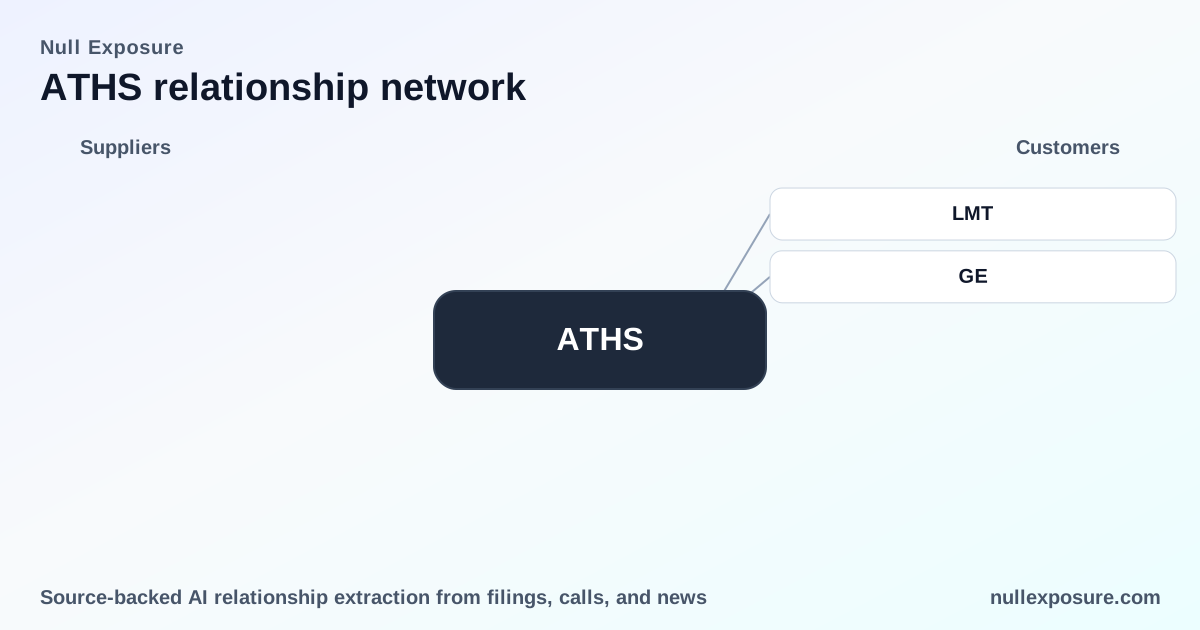
Athene (ATHS) — Customer Relationships and Strategic Implications for Investors
Athene monetizes by underwriting and reinsuring retirement liabilities—principally fixed annuities and pension risk transfers—and by investing premiums to generate durable yield. The company profits from fee and spread income on large institutional transactions, while distribution through independent agents, broker-dealers and banks feeds a stable retail flow. For investors, Athene’s economics are driven by liability acquisition scale, investment spread management, and the firmness of long-term cedent relationships. Explore a consolidated profile at https://nullexposure.com/ for additional corporate signals.
Why large pension transfers define the business model
Athene’s growth strategy centers on acquiring blocks of pension obligations through bulk annuity and pension risk transfer (PRT) deals that convert sponsor obligations into fixed annuity liabilities. These transactions deliver immediate scale, predictable cashflows and investable assets that the firm manages for spread; large, single-counterparty transactions materially move Athene’s balance sheet and earnings profile. Distribution breadth (IMOs, banks, broker-dealers) provides retail and institutional sourcing, while international ambition—particularly in Asia—provides optionality outside the U.S.
Customer relationships that move the needle
Below I catalogue each relationship result in the provided feed. Each entry is summarized in plain English and attributed to its reporting source.
Lockheed Martin — Royal Gazette (FY2021)
Athene completed a $4.9 billion pension risk transfer with Lockheed Martin, taking on a large block of pension obligations and transferring those liabilities into annuity contracts administered by Athene’s insurance subsidiaries. According to the Royal Gazette reporting on the FY2021 transaction, the deal represented one of Athene’s largest single pension risk transfers and reinforced its position in corporate PRTs (Royal Gazette, 2021; https://www.royalgazette.com/re-insurance/business/article/20210804/athene-inks-high-flying-pension-transaction/).
Lockheed Martin — Royal Gazette (duplicate mention, FY2021)
A separate feed item repeats the Royal Gazette coverage of the same transaction: Athene’s absorption of Lockheed Martin’s pension liabilities covered roughly 18,000 participants and was executed through Athene’s insurance entities to provide annuity benefits. The Royal Gazette noted the scale and participant coverage when reporting on Athene’s PRT activity in 2021 (Royal Gazette, 2021; same article).
Lockheed Martin — Artemis (FY2021)
Artemis reported that Lockheed Martin transferred $4.9 billion of pension obligations to Athene, with Athene’s U.S. insurance subsidiaries providing annuity payments to about 18,000 retirees; the story emphasized transaction structure and fee dynamics. Artemis also highlighted the use of a sidecar vehicle (ACRA) in the transaction mechanics, underscoring Athene’s flexibility in structuring large PRT deals (Artemis, 2021; https://www.artemis.bm/news/athene-uses-acra-sidecar-in-4-9bn-pension-risk-transfer-fees-rise/).
Lockheed Martin — Artemis (duplicate mention, FY2021)
A second Artemis entry mirrors the prior reporting: Athene and its wholly owned subsidiaries assumed the administration and annuity payments for the transferred participants, illustrating how large corporate pensions are converted into annuity-led liabilities on Athene’s balance sheet. The Artemis write-up underlined the operational complexity and fee profile of such a material transfer (Artemis, 2021; same article).
General Electric — Royal Gazette (FY2021)
Athene executed a $1.7 billion transaction with General Electric to serve approximately 70,000 retired employees, demonstrating Athene’s capacity to handle mass-retiree blocks at different scales. The Royal Gazette reported this FY2021 transaction as part of Athene’s broader wave of PRT activity, noting participant counts and the transfer’s contribution to the company’s retirement-services footprint (Royal Gazette, 2021; https://www.royalgazette.com/international-business/business/article/20210217/athene-sees-opportunities-ahead-after-strong-quarter/).
General Electric — Royal Gazette (duplicate mention, FY2021)
A duplicate Royal Gazette item reiterates the GE transaction: Athene took on a sizeable pension book servicing roughly 70,000 retirees via annuity issuance, strengthening its institutional client pipeline and demonstrating operational scale in large-volume retiree servicing. Royal Gazette coverage emphasized the aggregate impact of such deals on Athene’s growth trajectory (Royal Gazette, 2021; same article).
What these relationships reveal about Athene’s operating posture
- Contracting posture: Athene executes long-duration, high-certainty contracts with corporate sponsors; PRTs convert variable corporate pension exposure into predictable annuity liabilities. These are legally binding, capital-intensive agreements that lock in revenue and asset deployment over decades.
- Concentration and scale: Major single-party deals (Lockheed Martin $4.9bn, GE $1.7bn) create episodic but material concentration events on the balance sheet; a handful of large transactions materially shift Athene’s exposure and capital allocation.
- Criticality to customers: For cedents, transferring pension obligations is a strategic de-risking event; Athene plays a critical counterparty role by absorbing liability risk and guaranteeing benefits.
- Maturity and operational complexity: The repeated use of structural vehicles (e.g., sidecars referenced in Artemis coverage) and multiple insurance subsidiaries indicates a mature capability set for deal structuring, regulatory navigation and participant servicing.
These points are company-level signals derived from the transactional evidence; they are not attributed to any single relationship unless the source excerpt explicitly names it.
Geographic reach and distribution constraints
Athene’s operational footprint is primarily U.S.-centric but with explicit international ambitions. Company-level excerpts indicate a strong North American orientation—distribution through IMOs, banks and broker-dealers across all 50 states—and a stated focus on expanding into Asia. Geography is both a strength (deep U.S. retail and institutional channels) and a growth vector (targeted APAC expansion). Evidence: Athene’s distribution network and international expansion intent as reported in corporate materials and market commentary.
Investment implications and risk factors
- Upside: Athene’s model converts large, back-book liabilities into investable assets; successful pricing of longevity and interest-rate risk produces durable spread income and steady capital deployment opportunities.
- Concentration risk: Large PRT wins can distort margins and capital usage in a single period; investors must watch cadence and pricing of new deals.
- Operational execution: The complexity of administering tens of thousands of participants (as in the GE and Lockheed Martin deals) makes operational resilience and subsidiary governance essential for underwriting credibility.
- Geographic and distribution scale: A broad U.S. distribution footprint gives Athene a steady retail feed, while APAC expansion offers incremental growth but requires regulatory and distribution adaptation.
Bottom line and next steps
Athene’s customer relationships—anchored by multi-billion dollar pension transfers—are central to its monetization and balance-sheet strategy. For investors evaluating ATHS exposure, the firm’s ability to win, structure and service large PRTs is the most material commercial signal; concentration and execution risk are the principal watch items.
If you want a consolidated view of Athene’s customer relationships and signal extraction, visit https://nullexposure.com/ for the full profile and source-linked reporting.