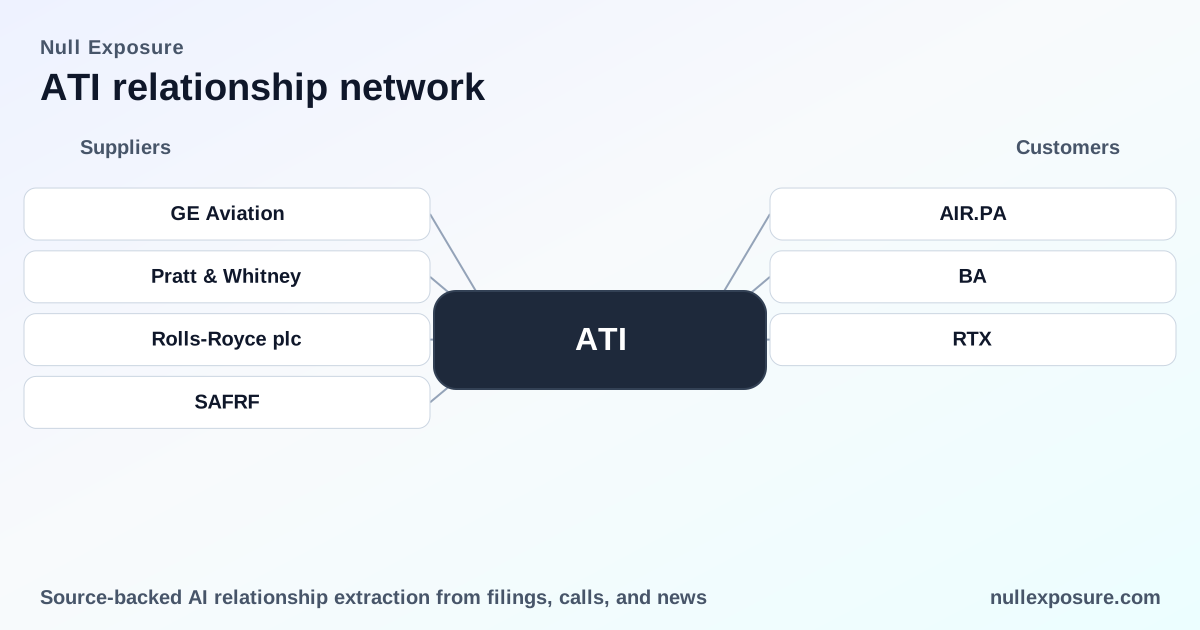
ATI’s customer backbone: long-term OEMs, defense primes and selective energy plays
Allegheny Technologies Incorporated manufactures and sells specialty metals and high-performance components to aerospace, defense, energy and industrial customers, monetizing through a mix of long‑term agreements (LTAs), multi‑year supply contracts and direct spot sales for forged parts, titanium and nickel products. ATI’s revenue is underpinned by a multi‑billion dollar backlog and concentrated relationships with large OEMs and defense primes that drive volume, pricing power and margin visibility. For investors and operators, the business model combines contractual durability, geographic diversification, and a reliance on a handful of large counterparties that materially influence near‑term cash flow and margin trajectory. Learn more at https://nullexposure.com/.
How ATI structures customer exposure and what that implies for risk and value
ATI sells predominantly into aerospace and defense through LTAs and multi‑year agreements that reduce supply uncertainty for customers and provide ATI with predictable demand for specialty materials. International sales account for a meaningful portion of revenues (roughly 42% of annual sales historically), creating geographic diversification across North America, EMEA and APAC while leaving the company exposed to cyclical aerospace OEM demand. ATI reports a sizable backlog (approximately $3.9 billion at year‑end 2024), which signals near‑term revenue visibility and operational load‑planning certainty.
Key operating model signals:
- Contracting posture: ATI uses LTAs and multi‑year agreements with major OEMs, positioning the company as a contracted supplier rather than a purely spot vendor.
- Counterparty concentration: Customers are large enterprises (OEMs and defense primes), so single‑customer dynamics can materially move volumes and pricing.
- Geographic reach and diversification: A global footprint with ~58% U.S. sales and significant EMEA/APAC exposure balances market cycles but introduces international demand sensitivity.
- Criticality and materiality: Specialty materials for jet engines, defense armor and nuclear components are high‑value and mission‑critical end uses, making ATI a strategic supplier for customers.
- Maturity and stage: Relationships are active and revenue‑generating today, with a backlog that translates into short‑to‑medium term fill rates and margin realization.
If you want a consolidated briefing for decision makers, start at https://nullexposure.com/ and contact our research team.
Relationship roll call — who matters to ATI today
Below are every customer relationship found in the recent coverage and transcripts, each described in plain English with the source context.
Airbus (Sahm Capital, March 18, 2026)
ATI’s expanded buyback commentary referenced recent long‑term contract wins with Airbus that support titanium and nickel volumes and pricing, signaling that Airbus is a structural aerospace customer for ATI’s specialty metal products. Source: Sahm Capital news commentary (Mar 18, 2026).
Boeing (Sahm Capital, March 18, 2026)
Sahm Capital noted ATI’s long‑term contract wins with Boeing as underpinning volume and pricing for ATI’s titanium and nickel lines, highlighting Boeing as a key OEM driving ATI’s aerospace revenue mix. Source: Sahm Capital news commentary (Mar 18, 2026).
Cameco (InsiderMonkey / ATI Q1 2026 call transcript)
ATI stated it extended a long‑standing partnership with Cameco via a new five‑year agreement, reinforcing ATI’s role as a supplier into the global nuclear supply chain for specialty materials. Source: Q1 2026 ATI earnings call transcript reported by InsiderMonkey.
GD (General Dynamics) (InsiderMonkey / ATI Q1 2026 call transcript)
ATI reported recognition in high‑performance titanium plate and sheet used for ground armor and noted being named a supplier of the year, confirming General Dynamics as a strategic defense customer for material solutions. Source: Q1 2026 ATI earnings call transcript reported by InsiderMonkey.
General Dynamics Land Systems (InsiderMonkey / ATI Q1 2026 call transcript)
Specifically for land systems, ATI was named General Dynamics Land Systems’ 2025 Supplier of the Year for titanium plate and sheet, underscoring the company’s importance in armored‑vehicle material supply. Source: Q1 2026 ATI earnings call transcript reported by InsiderMonkey.
Airbus (Sahm Capital, February 12, 2026)
Sahm Capital’s earlier analysis emphasized monitoring long‑term agreements with Airbus as a driver of ATI’s aerospace/defense growth story, reiterating Airbus’s strategic placement in ATI’s customer portfolio. Source: Sahm Capital research note (Feb 12, 2026).
BA (Boeing referenced as BA in Sahm Capital, February 12, 2026)
The same Sahm Capital note urged investors to track updates to long‑term agreements with Boeing (BA) as a determinant of ATI’s commercial vs. defense mix and margin outcomes. Source: Sahm Capital research note (Feb 12, 2026).
Boeing (Sahm Capital, February 12, 2026)
Sahm Capital highlighted Boeing again as a material counterparty whose order mix (commercial vs. defense) will influence ATI’s reported margins and revenue composition. Source: Sahm Capital research note (Feb 12, 2026).
MIGI (Mawson Infrastructure Group — Times Online, February 9, 2022)
Mawson Infrastructure Group leased six acres adjacent to ATI’s idled Midland melt shop to build a mobile data center for Bitcoin mining, reflecting opportunistic land leases and third‑party uses of ATI’s idled capacity rather than a manufacturing customer relationship. Source: The Times (Feb 9, 2022).
RTX (Pratt & Whitney context — ATI 2025 Q4 earnings call)
ATI cited isothermal forging deliveries to Pratt & Whitney as a clear example of growth, indicating ATI’s role as a supplier of forged engine components to RTX’s Pratt & Whitney business. Source: ATI 2025 Q4 earnings call transcript.
Pratt and Whitney (RTX context — ATI 2025 Q4 earnings call)
Pratt & Whitney was called out directly for isothermal forgings, making it a named customer for ATI’s high‑value forged components used in jet engines. Source: ATI 2025 Q4 earnings call transcript.
What these relationships mean for investors and operators
- Predictable near‑term cash flow: The combination of LTAs and a $3.9B backlog creates visibility into production plans and cash conversion over the next 12–18 months.
- Concentration risk balanced by contract durability: Revenue depends on a narrow set of large OEMs and defense primes, but multi‑year agreements and supplier awards reduce the probability of abrupt volume loss.
- Margin sensitivity to customer mix: Commercial aerospace demand cycles versus defense and energy markets will drive margin and utilization swings; ATI’s exposure to jet engines and defense armor keeps margins relatively high but cyclical.
- Geopolitical and geographic exposure: With roughly 42% international sales and material EMEA/Asia exposures, ATI benefits from global demand but requires active management of supply chains and trade dynamics.
- Asset optimization and non‑core monetization: Occasional leases of idled property (as with the Midland site) indicate management will monetize underutilized assets opportunistically.
Final takeaways for portfolio managers and operators
ATI is a supplier‑centric industrial with durable, contract‑backed revenue streams driven by a small number of large aerospace, defense and energy customers. The company’s operating model blends contractual durability and geographic diversification with concentration-driven sensitivity to OEM cycles and backlog execution. For active investors and operations leaders, the questions are execution risk on backlog fulfillment, the commercial/defense order mix, and how ATI converts contractual positions into margin expansion.
For a concise briefing and charted relationship map, visit https://nullexposure.com/ and contact our analyst team for a tailored review.