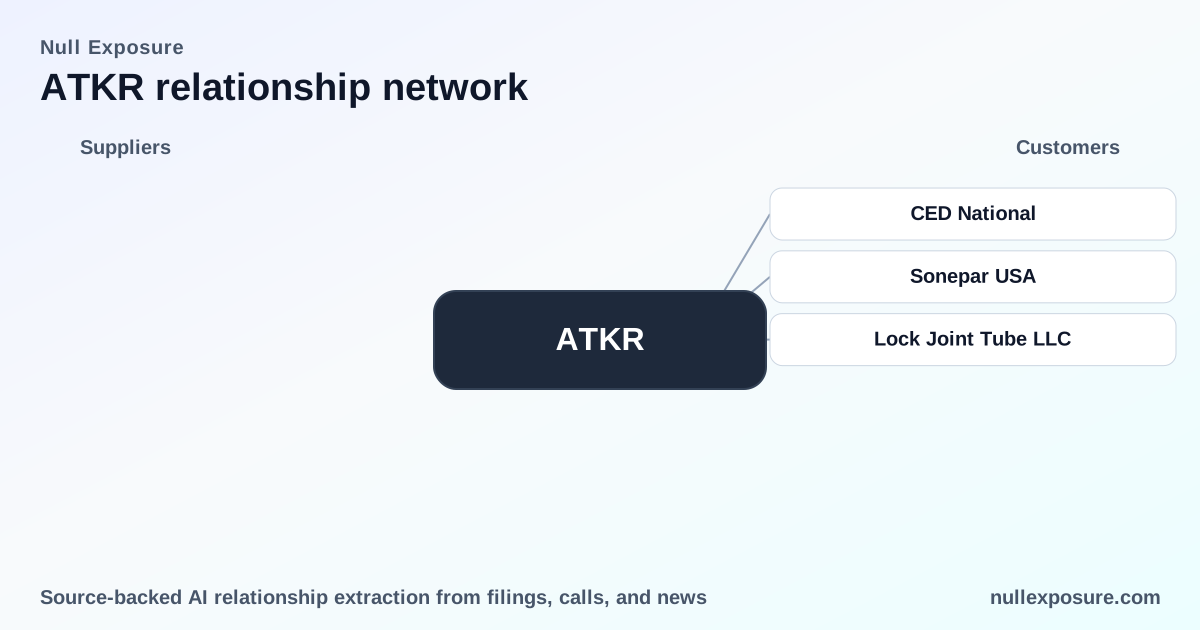
Atkore’s customer map: concentration, distributors, and a string of targeted divestitures
Atkore International Group manufactures and distributes electrical conduit and mechanical products, selling primarily into the non‑residential construction, renovation and industrial markets. The business monetizes through product sales to wholesale and national distributors and large enterprise buyers, recognizing revenue at the point of shipment, while periodically reshaping its portfolio through asset and product‑line sales. Investors should evaluate Atkore as a distributor‑centric manufacturer with material customer concentration, significant U.S. exposure, and an active strategy of divestiture to focus capital and operations.
Explore more on portfolio signals at https://nullexposure.com/ — useful context for comparative customer risk analysis.
What the customer disclosures reveal about how Atkore operates with buyers
Atkore’s SEC disclosure and recent press coverage paint a clear operating profile:
- Spot, point‑in‑time revenue recognition. The company recognizes revenue when title and control transfer to the customer—typically at shipment—indicating a transactional, inventory‑driven sales model rather than long‑term contractual receipts. This is a company‑level operating posture disclosed in the FY2025 filing.
- Distributor‑led go‑to‑market. Atkore sells largely through wholesale and national distributors; purchase orders, not long‑dated supply contracts, define most terms. That structure increases sensitivity to order flows and distributor inventory cycles.
- Concentration is real and persistent. In FY2025 Atkore’s top ten customers accounted for roughly 40% of net sales, and one distributor effectively represented more than 10% of sales in both FY2025 and FY2024—a concentration profile that amplifies counterparty and demand risk.
- Geography skews domestic but with international exposure. Approximately 88% of net sales occur in the United States, with the remaining ~12% in other currencies such as GBP, EUR, CAD, AUD and NZD—introducing some FX and regional diversification considerations.
- Receivables are concentrated but current. The FY2025 10‑K shows major distributor receivables with no significant past‑due amounts, supporting short‑term credit hygiene despite concentration.
Together these signals describe a mature industrial supplier with distributor dependence, transactional contracts, material top‑customer weight, and primarily U.S. market exposure.
How the recent divestitures change the customer landscape
Atkore is actively pruning and reassigning product lines, which alters who buys what from the company and reduces its exposure in targeted subsegments:
- The company sold HDPE pipe and conduit assets and other specialized product lines to third parties in 2026, transferring customers and backlog associated with those product families. These deals reduce Atkore’s served addressable market in specific niches while raising proceeds and concentrating remaining core businesses. A mid‑year review of these transactions is essential for investors modeling revenue sustainability and margin mix.
For a portfolio view of these transitions visit https://nullexposure.com/ for comparative transaction coverage.
Relationship roster: the counterparties on file and why they matter
Sonepar USA
Sonepar USA represented 13% of Atkore’s accounts receivable as of September 30, 2025, and is the single customer that accounted for more than 10% of sales in both FY2025 and FY2024; receivables showed no significant past due amounts, reflecting a high‑value distributor relationship with current payments. According to Atkore’s FY2025 10‑K filing, the company cites Sonepar USA as a principal distributor and top sales contributor for both years.
CED National
CED National accounted for 12% of accounts receivable at September 30, 2025 (11% at year‑end 2024), with no material aging issues reported—an indicator of concentrated but healthy credit exposure to a major wholesale partner. This detail comes from Atkore’s FY2025 10‑K.
The AZEK Company Inc.
A public report in May 2026 noted that AZEK acquired Northwest Polymers, LLC from Atkore, transferring that product line and its customer flows to AZEK; this is an asset sale that shifts customers away from Atkore in the affected polymer product segment. The transaction was reported by Simply Wall Street in May 2026.
Infra Pipes
On April 8, 2026 Atkore announced the sale of its HDPE pipe & conduit business to Infra Pipes, a transaction covered in MarketBeat/Yahoo Finance and cited across financial outlets; this divestiture transfers HDPE customers and production to Infra Pipes and reduces Atkore’s footprint in that specialty conduit market. MarketBeat and Finviz summarized the disposal in April–May 2026.
Lock Joint Tube LLC
Lock Joint Tube LLC acquired Atkore’s Tectron mechanical tube product line and an associated manufacturing facility, according to a March 2026 press synopsis; the sale removes that product family from Atkore’s portfolio and hands its customer relationships to Lock Joint Tube. MarketScreener published details of this transaction in March 2026.
Investment implications: concentration, counterparty risk and portfolio focus
Investors should weight the following points when assessing Atkore’s customer risk and earnings durability:
- High customer concentration elevates earnings volatility. With the top ten customers accounting for about 40% of net sales and Sonepar persistently a >10% buyer, Atkore’s revenue trajectory will track distributor order patterns and any large buyer shifts.
- Transactional contracts reduce revenue visibility. The point‑in‑time revenue model and purchase‑order terms mean limited forward revenue commitments; short notice order reductions can compress utilization and margins quickly.
- Divestitures sharpen core focus but reduce diversification. Recent sales of HDPE, Tectron and polymer lines pare non‑core exposure and reassign customers to acquirers—this improves capital allocation and returns if management redeploys proceeds effectively, while simultaneously concentrating remaining product lines.
- Domestic cyclicality dominates. With ~88% of sales in the U.S., Atkore’s results will move with U.S. construction and industrial cycles more than with global growth, though currency exposures of roughly 12% provide some geographic hedge.
- Credit profile of top distributors is a mitigant. The FY2025 10‑K shows major receivables from Sonepar and CED without significant aging, signaling disciplined credit control with large enterprise partners—an important operational strength.
Bottom line: where customer risk meets corporate action
Atkore operates as a distributor‑facing manufacturer with material customer concentration, transactional revenue, and a strategic program of divestitures that reshapes who buys its products. The company’s exposure to a few large distributors creates both upside when order momentum is strong and downside during construction slowdowns; recent asset sales reduce complexity but shift customer relationships to third parties. For investors focused on counterparty and demand risk, the Sonepar and CED concentrations, combined with the transactional contracting posture, are the single most important features to model.
If you want a structured comparison of Atkore’s customer exposures against peers and a timeline of its divestitures, see additional resources at https://nullexposure.com/.