Atlanticus Holdings (ATLC): How customer tie‑ups drive a niche consumer‑credit franchising model
Atlanticus operates as a specialist provider of consumer credit products and related services, monetizing through interest income on financed receivables and fees for technology, servicing and risk‑management support to third‑party lenders and retail partners. The company’s revenue mix is anchored in U.S. consumer lending, private‑label and general‑purpose card programs, and outsourced servicing, with intermittent capital markets activity (ABS issuance) to monetize receivable pools.
For investors and operators evaluating ATLC customer relationships, the key investment thesis is straightforward: Atlanticus owns differentiated servicing and credit decisioning capabilities that generate recurring fee income and interest spread, while relying on partnership distribution to scale originations without proportional balance‑sheet expansion. Learn more at https://nullexposure.com/ if you want a compact playbook on how these partnership fabrics translate to enterprise value.
What the relationships tell you about the business model
Atlanticus runs a classic platform‑plus‑asset model: it supplies infrastructure (technology, servicing, risk) and overlays capital or financing options through partner channels. The relationships in public filings and media coverage illustrate three operational traits:
- Contracting posture — service and distribution agreements dominate. Atlanticus provides loan servicing and outsourcing for third parties and works as a second‑look financier for other originators, implying multi‑year service contracts and operational SLAs rather than one‑off product sales.
- Concentration and spend profile — patchwork of small to mid‑sized revenue lines. Reported reimbursements and ESPP amounts show modest per‑counterparty cash flows rather than large concentrated payments; ABS pool disclosures indicate pockets of concentration within securitizations rather than across the corporate customer base.
- Criticality and maturity — infrastructure is mission‑critical for partners and proven in capital markets. Atlanticus services and CaaS capabilities underpin partner finance programs; the firm has marketed ABS transactions back to at least 2018, demonstrating recurring capital‑markets execution.
These signals are company‑level: Atlanticus generates all revenue in the U.S., serves predominantly individual consumers through partner channels, and positions as a service provider to other lenders and retailers, not a broad enterprise SaaS vendor.
Contracts, spend and counterparty signals that matter to investors
Atlanticus’s public disclosures and press reporting reveal several practical constraints:
- The company confirms all revenue is U.S.‑sourced, indicating domestic regulatory and credit‑cycle sensitivity rather than geographic diversification.
- Atlanticus describes its role in loan servicing, risk management and customer‑service outsourcing, signaling that partners depend on its operations for customer lifecycle management — a high‑value, sticky service.
- Internal reimbursements to Atlanticus (for example, employee leasing reimbursements) have been modest — roughly $0.6–$0.8 million annually in recent years — which characterizes some partner cash flows as small but recurring.
- Atlanticus’s client base is oriented toward individual consumers (its products target consumers declined elsewhere), which concentrates credit risk on subprime and near‑prime segments.
- The company’s segmenting (Auto Finance and CaaS) reflects service‑intensive offerings that leverage the same infrastructure across product lines, improving operating leverage as volumes grow.
Taken together, these constraints present a company whose value delivery is operational and regulatory know‑how plus access to receivable economics, with limited geographic diversification and exposure concentrated in U.S. consumer credit cycles.
Relationship rundown — what every partner link means for ATLC
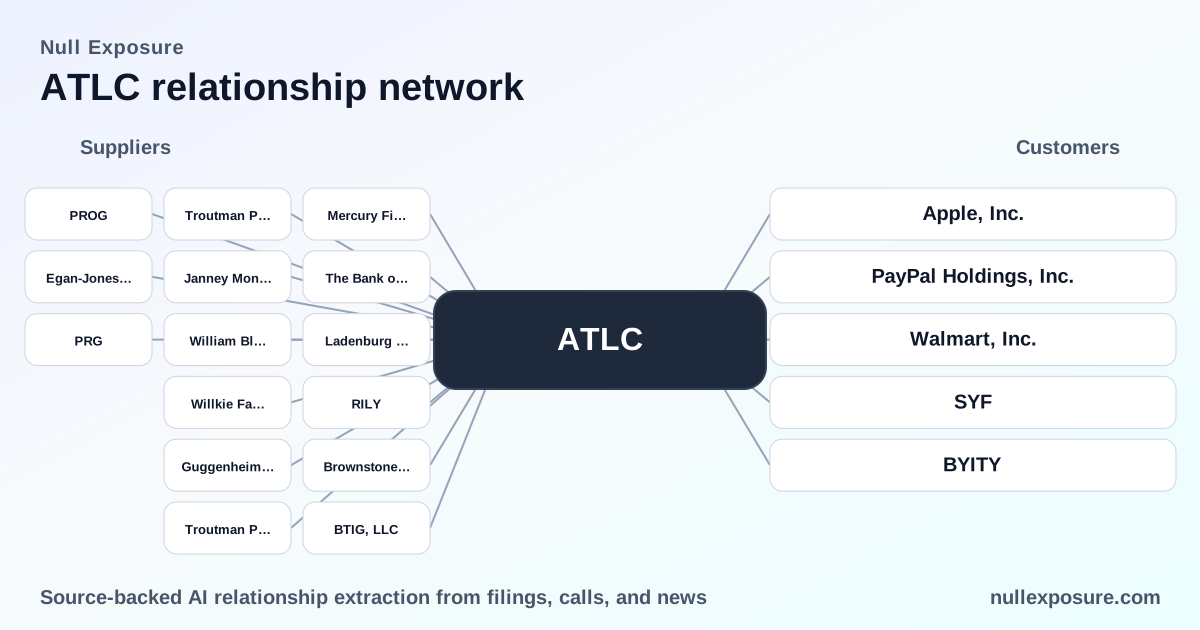
Below I cover each named relationship found in public filings and press coverage, with a concise read and source for each.
-
PayPal Holdings, Inc.: Atlanticus’s FY2024 10‑K mentions PayPal in the context of a third‑party patent litigation involving Fintiv Inc.; the reference is not a commercial partnership disclosure but shows Atlanticus documents catalog third‑party legal developments involving large payments platforms. According to Atlanticus’s FY2024 10‑K filing, this mention arises within a litigation disclosure.
Source: Atlanticus FY2024 10‑K (filed for the period ending 2024). -
Apple, Inc.: Apple is named in the same FY2024 10‑K passage describing Fintiv Inc.’s patent litigation; this is a legal mention rather than an operational relationship between Atlanticus and Apple. According to the FY2024 10‑K, the passage records external litigation that involves major technology and retail firms.
Source: Atlanticus FY2024 10‑K (FY2024). -
Walmart, Inc.: Walmart appears with Apple and PayPal in that FY2024 10‑K litigation excerpt; Atlanticus cites the case as part of broader third‑party legal developments. The filing does not describe a direct commercial financing program with Walmart.
Source: Atlanticus FY2024 10‑K (FY2024). -
Synchrony (SYF): Synchrony has entered a partnership with Atlanticus to deliver a preferred second‑look financing solution for Synchrony merchants, positioning Atlanticus as the downstream financier and service provider to optimize approvals and conversion. This commercial announcement was reported by Furniture Today in March 2026.
Source: Furniture Today report on Synchrony‑Atlanticus partnership (published March 2026). -
Home Depot (HD): In marketing an ABS, Atlanticus previously disclosed Home Depot represented a large single obligor within an initial receivables pool (approximately 27.5% of an initial pool referenced in a 2018 transaction), reflecting how Atlanticus has used retail receivables in securitizations. American Banker covered Atlanticus’s first ABS offering since 2004 and cited this exposure.
Source: American Banker/ASReport coverage of Atlanticus ABS (article referencing FY2018 pool). -
Sears Home Pro: The same ABS disclosure from 2018 identified Sears Home Pro as ~8% of that securitized pool; Atlanticus noted the issuer did not expect the Chapter 11 of Sears Holdings to materially affect that deal’s performance. This is historical ABS disclosure cited in press coverage.
Source: American Banker/ASReport coverage of Atlanticus ABS (FY2018 reporting). -
Byte (BYITY): Atlanticus announced a commercial arrangement to offer a second‑look lending solution to Byte’s consumer finance program — a direct example of Atlanticus acting as an embedded financing partner to optimize originations and approvals. The announcement and Atlanticus executive commentary were published via a Yahoo Finance press release in March 2026.
Source: Yahoo Finance press release quoting Atlanticus CCO David Caruso (published March 2026).
Investment implications and risk checklist
- Revenue model: recurring interest spread plus service fees. Partnerships like Synchrony and Byte show Atlanticus is positioned to capture conversion‑driven economics and fee income without necessarily holding all originations on balance sheet.
- Concentration risk exists at the pool level. ABS disclosures show individual retail partners can represent material slices of a securitized pool; this increases event risk if a major retail partner underperforms.
- Operational dependence is high. Atlanticus’s value is in servicing and decisioning; large partners will treat those functions as mission‑critical, creating stickiness but also execution risk if platform outages or compliance failures occur.
- Credit cycle sensitivity. All revenue is U.S. sourced and consumer‑facing; macro downturns will compress originations and increase charge‑offs across Atlanticus’s partner channels.
Bottom line: Atlanticus’s customer relationships are a mix of press‑announced strategic second‑look partnerships (Synchrony, Byte) and historical securitization counterparties (Home Depot, Sears Home Pro), with legal mentions in the 10‑K reflecting external industry litigation rather than direct commercial ties. The firm’s moat is operational capability in servicing and second‑look capital; investor focus should be on partner concentration in securitizations, contractual tenure of servicing agreements, and the credit quality of underlying consumers.
If you want a structured brief on how each partner type (merchant, card issuer, securitization counterparty) translates to cash‑flow sensitivity and valuation multiples, visit https://nullexposure.com/ for more investor‑grade notes.