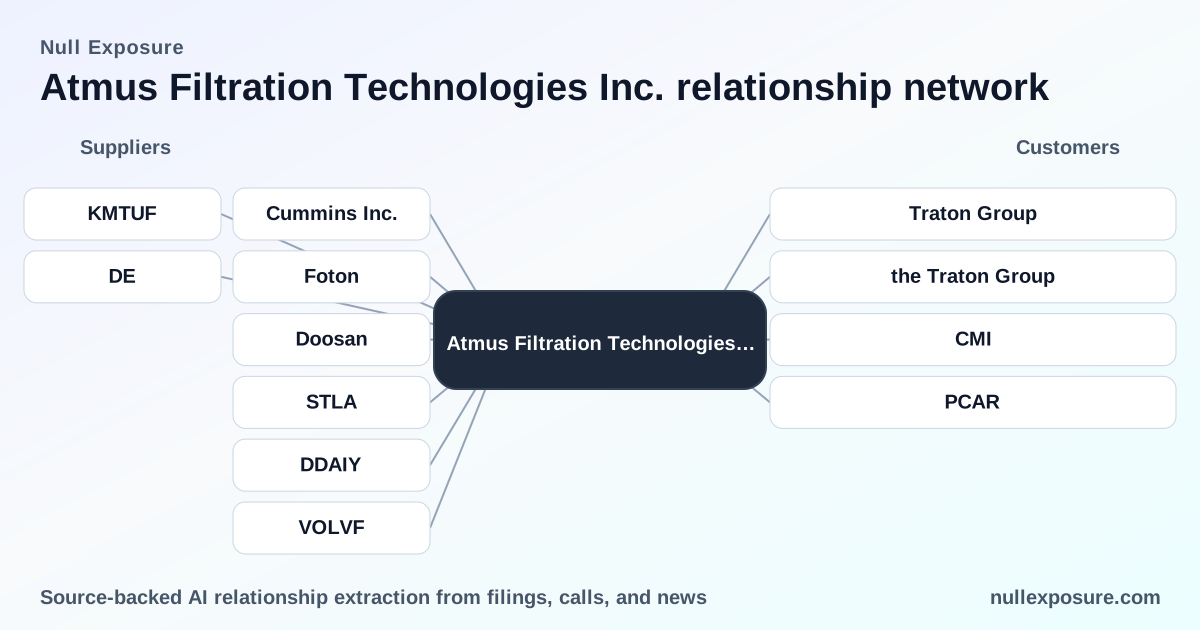
Atmus Filtration Technologies — customer relationships that drive revenue and risk
Atmus sells engineered filtration products under the Fleetguard brand to original equipment manufacturers (first‑fit) and to the aftermarket, monetizing through product sales secured by a mix of long‑term commercial agreements and framework purchase arrangements. The company captures margin through proprietary designs, scale manufacturing and global distribution, while revenue depends heavily on a small set of large OEM customers and broad aftermarket demand for replacement parts.
For a concise lookup of source material and relationship signals, visit https://nullexposure.com/ for an integrated view of Atmus’ disclosures and news coverage.
Why customers matter more than product innovation for valuation
Atmus’ economics are simple and concentrated: sale of filtration hardware to OEMs and aftermarket channels. The operating model blends stable long‑term commercial terms with non‑binding framework elements — contracts that guarantee access and pricing disciplines but do not commit customers to fixed volumes. That posture gives Atmus commercial flexibility while leaving top‑line vulnerable to OEM order cycles and longer‑term structural shifts in engine technology.
Company‑level signals from Atmus’ FY2025 disclosures and investor commentary provide the operating context investors need to price the stock:
- Contracting posture: Atmus uses a mix of long‑term agreements and framework arrangements; long‑term agreements set price and operational expectations but often do not obligate specific volumes. This structure supports recurring revenue but permits rapid revenue volatility if OEM orders contract.
- Concentration and criticality: Three customers—Cummins, PACCAR and the Traton Group—each generated more than 10% of net sales in 2025, making customer loss a material business risk.
- Relationship maturity and role: Atmus has sold to each major partner for at least a decade; it operates as both manufacturer (design and production under Fleetguard) and distributor through OEM dealer and independent channels.
- Geographic reach: Atmus is global (roughly half of sales outside North America in 2024), which diversifies end markets but also exposes the company to regional industrial cycles.
- Segment exposure: Core markets split roughly 60% on‑highway and 40% off‑highway, keeping product demand tied to commercial vehicle and heavy equipment utilization.
These signals translate to predictable margin leverage in expansions, and to high downside sensitivity if OEM volume or aftermarket replacement rates fall because of engine longevity gains or electrification.
The roster that matters — what each relationship means for investors
Cummins (CMI / Cummins)
Cummins is Atmus’ largest customer, accounting for approximately 18.8% of net sales in 2025 according to Atmus’ FY2025 Form 10‑K; that places significant concentration risk on Cummins’ purchasing patterns. Independent commentary in early 2026 highlighted that Atmus’ earnings and valuation are sensitive to demand from Cummins and to structural risks such as longer engine life or electrification reducing aftermarket replacement volumes (Simply Wall St, Mar–May 2026).
Source: Atmus 2025 Form 10‑K; Simply Wall St coverage (March–May 2026).
PACCAR (PCAR / PACCAR)
PACCAR was one of three external customers that each exceeded 10% of Atmus’ annual net sales in FY2025. PACCAR’s contribution underlines Atmus’ exposure to North American Class 8 truck production cycles and first‑fit pricing arrangements that are typically managed under long‑term commercial terms (Atmus FY2025 10‑K).
Source: Atmus 2025 Form 10‑K.
Traton Group (the Traton Group / Traton Group)
The Traton Group also accounted for more than 10% of Atmus’ net sales in FY2025, joining Cummins and PACCAR as a material counterparty. The 10‑K language identifies Traton as a top customer and frames the loss of any of these customers as having a material adverse effect on operations and cash flows (Atmus FY2025 10‑K).
Source: Atmus 2025 Form 10‑K.
Note: news articles and analyst write‑ups frequently reference Cummins by ticker (CMI) and discuss Atmus’ dependence on Cummins and the aftermarket as a key sensitivity; those pieces reinforce the 10‑K concentration signal (Simply Wall St, March–May 2026).
If you want a single place to track these filings and media signals in context, check https://nullexposure.com/.
What investors should watch next — catalysts and risk triggers
- OEM order cycles and first‑fit wins. Because Atmus’ long‑term agreements provide availability and pricing but not guaranteed volumes, secular or cyclical weakness among Cummins, PACCAR or Traton will directly compress revenue.
- Aftermarket resilience vs. technological change. Atmus’ aftermarket business cushions OEM volatility, but longer engine service intervals and adoption of electrified drivetrains reduce replacement frequency and create medium‑term downside risk.
- Contract renewals and pricing leverage. Renewal terms and any movement from framework to fixed‑volume commitments would materially de‑risk revenue predictability; conversely, aggressive price concessions to secure OEM content would pressure margins.
- Geographic and segment mix. Global sales reduce single‑market dependence, but heavy weighting to on‑highway commercial vehicles ties performance to freight demand and equipment investment cycles.
Final read: balance of franchise and concentration
Atmus owns a technically strong, globally distributed filtration franchise with premium branding and sustained aftermarket channels. The company’s growth and margin profile depend on converting product and IP leadership into repeatable OEM content wins while defending aftermarket replacement economics. Concentration among three customers (Cummins, PACCAR, Traton) is the defining structural risk — material today and the primary variable investors should monitor across quarterly updates and contract announcements.
Key takeaway: Atmus offers a compelling product franchise with predictable margin upside in expansion, but valuation must be discounted for customer concentration and structural aftermarket risk until the company demonstrably diversifies its OEM mix or secures volume‑committing contracts.
For regular updates and an aggregated view of Atmus’ filings and market commentary, visit https://nullexposure.com/.