Atomera (ATOM): Licensing MST to the world's fabs — commercialization ahead of scale
Atomera monetizes proprietary MST materials and simulation software by licensing technology to semiconductor manufacturers and by selling time‑based MSTcad simulation subscriptions and integration services. Revenue drivers are licensing fees, ongoing royalties from MST-enabled manufacturing, and recurring MSTcad subscriptions, while validation from leading foundries and an OEM partnership create the go‑to‑market pathway for production adoption. For focused investor intelligence and customer-mapping, visit https://nullexposure.com/.
How Atomera’s commercial model actually works
Atomera takes a licensor-first posture: the company signs commercial manufacturing licenses that allow customers to integrate MST into their process flows and pay initial license fees plus ongoing royalties on volume. The firm also sells MSTcad simulation access on monthly or annual terms and recognizes revenue either at a point in time for manufacturing licenses or over time for subscriptions and some integration agreements. These contract characteristics create a hybrid cash flow profile—lumpy upfront license payments with the potential for recurring royalty streams and subscription revenue.
Company disclosures flag several operational constraints that shape this model: Atomera reports MST engagements across multiple phases, with 14 integrations underway and two customers in process installation, showing that most customer relationships are still in technical ramp rather than broad production. The firm’s geographic revenue mix skews small and concentrated, and near‑term revenue is minimal relative to market value—current top‑line receipts are effectively immaterial while the commercialization pipeline builds. One explicitly named constraint: Atomera entered a full commercial license with STMicroelectronics in April 2023, establishing a precedent for its licensing approach.
Customer map: who validates MST and where revenue will come from
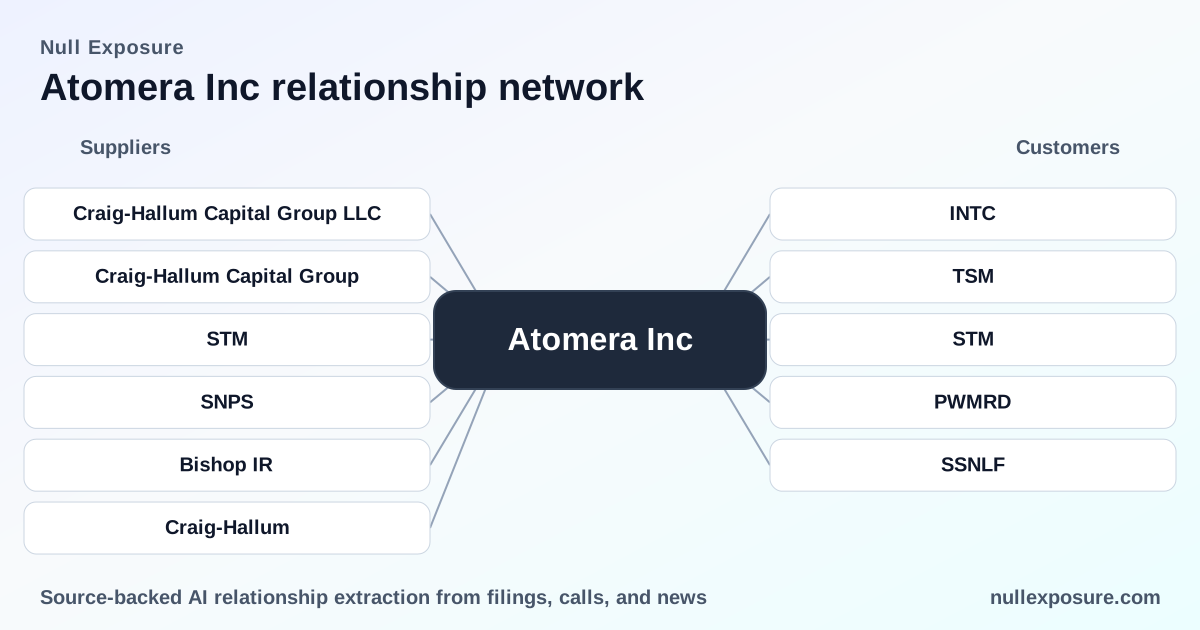
Below are every customer relationship flagged in Atomera’s recent public filings and media coverage, with a concise description and source reference for each.
TSMC (TSM)
Atomera lists TSMC as a target production customer, positioning the world’s largest foundry as a prime channel for MST adoption and royalties once process qualification completes. According to Atomera’s Q4 2025 earnings call, TSMC is explicitly named among customers “in production.” (Atomera Q4 2025 earnings call; cited Mar 2026).
Intel (INTC)
Intel is likewise identified as a production target for MST-enabled processes, giving Atomera potential direct exposure to on‑chip performance and power markets if integration succeeds. This designation appears in the company’s Q4 2025 earnings commentary and follow‑up press coverage. (Atomera Q4 2025 earnings call; Investing.com transcript, FY2026 coverage, May 2026).
Samsung (SSNLF / 0L2T.LON)
Atomera cites Samsung among customers that are in production, indicating a broad foundry/customer set that spans Asia’s major fabricators. The company reiterated Samsung’s inclusion during its Q4 2025 remarks and in subsequent press transcripts. (Atomera Q4 2025 earnings call; Investing.com transcript, FY2026).
Rapidus
Atomera identifies Rapidus—the new Japanese advanced‑node manufacturer—as a development-stage target, which reflects efforts to win early design‑in with greenfield fabs. Rapidus was called out during the Q4 2025 earnings presentation as a customer “deep in development.” (Investing.com transcript of Atomera Q4 2025 earnings call, FY2026 coverage, May 2026).
Synopsys (SNPS)
Atomera’s MSTcad has been integrated into Synopsys’ Sentaurus TCAD, embedding Atomera models in mainstream design flows and lowering adoption friction for foundry and device engineers. News reports in April 2026 described the Synopsys integration as a deliberate route to accelerate RF and GaN design workflows. (Stockstotrade / news coverage, Apr 2026; StocksToTrade report on Synopsys partnership, Apr 2026).
STMicroelectronics (STM)
STMicroelectronics is a named licensee: Atomera signed a full commercial license with ST in April 2023, and management disclosed later setbacks in process qualification that could delay revenue realization. Public remarks and market commentary tied the ST qualification issue to near‑term revenue timing risk. (Atomera annual disclosures describing the April 2023 license; Atomera Q4 2025 earnings call and March 2026 press reporting; StockTwits/Investing.com coverage, Mar–May 2026).
Power America (PWMRD)
Atomera reported that its GaN on Silicon concept advanced to the proposal stage with Power America, signaling government or consortia‑backed R&D that validates Atomera’s GaN roadmap and could unlock future commercial routes for power electronics. This was described during the Q4 2025 earnings call. (Atomera Q4 2025 earnings call, Mar 2026).
Where the model creates value — and where it creates risk
- High leverage to validation events. The path to scalable royalty revenue hinges on a small number of process qualifications at major foundries and OEMs; each qualification converts technical progress into durable revenue. Atomera’s pipeline shows active integrations, but production scale remains concentrated until multiple large customers ramp concurrently.
- Mixed contract economics. Licensing produces lumpy upfront cash followed by royalties; MSTcad subscriptions offer recurring revenue but are modest today. Atomera recognizes some license revenue at a point in time and other revenues over time, producing uneven near‑term cash flow. This characteristic requires careful modeling of timing versus eventual volume royalties (company revenue recognition notes, FY2024–2025).
- Customer concentration and timing risk. Public disclosures note a small revenue base and a limited number of phase‑advanced engagements; this amplifies the impact of any single qualification delay—as visible in the STMicroelectronics qualification setback reported in March 2026.
- Strategic validation through software partnerships. The Synopsys integration is a tangible commercial multiplier: embedding MST models into Sentaurus means design teams see Atomera’s value earlier, reducing friction for foundry customers to evaluate MST in their flows (Stockstotrade reporting, Apr 2026).
Investment implications and what to watch
- Watch for process qualification milestones at TSMC, Samsung, Intel, and ST; each public progress update materially increases the probability of license revenue and royalties.
- Monitor Synopsys distribution metrics and MSTcad subscription uptake as early leading indicators of broader engineering adoption.
- Track cash runway and deferred revenue notes: current reported revenue is minimal while operating losses persist, so the company remains valuation‑sensitive to execution milestones (Atomera financials through FY2025).
Bottom line: binary scaling, asymmetric upside
Atomera’s business is binary in character: a small set of large foundry and OEM wins convert to licensing royalties that can scale profitably, while qualification delays or technical setbacks produce meaningful valuation downside. For investors, the core thesis is simple—pay today for the option on multiple foundry ramps and software distribution; for operators and partners, Atomera offers differentiated MST technology coupled with software that eases adoption.
For a deeper customer intelligence brief and ongoing tracking of qualification milestones, explore the Atomera customer coverage at https://nullexposure.com/.