ATPC customer relationships: what investors need to know
Agape ATP Corporation (ATPC) operates at the intersection of product distribution and energy trading: the company sells health and wellness products through a network of distributors and stockists in Malaysia while its energy arm, ATPC Green Energy, executes bilateral fuel supply agreements. ATPC monetizes through direct product sales and commissions paid to distributors/stockists, and through negotiated fuel supply contracts that generate merchant margins when executed and fulfilled. For investors, the revenue mix and counterparty concentration drive both upside opportunity and short-term liquidity risk. Learn more at https://nullexposure.com/.
One-sentence thesis for busy investors
ATPC combines a distributor-driven retail model for health and wellness products with opportunistic fuel supply contracts under its energy subsidiary; this hybrid model produces variable working capital demands and concentrated receivable risk despite broad top-line channels.
The customer relationships on record (what the coverage shows)
Below I cover every relationship captured in the public records and news items linked to ATPC’s customer landscape.
-
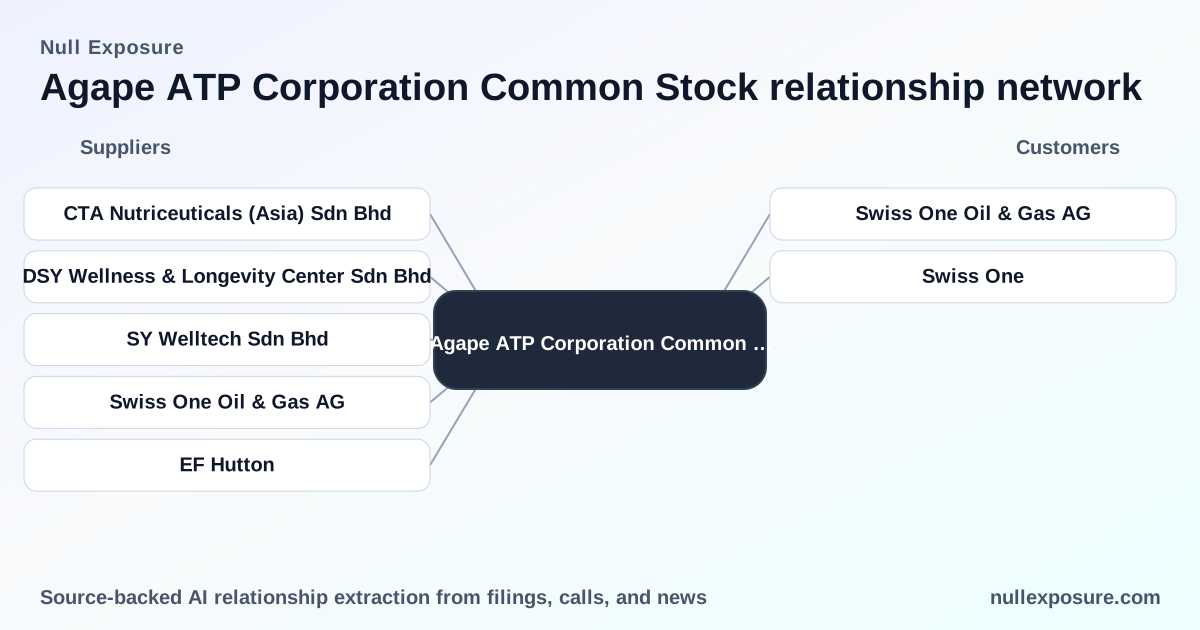
Swiss One / Swiss One Oil & Gas AG — ATPC Green Energy has a year-long fuel supply agreement to deliver refined products including EN590 10PPM diesel and Jet Fuel A1, with an initial trial order of 200,000 metric tonnes of diesel and 2 million barrels of Jet Fuel A1. According to The Star’s April 4, 2025 report, the contract is structured as a 12‑month supply with extension rolls and represents a large-volume, merchant-style supply arrangement that can materially affect near-term revenue if shipments proceed as announced. (The Star, April 4, 2025; New Straits Times / BusinessToday coverage April 2025.)
-
Sportradar (SRAD) — the items matched to ATPC reference Sportradar’s media and rights business noting coverage of ATP sporting content; the cited Sportradar materials describe sports-rights partnerships and do not document a commercial buyer–seller relationship with Agape ATP, indicating the linkage stems from text overlap around the acronym “ATP” rather than a trade relationship. See Sportradar press materials and Q3 2025 earnings commentary referencing ATP content and broader rights expenses. (Sportradar press releases and transcripts, Q3 2025; Yahoo Finance / Globe and Mail coverage March 2026.)
What the relationships imply about ATPC’s commercial posture
The Swiss One contract is a clear example of ATPC operating as a merchant supplier in commodity markets: large lot supply, fixed-term windows, trial shipments ahead of roll extensions. That structure converts contract announcements into binary operational outcomes—ship or not ship—with direct impact on revenue recognition and cash flow.
The Sportradar link does not strengthen the commercial case for ATPC; it is a text-level association reflecting sports-rights commentary and not a documented customer. Investors should treat Sportradar references as noise for commercial due diligence unless direct contractual evidence surfaces.
Company-level operating characteristics and constraints investors must weight
The public disclosures and extracted constraints paint a consistent picture of how ATPC runs its business and where the risks concentrate. These are company-level signals, not relationship-specific assertions unless explicitly named in a disclosure.
-
Contracting posture — spot/transactional: Revenue recognition language indicates sales are recognized when control transfers at shipment or delivery, consistent with spot or shipment-based contracts; this implies working capital swings tied to inventory and shipment scheduling.
-
Channel structure — distributor/reseller emphasis: The company sells via sales distributors, stockists (retailers carrying inventory), and a sales network that earns commissions, which creates recurring commission expense and a multi-tier settlement cycle that lengthens cash conversion.
-
Geography — APAC focus, Malaysia base: Disclosures emphasize customer acquisition in Malaysia and the APAC region, concentrating go-to-market efforts regionally.
-
Materiality paradox — concentrated receivables vs. dispersed revenue: Disclosures report that one entity represented ~79.7% of accounts receivable at Dec 31, 2024, yet for the fiscal years ended 2024 and 2023 no single customer contributed ≥10% of revenue. This signals a receivables concentration risk that is not mirrored at the revenue level, consistent with either timing mismatches (large uncollected invoices) or a single financing/collection counterparty holding balances. That receivable concentration is a high-impact balance-sheet risk even if revenue diversification appears acceptable on a periodic basis.
-
Role mix — seller, distributor, reseller, and service provider: The company functions as a principal seller of core products, a supplier of wellness services, a distributor/franchise-style operator paying commissions, and a supplier to stockists. This diversity blunts single-channel failure risk but increases operational complexity and commission leakage.
-
Segment mix — products and services: Core revenue drivers include health and wellness product sales and related wellness programs, while the energy business (fuel supply) introduces occasional, high-dollar contract revenue events.
-
Governance and ownership signals: Public data show high insider ownership (52.6%) and minimal institutional ownership (0.65%), which concentrates control and implies market liquidity and governance dynamics that investors should model into their risk assessment.
Key takeaways for investors
-
Concentration risk is real and immediate: the large accounts-receivable concentration exposes near-term solvency risk if collection or a single trading counterparty falters. Balance-sheet monitoring should precede any valuation rerating.
-
Revenue mix is bifurcated: steady but lower-dollar distributor-driven product sales provide baseline revenue, while fuel supply contracts deliver episodic, high-dollar potential that can swing EBITDA and cash flow materially.
-
Operational complexity increases execution risk: managing a distributor network, stockist inventory, and large-scale commodity shipments requires different operating disciplines; execution shortfalls in either leg will affect margins and liquidity.
-
Documented customer wins (Swiss One) are meaningful if executed: the Swiss One supply agreement, if fulfilled at scale, will materially affect top-line and could reduce per-unit fixed costs, but it also places execution demands on logistics, compliance, and working capital.
Actionable checklist for due diligence
- Verify receivable aging and counterparty identity to understand the 79.7% receivables concentration.
- Confirm shipment schedules, financing terms, and performance assurances on the Swiss One supply agreement.
- Validate distributor commission economics, stockist inventory levels, and cash conversion cycle.
- Monitor insider disposition and any equity financing plans given the company's high insider stake and low institutional ownership.
If you want a concise intelligence brief or a tailored model showing how the Swiss One shipments would affect ATPC cash flow under multiple realization scenarios, visit https://nullexposure.com/ for detailed coverage and subscription options.
Bottom line
ATPC presents a mixed risk-reward profile: a steady distributor-backed revenue base paired with high-variance commodity supply opportunities and concentrated receivable exposure. For investors and operators, the most actionable near-term focus is collection transparency on receivables and verification of execution capability on the announced fuel contracts; those two factors will determine whether ATPC’s hybrid model is a compelling turnaround story or a balance-sheet vulnerability.