Atara Biotherapeutics (ATRA): Commercial Partnerships Drive Near-Term Cash and Long-Term Optionality
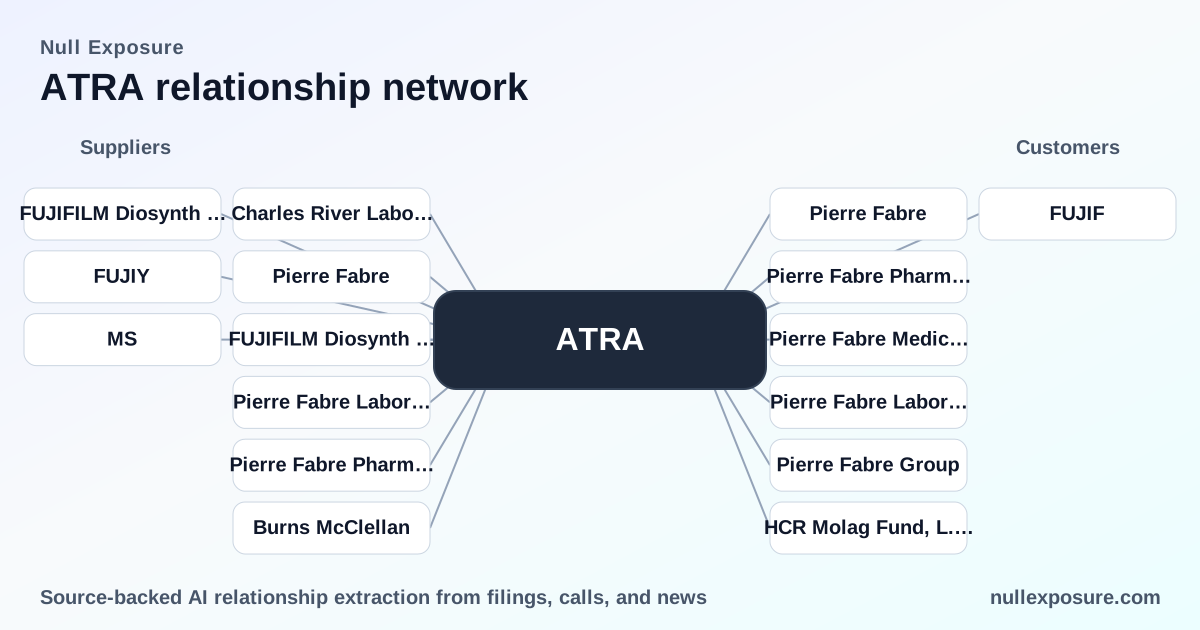
Atara monetizes its T‑cell immunotherapy assets by licensing global commercialization rights, contracting to manufacture product components, and monetizing future royalties and milestones through financing arrangements. The company’s revenue profile is concentrated around one commercial partner—Pierre Fabre—and supplemented by structured monetizations such as royalty sales and one‑off asset disposals, creating a capital-light route to near-term cash while leaving upside tied to regulatory outcomes and commercial execution.
Learn more about how we map customer relationships and commercial exposure at https://nullexposure.com/.
How the commercial architecture actually works (and why it matters to investors)
Atara operates as a developer-licensor and selective manufacturer. It has granted exclusive territorial commercialization licenses (initially EMEA/Initial Territory, subsequently expanded globally) to Pierre Fabre for its EBV‑focused assets (branded Ebvallo / tabelecleucel). Under that arrangement Atara recognizes revenue in a hybrid fashion: upfront and milestone receipts, deferred revenue for manufactured intermediates, and share-based royalties when product sales occur. Atara also sold intermediates and its Thousand Oaks manufacturing site and has monetized future royalty streams to third‑party investors, converting prospective upside into current liquidity.
- Contracting posture: Licensing with staged manufacturing transition; Atara is both licensor and interim manufacturer/service provider during transition periods.
- Concentration and criticality: High counterparty concentration—Pierre Fabre is the primary commercial counterparty and source of milestone and royalty economics.
- Maturity and revenue characteristics: Agreements include large milestone triggers and deferred recognition tied to manufacturing transition dates; financing agreements (HCRx) cap some upside in exchange for immediate cash.
- Operational implication: Outsourced manufacturing (and an outright plant sale) reduces fixed cost but increases dependency on partner timelines and third‑party manufacturing capacity.
For more context on how partner concentration maps to corporate cash flow, see https://nullexposure.com/.
Relationship inventory — every customer relationship in the source set
Pierre Fabre (10‑K excerpt, FY2024)
Atara recognizes commercialization revenue tied to sales of Ebvallo and intermediate inventory to Pierre Fabre only after Atara performs related manufacturing or completes technology transfer; Atara also had a manufacturing and supply arrangement with Pierre Fabre with fixed pricing through 12/31/2023 and cost‑plus thereafter. According to Atara’s FY2024 Form 10‑K, these provisions drive deferred revenue and transitional manufacturing economics.
Pierre Fabre Pharmaceuticals (FinancialContent MarketMinute, 14 Jan 2026)
A market report documented that an FDA reversal precipitated a stock collapse and eliminated the immediate prospect of a $40 million milestone payment from Pierre Fabre to Atara, demonstrating how regulatory outcomes directly affect near‑term cash flows. (Markets.FinancialContent.com, Jan 14, 2026)
Pierre Fabre (AccessNewswire / Pomerantz filing, May 2026)
A securities pleading referenced the Pierre Fabre commercialization partnership for tabelecleucel and highlighted Atara’s reliance on milestone payments and partner services to fund operations and support regulatory activities. (AccessNewswire coverage of Pomerantz LLP filing, May 2, 2026)
Pierre Fabre (VC Star, Jan 27, 2026)
Local press noted that Atara sold commercialization rights to Pierre Fabre in stages (Europe 2021, worldwide 2023) and that a U.S. approval would trigger a $31 million payment from Pierre Fabre plus a royalty share ranging from single digits to mid‑double digits. (VC Star, Jan 27, 2026)
Pierre Fabre Medicament (BioSpace press release, FY2025)
Atara’s public operating update reiterated eligibility to receive a $40 million milestone from Pierre Fabre Medicament upon FDA approval of the tab‑cel BLA, underscoring the materiality of that single contractual payment. (BioSpace press release, FY2025)
Pierre Fabre (PR Newswire, FY2022)
When the European Commission approved Ebvallo, Atara confirmed that Pierre Fabre would lead commercialization and distribution in Europe and select markets after the marketing authorization transfer, reflecting the early structural allocation of go‑to‑market responsibilities. (PR Newswire, FY2022)
Pierre Fabre Laboratories (RTTNews, FY2025)
Analyst coverage and industry write‑ups restated that Atara stood to receive a $40 million approval milestone from Pierre Fabre Laboratories, reinforcing the same milestone as a key binary cash event. (RTTNews, FY2025)
Pierre Fabre Group (LA Business Journal, FY2024)
Local business reporting noted Atara’s expanded partnership with the Pierre Fabre Group in 2023, placing potential aggregate consideration (up to $640 million in additional payments and double‑digit royalties) on the table contingent on cumulative regulatory and commercial milestones. (LA Business Journal, FY2024)
Pierre Fabre Medicament (StockTitan coverage of 8‑K, FY2026)
An 8‑K summarized an amendment that deferred a one‑time $9.0 million cash payment associated with a specific commercialization milestone from June 30, 2026 to January 1, 2028, illustrating contractual flexibility on payment timing. (StockTitan reporting on Atara 8‑K, FY2026)
Pierre Fabre Médicament (AccessNewswire, FY2026)
Investor commentary emphasized that Atara “relies in significant part on milestone payments…by Pierre Fabre” to fund operations and that Pierre Fabre provides services critical to pursuing regulatory approvals—again highlighting counterparty dependency. (AccessNewswire, May 2026)
HCR Molag Fund, L.P. / HealthCare Royalty (HCRx) (StockTitan, FY2026)
Atara entered an amendment to a Purchase & Sale Agreement with HCR Molag Fund that originally transferred rights to certain Ebvallo royalties and milestones in exchange for an upfront $31.0 million investment, indicating a royalty monetization that constrains upside in return for liquidity. (StockTitan coverage of amendment, FY2026)
FUJIF (FUJIF) (VC Star, Jan 27, 2026)
Local reporting stated Atara sold its Thousand Oaks manufacturing plant to a biotech subsidiary of FujiFilm for $100 million, using proceeds to fund clinical work and regulatory activities—an asset sale that converted fixed capacity into cash. (VC Star, Jan 27, 2026)
FujiFilm (VC Star, Jan 27, 2026)
The same coverage described FujiFilm’s acquisition of the manufacturing site, which materially changed Atara’s manufacturing footprint and pushed Atara toward outsourced/partner manufacturing arrangements. (VC Star, Jan 27, 2026)
Constraints and what they signal for operating risk and upside capture
The source material establishes clear, named constraints tied to the Pierre Fabre relationship: licensing (exclusive commercial license for initial and then global territories), manufacturing transition (Atara obligated to manufacture and provide cell selection services until transfer events), seller role (sale of intermediates and recognition timing), and service provider obligations for cell selection. These are direct contractual constructs that produce deferred revenue, transitional manufacturing economics, and dependency on partner timing. Separately, the HCRx agreement is a named royalty monetization contract that reduces future revenue participation in exchange for immediate cash.
From an investor perspective, these constraints create a dual profile: immediate liquidity and lower fixed cost versus concentrated commercial exposure and capped upside where regulatory milestones (e.g., the $40 million BLA milestone) and approval outcomes act as binary drivers of value.
Investment implications — concise conclusions for investors
- Concentration risk is material: Pierre Fabre is the primary commercial counterparty and near‑term cash driver.
- Cash vs. upside trade‑off: Asset sales and royalty financing have shored up liquidity but reduce future optionality.
- Regulatory outcomes are single‑event value drivers: Several public sources tie multiple material payments (notably a $40M milestone and other staged payments) to FDA/regulatory success.
- Operational flexibility is reduced: Manufacturing transfer mechanics and deferred revenue recognition mean revenue timing is governed by partner milestones and transfer dates rather than immediate market demand.
For a concise, structured view of Atara’s partner exposures and contract mechanics, visit https://nullexposure.com/.
In aggregate, Atara’s strategy converts clinical and regulatory potential into a staged commercial plan supported by a single major partner and selective financial monetizations—an approach that lowers near‑term cash strain but concentrates both execution risk and future upside.