AtriCure (ATRC): Customer Relationships, Commercial Footprint, and the NHS Headwind
AtriCure sells surgical-ablation devices and supporting systems to hospitals and cardiac centers and monetizes through direct product sales and channel distribution in developed and selected emerging markets. The commercial model combines a direct sales force in core markets with distributor partnerships in other regions, generating revenue from capital equipment and procedure-related disposables and services. This structure delivers scale in the U.S. and Europe while exposing the company to public payer and reimbursement dynamics in single-payer systems. For a concise view of AtriCure’s coverage and relationship intelligence, visit the Null Exposure homepage: https://nullexposure.com/.
Commercial footprint: direct sales where it matters, distributors where needed
AtriCure operates a mixed contracting posture. The firm engages in direct, salesforce-driven relationships with medical centers in the United States and a set of European and developed markets while using distribution partners to extend reach across Asia and South America. Company disclosures list direct sales coverage in the United States, Germany, France, the United Kingdom, the Benelux region, Canada and Australia, while distributors are used to market and sell products in Asia, South America and “certain countries in Europe.” These disclosures indicate a deliberate two-tier commercial model: directly controlled go-to-market in high-value, high-compliance regions and channel-led expansion in markets where local regulatory or logistical complexity benefits from partners.
This hybrid model creates several company-level operational signals:
- Contracting posture: Mixed — direct contracts with major medical centers and distribution agreements in international and emerging markets.
- Concentration: Geographic diversification across NA, EMEA and APAC reduces single-market concentration risk, but exposure to public payers in certain developed markets introduces political and reimbursement risk.
- Criticality: Product set—devices for cardiac surgical ablation—is clinically important to cardiac surgery programs, which supports durable demand but keeps procurement sensitive to hospital budgets and payer policies.
- Maturity: Direct sales presence in major markets and an established distributor network signal a mature commercial organization capable of scaling procedures and training.
These company-level signals come from AtriCure’s own disclosures (company filings and investor materials, FY2025–FY2026).
The National Health Service: a material customer and a source of revenue volatility
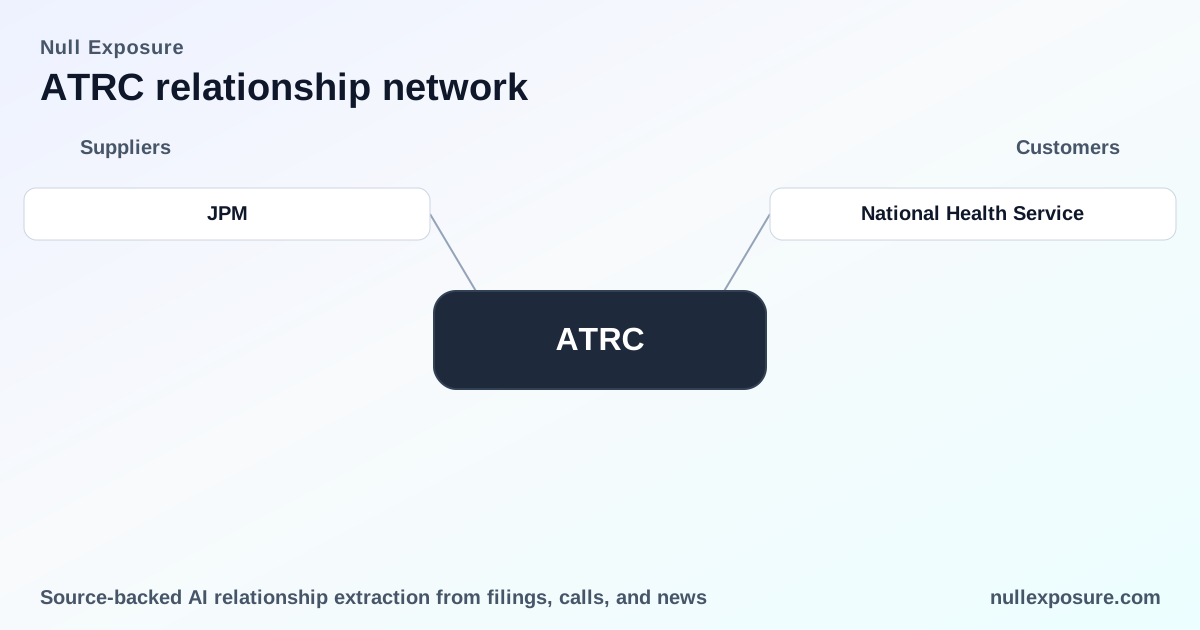
- National Health Service (NHS): AtriCure reported a decline in U.K. sales in Q4 driven by funding and reimbursement uncertainty with the NHS, which directly impacted fourth-quarter results in FY2026. According to a Q4 FY2026 earnings call transcript published on March 9, 2026, the company flagged the NHS funding environment as the proximate cause of weaker U.K. performance. (Source: Q4 FY2026 earnings call transcript reported on InsiderMonkey, March 2026.)
The NHS relationship illustrates a core commercial risk: exposure to single-payer funding cycles and reimbursement policy changes can produce abrupt revenue swings even where clinical need remains intact. Public-system procurement decisions and reimbursement policies directly influence hospital purchasing timing for capital devices and procedure volumes.
All customer relationships covered in this review
- National Health Service — AtriCure disclosed that U.K. sales declined in Q4 FY2026 due to ongoing NHS funding and reimbursement uncertainty, a dynamic that materially affected quarterly results. (Source: Q4 FY2026 earnings call transcript, InsiderMonkey, March 2026.)
This review covers every customer relationship returned in the underlying results; the NHS is the sole identified named customer in the report set and is treated as a representative example of public-payer exposure.
What investors should watch: risk factors and monitoring triggers
AtriCure’s customer profile generates a clear set of investor-focused monitoring priorities:
- Reimbursement and public funding cycles. The NHS episode is a concrete reminder that public payer decisions drive timing and scale of capital purchases in key markets. Track U.K. health budget announcements, NHS procurement frameworks, and clinical guidance updates tied to cardiac ablation.
- Geographic revenue mix. The company’s direct sales footprint in NA and key EMEA markets provides revenue stability; distributors expand reach but reduce control over execution. Quarterly regional revenue breakdowns will indicate whether direct or channel sales are gaining traction and whether the company is deconcentrating payor risk.
- Commercial maturity signals. Adoption metrics such as procedure volumes, installed base utilization, and training throughput are critical leading indicators of consumable replacement and recurring procedure revenue. AtriCure’s disclosures and investor presentations provide the best public read on these operational KPIs.
- Contracting and counterparty risk. Distributor agreements introduce execution and receivables risk; public healthcare customers introduce reimbursement and budgetary risk. Material shifts in the composition of direct vs. distributor sales will change working capital and margin dynamics.
For investors focused on customer exposures, regularly reviewing AtriCure’s regional revenue disclosures and management commentary on reimbursement environments is essential. For a deeper look at AtriCure’s commercial relationships and structured intelligence, see the company profile at Null Exposure: https://nullexposure.com/.
Concluding assessment: durable product demand, cyclical payer sensitivity
AtriCure’s commercial strategy balances direct control in high-value markets with distributor-led expansion, creating a resilient revenue engine that is nonetheless sensitive to payer policy shifts. The NHS-related Q4 FY2026 sales decline is a real-world example of how public payers can introduce quarter-level volatility even as underlying clinical need persists. Investors should treat AtriCure as a growth medical-device company with solid clinical positioning and a commercial model that requires active monitoring of payers, regional adoption metrics and distributor execution.
Key takeaway: AtriCure generates revenue through direct sales and distributor channels across NA, EMEA and APAC, but public healthcare funding cycles—exemplified by the NHS impact—are a primary driver of short-term top-line volatility.