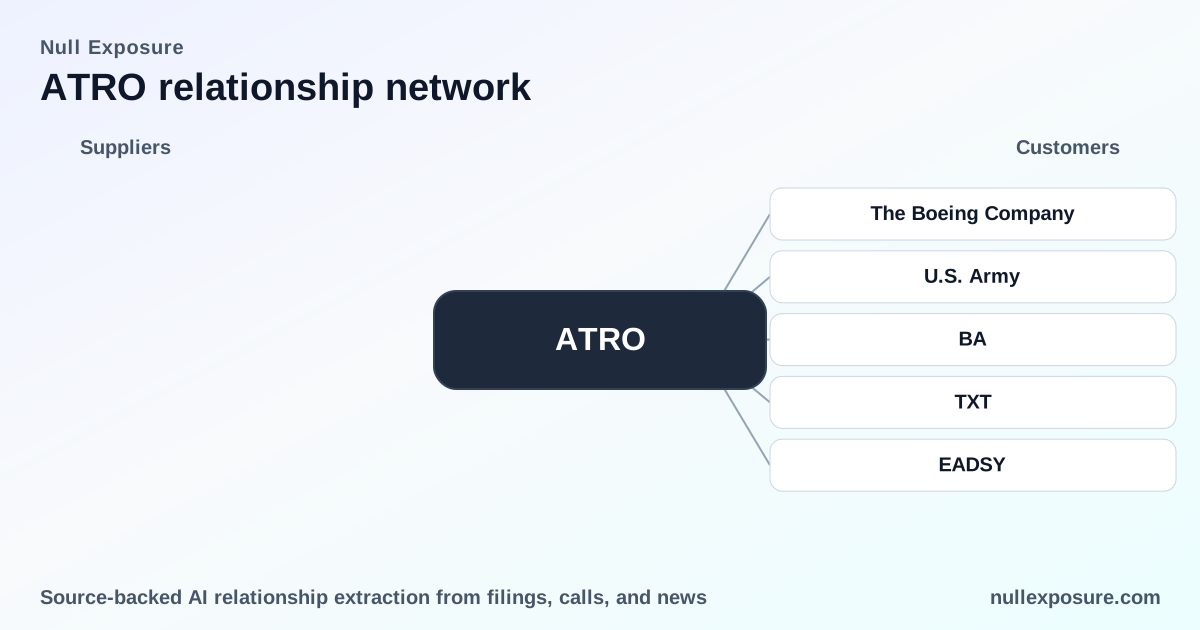
Astronics (ATRO): Customer Map, Concentration Risk, and Commercial Dynamics
Astronics Corporation designs and manufactures avionics, cabin electronics and test systems and monetizes through component and subsystem sales to airframe OEMs, airlines and defense primes, plus service and long‑term test-system contracts. Revenue mixes across spot deliveries, short‑term purchase orders and multi‑year test programs, with a material customer concentration in large airframers that drives revenue volatility and operational dependency. For quick access to the underlying coverage and signals, visit the Null Exposure homepage: https://nullexposure.com/.
Investment thesis up front
Astronics is a mid‑cap aerospace supplier that captures value by winning product supply positions (power systems, outlets, access doors) and by leveraging engineered test systems for defense customers. The company’s commercial upside comes from platform wins at Boeing and Airbus and scaling defense test programs, while the primary risk is customer concentration and program timing. Investors should evaluate order book convertibility, program ramp cadence, and the proportion of revenue that is recognized over time versus at delivery.
How Astronics sells: contract mix, customers and operational posture
Astronics operates with a hybrid contracting posture. The Test Systems business pursues large, often multi‑year projects and recognizes revenue over time on performance‑based contracts; concurrently, the Aerospace manufacturing arm transacts via day‑to‑day purchase orders and single‑year procurements, and a majority of product revenue is recognized at point of delivery. The company reports a large and active backlog — $599.2 million in remaining performance obligations at year‑end 2024, with roughly $488.8 million expected to convert to revenue in 2025 — which underpins near‑term revenue visibility but also concentrates execution risk into fewer program ramps. Astronics sells globally but is North America‑heavy in sales, with significant government and defense exposure within its Test Systems segment. These characteristics create a mixed maturity profile: mature OEM supplier relationships combined with earlier‑stage defense program production ramps.
Customer relationships — what matters to investors
Below I summarize every named counterparty identified in the public record and news coverage, with a concise takeaway and source pointers.
Boeing — the single largest commercial exposure
Astronics reports significant concentration with The Boeing Company, and Boeing accounted for roughly 10.4% of sales in 2025, making it Astronics’ largest identifiable customer exposure. Recent news shows Astronics was selected to supply fuel tank access doors for the Boeing 737 MAX, and the company integrates power outlets across many Boeing platforms — reinforcing both recurring and new program revenue potential. Source: Astronics 2024 Form 10‑K (disclosure of concentration) and multiple industry reports in 2026 including Avitrader and Finviz coverage on the 737 MAX award.
U.S. Army — defense program production upside
Astronics is engaged with the U.S. Army for test systems work, and management explicitly referenced waiting for the Army to “turn us on” for volume production of the 4549T radio test program, indicating a program currently in transitional or low‑rate phases that can scale. This is a high‑criticality government relationship tied to defense procurement timelines. Source: Q4 2025 earnings call transcript coverage, March 2026 (Insidermonkey/earnings call notes).
Airbus — strategic OEM alignment and production planning
Astronics continues to align operations with production expectations from major OEMs such as Airbus, indicating that Airbus is a strategic peer customer that shapes capacity and product planning even if specific awards are not detailed in the same way as Boeing. This links Astronics’ manufacturing cadence to the broader commercial aircraft build rates. Source: Astronics commentary in SEC filings and March 2026 market summaries (TradingView coverage citing company planning).
Bell — platform supplier in rotorcraft programs
Management has highlighted Astronics’ role on Bell’s V‑280 FLRAA program, the planned U.S. Army replacement for legacy rotorcraft, positioning Bell as a prime platform customer for components and subsystems in a defense airframe program. That relationship ties Astronics to next‑generation vertical lift programs with multi‑year production potential. Source: March 2026 reporting on the company’s Q4 2025 results and management discussion (Yahoo Finance summary).
TXT (Textron?) — program references and partner context
Press summaries referenced TXT in news metadata around Astronics’ Q4 reporting; context indicates Astronics’ program commentary included participation on Bell’s V‑280 and similar prime programs where Textron/Bell family contractors interact. Treat this as contextual partner/industry linkage rather than a separately documented revenue concentration. Source: Q4 2025 reporting coverage on Yahoo Finance (March 2026).
What the customer map implies for risk and upside
- Concentration risk is material and measurable. With Boeing accounting for double‑digit percent of sales, a program loss or production pause at a major OEM would have immediate revenue impact. TradingView and company‑filed commentary both cite Boeing at ~10.4% of 2025 sales.
- Backlog gives visibility but creates execution risk. A near‑term backlog of nearly $600 million provides revenue runway, but the majority scheduled for conversion in the next year concentrates execution demands and supply chain stress on Astronics’ manufacturing footprint.
- Revenue recognition and contract types are mixed. Astronics balances long‑term, milestone‑based Test Systems projects that recognize revenue over time with short‑term purchase orders and point‑in‑time product sales; this mix cushions margins but requires program management discipline.
- Defense exposure is strategic and program‑dependent. Government and defense work (U.S. Army, Bell V‑280) represent high‑value but timing‑sensitive opportunities that can flip financial outcomes when a program moves into volume production.
Practical takeaways for investors and operators
- Monitor Boeing program awards and delivery schedules as leading indicators for Astronics’ commercial revenue trajectory. Recent 737 MAX access door wins are a positive signal for content growth on that platform.
- Watch conversion of the 4549T and V‑280 programs from development to production; management’s comment that it is “waiting to be turned on” by the Army implies upside if volume orders commence.
- Scrutinize backlog convertibility and margin profile in upcoming quarters to confirm that the $599.2 million of remaining performance obligations converts at expected pace and margin.
- For deeper signal tracking and relationship mapping, visit Null Exposure for ongoing updates: https://nullexposure.com/.
Conclusion
Astronics is a specialized aerospace/defense supplier with clear commercial levers — OEM platform content and defense test systems — but concentrated customer exposure and program timing risks that require active monitoring. Investors should balance the company's backlog and OEM wins against the execution stretch and sensitivity to large OEM production rates.