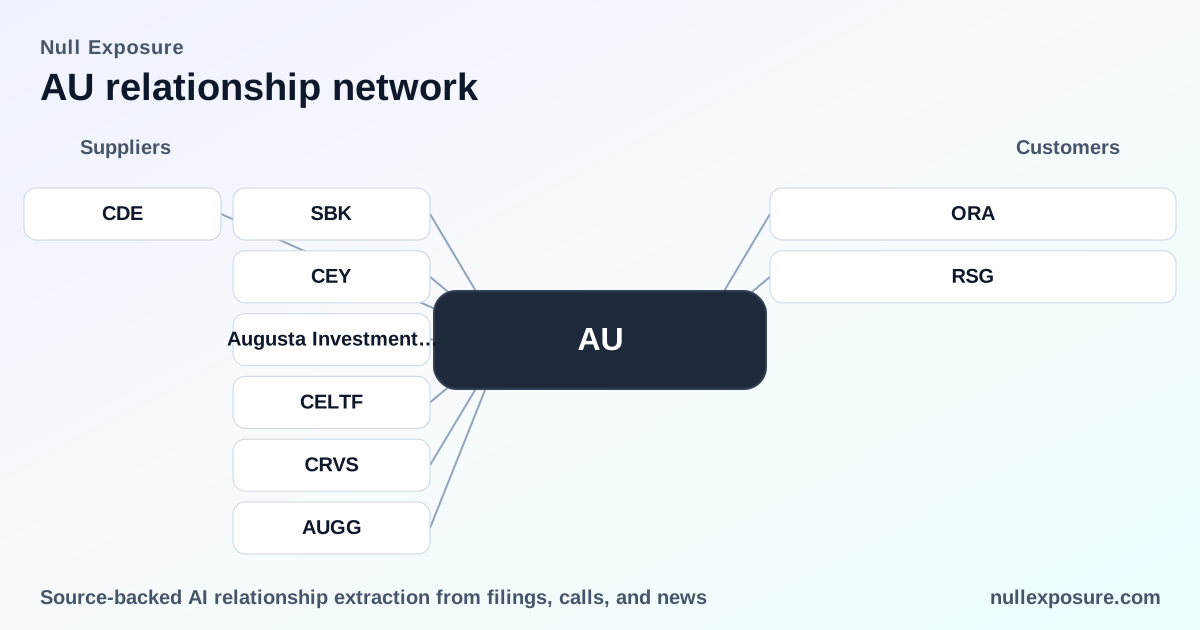
AngloGold Ashanti (AU): Who buys its assets and why investors should care
AngloGold Ashanti (NYSE: AU) operates as a global gold producer that monetizes through mine production, royalties and selective asset disposals; the company complements operating cashflow with strategic sales of non-core projects to peer miners and royalty holders. With a market capitalization near $45.8 billion and trailing revenue around $9.9 billion, AngloGold’s commercial relationships are transaction-driven and centered on asset transfers, royalties and project partnerships that reshape the company’s geographic footprint and risk profile.
For a concentrated, deal-heavy industry position, understanding counterparties is crucial for investors. If you want a concise view of counterparties and what each transaction signals for AngloGold’s strategy, read on. For broader exposure analysis visit https://nullexposure.com/.
What the public record shows about counterparties and transaction types
Below I list every counterparty identified in the provided public records, with a short plain-English description of the transaction or mention and a source reference.
Mineros S.A.
Mineros agreed to acquire a gold exploration project in the Tolima department of Colombia from an AngloGold Ashanti subsidiary, illustrating AngloGold’s continued disposal of country- or project-level exploration assets to regional miners. Source: Pulse2 news report, May 2, 2026 — https://pulse2.com/mineros-10-million-acquisition-of-tolima-gold-exploration-project-from-anglogold-ashanti/
Agnico Eagle Mines (AEM)
A GoldSilver industry piece referenced Agnico Eagle’s acquisition of Aurion Resources for C$481 million, but the excerpt does not record a transaction between AngloGold and Agnico Eagle; the mention appears in the AU results corpus without indicating a buyer-seller relationship to AngloGold in this citation. Source: GoldSilver industry news, May 2, 2026 — https://goldsilver.com/industry-news/goldsilver-news/gold-is-down-19-percent-this-3-8b-bet-says-it-doesnt-matter/
Resolute Mining Limited (RSG)
Resolute acquired the Doropo and ABC gold projects in Côte d’Ivoire from AngloGold for $150 million, representing a material regional divestiture and demonstrating AngloGold’s use of asset sales to refocus portfolio exposure in West Africa. Source: SimplyWallSt coverage of AngloGold, March 9, 2026 — https://simplywall.st/stocks/us/materials/nyse-au/anglogold-ashanti
Aura Minerals Inc. (ORA)
Aura Minerals completed the acquisition of Mineração Serra Grande S.A. from AngloGold, a transaction consistent with AngloGold’s pattern of divesting operating assets to mid-tier buyers and reallocating capital. Source: SimplyWallSt coverage of AngloGold, March 9, 2026 — https://simplywall.st/stocks/us/materials/nyse-au/anglogold-ashanti
Triple Flag Precious Metals (TFPM)
Triple Flag’s public commentary and earnings calls reference a 1% on‑title royalty held by Triple Flag over the Arthur project in Nevada and AngloGold’s designation of Arthur as a “marquee asset.” AngloGold’s near-term release of a pre-feasibility study (PFS) for Arthur represents an operational catalyst for the royalty holder and a valuation inflection for AngloGold’s project pipeline. Sources: Yahoo Finance commodity report, May 4, 2026 — https://finance.yahoo.com/markets/commodities/articles/triple-flag-precious-metals-updates-070647271.html; TFPM Q4 2025 earnings call transcript, March 7, 2026; TFPM commentary cited in InsiderMonkey, March 10, 2026 — https://www.insidermonkey.com/blog/triple-flag-precious-metals-corp-nysetfpm-q4-2025-earnings-call-transcript-1699676/
Harmony Gold Mining Co. Ltd. (HMY)
Regulatory and trade press reported that conditions were met for Harmony Gold’s purchase of AngloGold’s remaining South African mines, marking a major domestic divestment that reduces AngloGold’s South African operating footprint and transfers local production obligations. Source: Engineering & Mining Journal (E&MJ), March 10, 2026 — https://www.e-mj.com/breaking-news/anglogold-ashanti-receives-approval-for-sale-of-south-african-mines/
(Records provided contained duplicate listings for some counterparties; each unique counterparty above is covered once.)
What these counterparty patterns tell investors about AngloGold’s operating model
The collected transactions and mentions reveal a clear, repeatable commercial posture:
- Contracting posture — transactional and asset-level. AngloGold predominantly executes single‑asset sales, royalty arrangements and project transfers rather than long-term supply contracts; counterparties are buyers of assets or holders of royalty interests.
- Concentration — diversified buyer set but concentrated transactions. Buyers range from regional miners (Mineros), mid‑tier acquirers (Aura, Resolute) to royalty companies (Triple Flag) and major South African peers (Harmony). This provides diversification across counterparty type while AngloGold concentrates capital into a smaller set of strategic portfolio moves.
- Criticality — asset sales are strategically material. Dispositions such as the Côte d’Ivoire projects and South African mines materially change AngloGold’s regional exposures and operating cashflow profile, signaling active portfolio reshaping rather than opportunistic divestitures.
- Maturity — counterparties are established market participants. Acquirers and royalty holders in these records are listed, established companies capable of closing complex mining transactions, reducing execution risk on the buyer side but transferring operating, permitting and regional risks off AngloGold.
- Data disclosure signal. The provided records do not include relationship-specific contractual terms or long-term customer contracts; that absence is itself a company-level signal that AngloGold’s public disclosures emphasize strategic transactions and project milestones over granular counterparty contract detail.
Investment implications and near-term catalysts
- Portfolio refocus is driving realized value. Asset sales to Resolute, Aura and Harmony crystallize value from legacy operations and redeploy capital into prioritized projects or returning cash to shareholders.
- Royalties and PFS timelines matter. The Arthur project PFS is an explicit catalyst: a favorable PFS will unlock valuation for AngloGold and increase the present value of Triple Flag’s royalty interest.
- Counterparty mix reduces single-buyer concentration risk. AngloGold’s counterparty set spans regional and international buyers, limiting counterparty concentration, but divestitures create execution and reinvestment risk — the company must redeploy proceeds effectively.
- Watch for further divestitures and PFS outcomes. Additional asset sales or project studies will provide clear signals on management’s capital allocation and operational priorities.
Bold takeaways for portfolio managers: AngloGold is executing an asset-recycling playbook that reduces legacy regional exposure while monetizing exploration upside through royalties and project sales. The company’s counterparties are credible market participants, which mitigates transaction execution risk but leaves investors dependent on management’s ability to redeploy capital and realize project-level milestones such as the Arthur PFS.
For a deeper exposure and counterparty map of AngloGold’s public relationships and to monitor new transactions in real time, see https://nullexposure.com/.