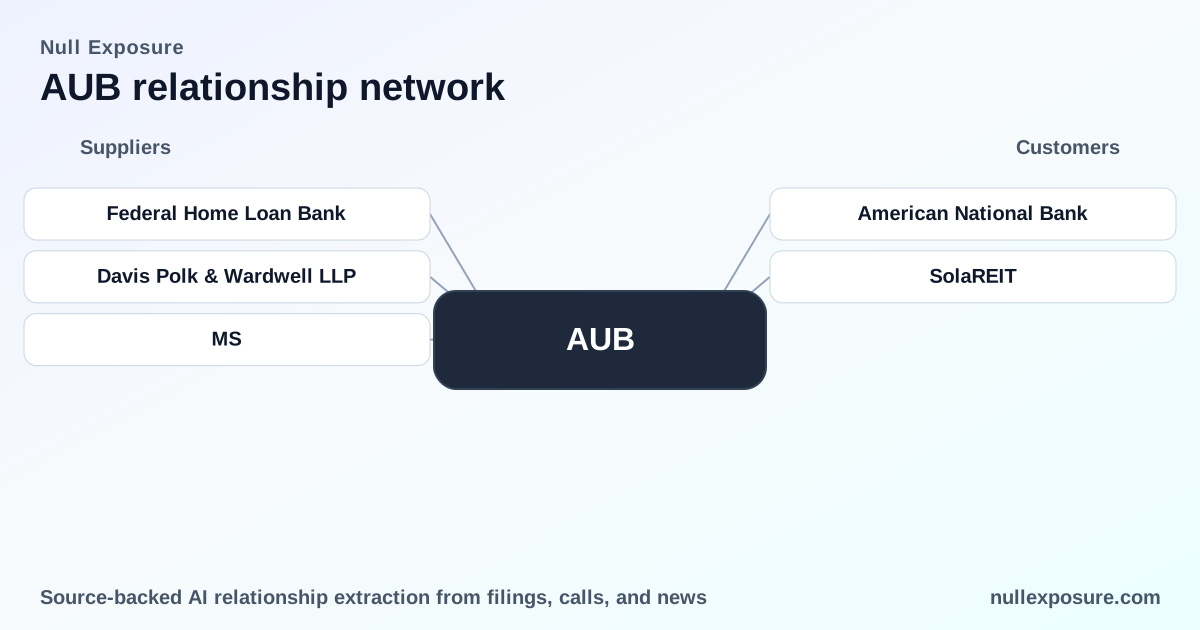
Atlantic Union Bankshares (AUB): Customer Relationships that Drive Fee and Credit Economics
Atlantic Union Bankshares is a regional bank holding company that monetizes through net interest income on a portfolio concentrated in commercial real estate (CRE) and through fee income from deposit services, treasury management, and asset servicing. AUB earns recurring margin by originating and retaining loans, syndicating or selling loans to manage balance-sheet concentration, and capturing fees as a principal on deposit and servicing relationships. For investors, the mix of retained credit exposure, active loan sales, and wholesale lending partnerships defines both earnings upside and concentration risk. Learn more at https://nullexposure.com/.
How Atlantic Union runs its customer franchise — what the operating signals say
Atlantic Union is a classic regional bank: geographically concentrated across Virginia, parts of Maryland and the Carolinas, with a full-service branch footprint complemented by wholesale and equipment finance capabilities. The company’s disclosures and market activity generate a consistent set of operating signals:
- Contracting posture: AUB runs a mix of short-term commercial contracts for deposit and service fees and uses structured, time-bound arrangements when managing capital (for example, forward sale agreements referenced in filings). This supports near-term liquidity and fee realization rather than multi-decade service lock-ins.
- Concentration: CRE is the single largest loan-type concentration for the bank, making loan-level credit economics and secondary-market dispositions core to risk management.
- Counterparty mix and criticality: Customers span individuals, small businesses, and large enterprises; the bank plays the role of both seller (loan originations and portfolio dispositions) and service provider (deposit processing, treasury services, swaps and hedging facilitation).
- Maturity and stage: Relationships are predominantly active and transactional, with ongoing fee flows and periodic capital-market actions (syndications, credit facility expansions, loan sales) to manage balance-sheet composition.
These company-level signals should frame your view of the counterparties covered below.
Deal-by-deal relationship review — what matters to credit and fee profiles
American National Bank — an acquisition that expands the deposit and lending footprint
Atlantic Union completed the acquisition of American National (the holding company for American National Bank and Trust Company) on April 1, 2024, a transaction that materially increased branch and loan exposure in the bank’s markets. According to Atlantic Union’s FY2024 10‑K, the American National acquisition closed April 1, 2024 and is now part of AUB’s consolidated operations (FY2024 10‑K filing).
Blackstone Real Estate Debt Strategies (BREDS) — strategic loan sale to reduce CRE concentration
Atlantic Union sold approximately $2 billion of performing commercial real estate loans to Blackstone Real Estate Debt Strategies, a large institutional CRE debt buyer, demonstrating active portfolio risk management and a willingness to transact large blocks to reduce concentration. This transaction was reported in a fintechfutures article in May 2026 detailing the sale of the performing CRE loans (fintechfutures, May 2026).
SolaREIT — renewable infrastructure lending and syndicated revolving credit
SolaREIT expanded its revolving credit facility to $80 million with increased commitments from Atlantic Union Bank and syndication partner EagleBank, showing AUB’s participation in specialized asset-backed lending to renewable energy REITs. Multiple press releases (SolaREIT press release and syndicated coverage in March 2026) reported the $80 million facility increase and Atlantic Union’s role in the expanded credit line (SolaREIT press release, March 2026).
Sandy Spring Bank — legacy customer flows and interest-rate swap income
About 27% of interest-rate swap income in Atlantic Union’s quarter was attributable to former Sandy Spring customers, indicating that the Sandy Spring transaction and customer migration materially influence derivatives and fee income streams for the bank. This detail comes from the Q4 2025 earnings call transcript published on Investing.com (earnings call transcript, Q4 2025).
Note: Atlantic Union’s October 2024 merger activity with Sandy Spring also triggered capital-market actions tied to forward sale agreements, which are disclosed in the company filing and reflect short-term contractual settlement mechanics associated with that transaction (company 2024 disclosure).
DLHC transaction (arranger role) — AUB as a capital markets participant
In the DLHC-related financing, Atlantic Union acted as a joint lead arranger alongside other regional banks for acquisition financing, highlighting AUB’s participation in syndicated, middle‑market capital markets activity. The role as joint lead arranger is noted in a 2022 press release about the transaction where First National Bank of Pennsylvania acted as agent and Atlantic Union Bank was a joint lead arranger (GlobeNewswire, Dec 2022).
What these relationships imply for investors
- Active balance-sheet management: The $2 billion CRE sale to BREDS is a clear execution of de-risking strategy; investors should view AUB as prepared to use capital markets to trim concentrations rather than passively hold to maturity. This reduces near-term CRE concentration but shifts earnings composition toward fee recognition and potential lower recurring NII if loans are not replaced.
- Fee-income diversification via treasury and derivative flows: The Sandy Spring customer flows that produced a material share of swap income show derivatives and treasury services as meaningful fee contributors, not just loan yield—important when modeling noninterest income stability.
- Targeted sector lending (renewables): The SolaREIT facility flags a strategic tilt into renewable infrastructure-backed lending, which can generate attractive spreads but introduces sector and collateral specificity to underwriting risk.
- Regional footprint and borrower profile: AUB’s business remains regionally concentrated in North America (primarily Mid‑Atlantic and Southeast states), exposing performance to localized economic cycles and CRE market conditions in those jurisdictions.
Risk and concentration checklist for operators and researchers
- CRE remains a material exposure—monitor subsequent loan sales, charge-off trends, and underwriting caveats in new originations.
- Counterparty breadth includes individuals, small businesses, and large enterprise participants; underwriting standards across these segments determine aggregate credit volatility.
- Contracting posture is transactional and often short-term for many fee streams; revenue continuity depends on customer retention and periodic syndication activity.
- Balance-sheet flexibility is higher when AUB can access capital-market counterparties (e.g., Morgan Stanley forward sales, large institutional buyers like BREDS) to shift exposures quickly.
For a concise, data-driven read on specific counterparties and recent transactions, visit https://nullexposure.com/.
Bottom line
Atlantic Union operates as a regional bank that actively manages concentration via loan sales and syndications while deriving meaningful fee income from treasury, swaps, and deposit services. Investors should weigh the trade-off between reduced CRE concentration and the potential for lower recurring interest income, against the upside from fee diversification and capital-markets responsiveness.