Atlantic Union (AUB-P-A) — customer relationships that move the lending ledger
Atlantic Union (AUB-P-A) operates as the preferred-equity instrument of a REIT-focused banking and financing ecosystem: the bank monetizes through commercial lending, syndicated credit facilities, and interest-rate sensitive products such as swaps, and that cashflow underpins returns for preferred holders. The relationships disclosed in the customer feed show a concentrated set of commercial credit and derivative income touchpoints that drive fee and interest income, and therefore are material to underwriting the preferred instrument’s risk profile. Learn more about how customer relationships change credit dynamics at https://nullexposure.com/.
Why customers matter for a bank-backed REIT security
Banks that serve real estate operators generate revenue in three linked ways: interest income on loans and credit lines, fee income from syndications and advisory, and trading/derivatives income tied to rate hedging. For Atlantic Union, the customer mentions in the feed highlight precisely those levers—an expanded revolving facility and tangible swap-related income—both of which translate into predictable cash flows or episodic gains for the bank’s earnings stream that back preferred security coverage.
- Credit facilities produce recurring interest and fee income and also create counterparty exposure to real estate borrower performance.
- Interest-rate swap income indicates active risk management and trading revenues that are sensitive to balance-sheet positioning and market rates.
- Concentration in a few large counterparties increases earnings volatility and credit risk if a borrower or cohort underperforms.
What the customer list tells an investor about Atlantic Union’s posture
Atlantic Union is operating as a relationship lender to specialized real estate operators, participating both as lead lender and syndication partner. The evidence in the customer feed implies a contracting posture oriented toward secured, revolving credit facilities and derivative arrangements, with revenue concentration risks tied to major counterparties and to the bank’s swap book. This positions the firm as a mid-market commercial bank with direct exposure to real estate finance cycles—a structural feature investors should price into preferred security spread requirements.
Detailed relationship breakdown (each documented customer)
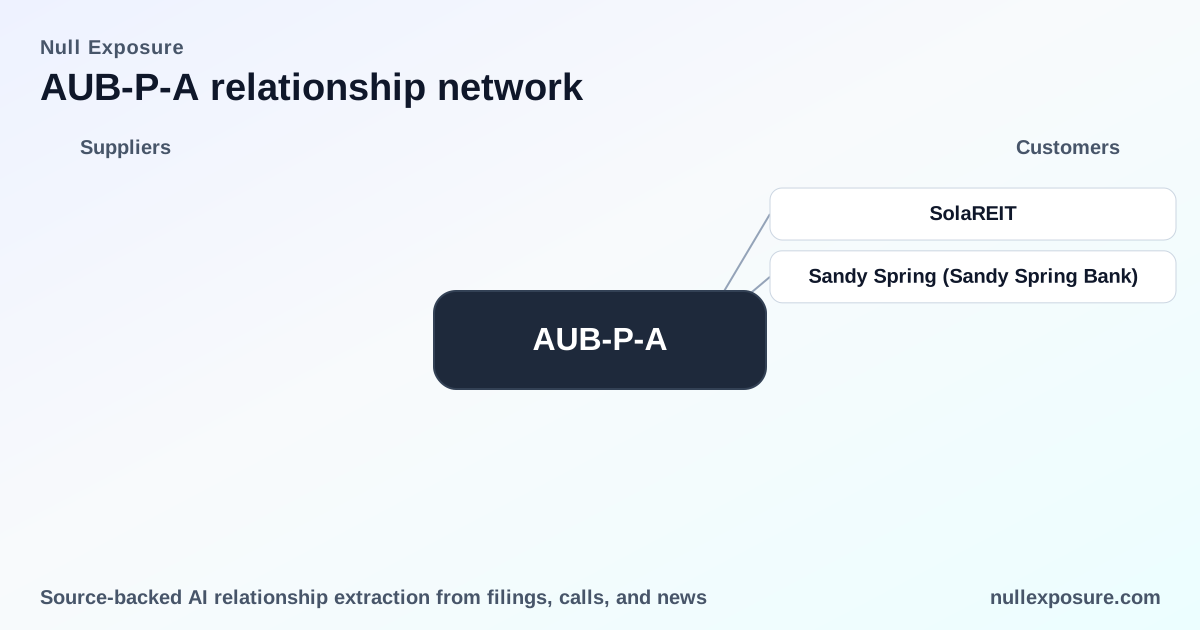
SolaREIT — SolaREIT expanded its revolving credit commitment to $80 million with Atlantic Union and EagleBank in March 2026; this shows Atlantic Union acting as a lead lender and syndication partner on growth-stage renewable-asset real estate finance. According to StockTitan’s March 9, 2026 coverage and related 8‑K filings, the facility increase was publicly announced with Atlantic Union named among the lending group.
Sandy Spring (Sandy Spring Bank) — A portion of Atlantic Union’s interest-rate swap income in the quarter was directly attributed to portfolios originating with former Sandy Spring customers, representing roughly 27% of swap income for that period. The detail comes from the Q4 2025 earnings-call transcript published on InsiderMonkey, which noted the outsized share of swap income attributable to that customer cohort.
What these relationships mean operationally and for underwriting
- Contracting posture: Atlantic Union demonstrates an active role in revolving credit facilities and syndicated lending, implying standard loan covenants, collateralized structures, and ongoing credit monitoring rather than purely transactional, one-off deals.
- Concentration: The customer feed shows material revenue lines tied to a small number of counterparties (e.g., SolaREIT and a significant share of swap income from former Sandy Spring customers), indicating concentrated earnings and credit exposure that require active portfolio oversight.
- Criticality: Lending to specialized REITs and generating swap income is core to the bank’s earnings profile; disruptions in these relationships would have a direct impact on interest and non-interest income.
- Maturity and relationship depth: The presence of syndicated facilities and recurring swap income indicates multi-year, contractual relationships rather than shallow, transactional engagements—useful when modeling probability of default and recovery timing for credit instruments.
Note: There are no explicit constraints listed in the customer-scope feed for AUB-P-A; the operating signals above are derived from the relationship evidence and are presented as company-level observations.
Key takeaways for investors and operators
- Syndicated credit exposure is a primary revenue engine. The SolaREIT $80 million expansion is concrete evidence Atlantic Union underwrites and scales credit facilities for asset-specialized REITs, driving recurring interest and fee income (StockTitan / 8‑K, March 2026).
- Derivatives income is a material earnings vector. The disclosure that about 27% of swap income stemmed from former Sandy Spring customers highlights that swaps and hedging positions contribute meaningfully to quarterly results (InsiderMonkey, Q4 2025 transcript).
- Earnings and credit concentration increase sensitivity to real estate cycles. A narrow set of large counterparties can amplify earnings volatility and credit risk during market stress; model scenarios should stress both loan performance and derivative valuation shifts.
Risk considerations and monitoring checklist
Investors should monitor:
- Covenant performance and utilization trends on major facilities (e.g., SolaREIT revolver utilization and covenant breaches).
- Swap portfolio marks and counterparty composition, given the swap-income concentration tied to former Sandy Spring customers.
- Syndication appetite and secondary-market demand for these loans, which affects primary lender risk retention and capital consumption.
For proactive monitoring, subscribe to issuer filings and timely coverage of material events like 8‑Ks and earnings call transcripts that document facility changes and income attribution.
Conclusion — how to act on this information
Atlantic Union’s customer footprint in the recent feed identifies credit and derivatives exposure to specialized real estate operators as the levers driving earnings that support preferred securities. For investors in AUB‑P‑A, the principal focus should be credit quality of syndicated borrowers and the bank’s hedging book composition, both of which determine distributable capacity and preferred coverage. For a deeper view into how customer relationships change issuer credit profiles, visit https://nullexposure.com/.
Sources referenced in-text: StockTitan and related SEC 8‑K coverage on March 9, 2026 (SolaREIT facility expansion); InsiderMonkey earnings-call transcript covering Q4 2025 (swap income detail).