Ault Alliance (AULT‑P‑D) — Customer Relationship Intelligence and Investment Thesis
Ault Alliance operates as an acquirer and financial counterparty for distressed and affiliated businesses, monetizing through targeted asset purchases, short‑term financing (including debtor‑in‑possession loans), and securities transactions such as convertible preferreds and warrants. The company’s revenue and capital deployment profile is defined by concentrated, high‑purpose transactions rather than broad, recurring customer contracts, so investors should evaluate Ault Alliance by tracking discrete deals, related‑party exposure, and governance signals. For ongoing monitoring and indexed relationship feeds, see our coverage at https://nullexposure.com/.
How the three recent customer relationships frame the business model
The most recent public items show Ault Alliance operating as a deal‑maker and liquidity provider: purchasing securities, underwriting asset acquisitions, and extending DIP financing while engaging with entities described as related parties. Collectively these items indicate a contracting posture that favors opportunistic, concentrated commitments with high leverage on individual outcomes rather than diversified recurring revenue.
Ault & Company, Inc. — securities transfer between affiliates
According to Investing.com (May 2, 2026), Ault Alliance sold 300 shares of Series C convertible preferred stock and accompanying warrants to Ault & Company, Inc. for a total of $300,000 (FY2024 reporting context). This transaction is a direct securities transfer between closely related entities and highlights capital redeployments inside the group and potential intra‑company liquidity management. (Source: Investing.com, May 2, 2026 — https://www.investing.com/news/company-news/ault-alliance-executive-chairman-buys-shares-worth-312-93CH-3582363)
Avalanche International Corp. — large related‑party purchase order disclosed in legal filings
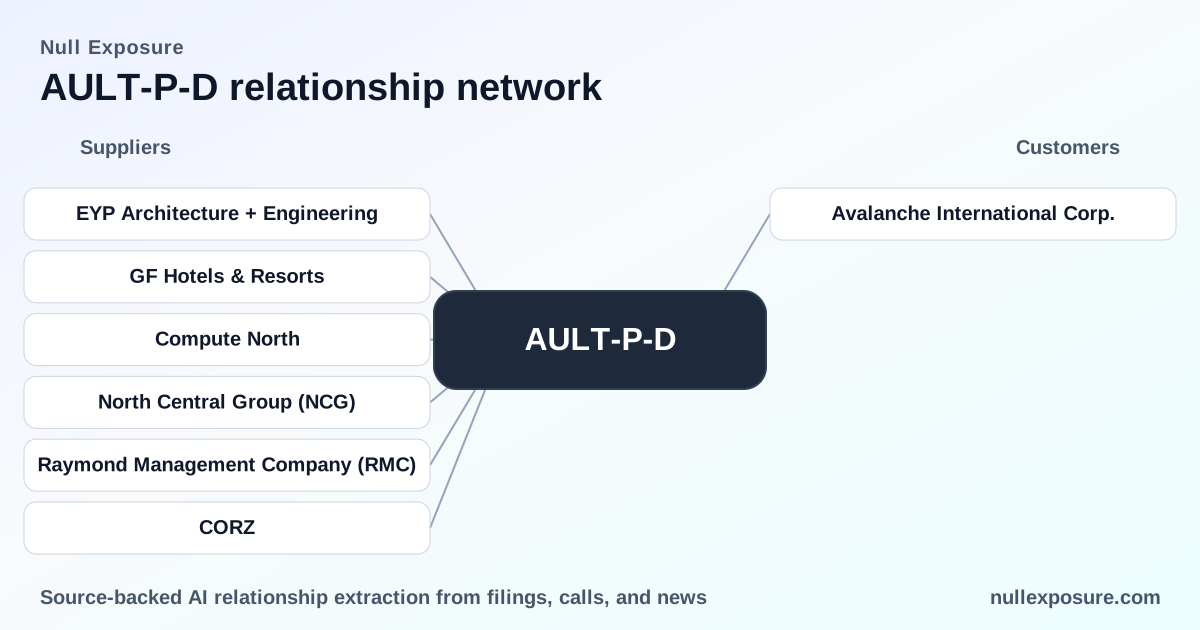
Bloomberg Law reported (March 2026) that a prior disclosure included a $50 million purchase order from a “related party” identified as Avalanche International Corp. The reporting context was a securities disclosure matter that culminated in an executive settlement, and the purchase order’s size signals material counterparty concentration when disclosed alongside governance and disclosure scrutiny. Investors should treat large related‑party orders as a core risk vector for revenue volatility and reputational exposure. (Source: Bloomberg Law, March 9, 2026 — https://news.bloomberglaw.com/securities-law/ault-alliance-execs-pay-956-000-to-settle-sec-disclosure-case)
EYP Group Holdings — asset acquisition and DIP financing
Engineering News‑Record reported that EYP Group Holdings proposed selling its assets to Ault Alliance for $67 million, and that Ault would provide $5 million in debtor‑in‑possession (DIP) financing as part of the bankruptcy plan (FY2022 context). This demonstrates Ault Alliance’s role as both purchaser and pre‑emergence creditor in distressed restructurings, which creates upside if the asset sale and turnaround succeed but also concentrates downside exposure into bankruptcy‑stage wagers. (Source: ENR, May 2026 — https://www.enr.com/articles/54045-financially-distressed-designer-eyp-group-seeks-bankruptcy-protection)
What these relationships imply about operating posture and business model constraints
- Contracting posture: The company executes high‑intent, event‑driven contracts rather than commodity supply deals. Equity transfers, DIP loans, and asset purchases show a posture of capital deployment into single‑counterparty or related‑party transactions that are transactional and outcome‑dependent.
- Counterparty concentration: The existence of a $50 million purchase order from a related party and a $67 million asset purchase proposal indicates material concentration risk at the deal level; a small number of outcomes will disproportionately affect financial results.
- Criticality: Ault Alliance functions as a strategic counterparty in distressed situations — DIP financing and direct asset acquisition make the company a critical participant for sellers or debtors in bankruptcy contexts. That criticality creates negotiating leverage but also ties balance‑sheet performance tightly to successful turnarounds.
- Maturity and instrument mix: Use of convertible preferreds and warrants in intra‑group transfers shows flexible capital structuring consistent with an investor/manager model rather than a pure operating company. These securities can expand equity exposure if exercised and also signal staged liquidity strategies.
- Governance and disclosure sensitivity: The Bloomberg Law coverage tying a large related‑party purchase order to an SEC disclosure settlement introduces an elevated governance constraint — markets will price-in disclosure risk and the potential for regulatory remediation costs.
Risk profile and monitoring checklist for investors
Investors and operators should prioritize monitoring the following items for Ault Alliance:
- Related‑party deal terms and scale: Track whether the $50 million Avalanche purchase order is recurring or one‑off and whether similar related‑party placements appear in subsequent filings.
- Outcomes of distressed asset plays: Follow progress and valuation realization on the EYP transaction and the performance of assets post‑acquisition; DIP exposure is junior to bankruptcy risk models.
- Dilution and capital structure changes: Monitor conversion features and warrant exercises arising from intra‑group preferred sales that can dilute common holders or reallocate economic upside.
- Regulatory developments and disclosure remediation: Watch follow‑on SEC filings and any further enforcement activity that could increase disclosure costs or impose operational constraints.
- Cash flow timing and concentration: Because revenue from these relationships is lumpy, confirm liquidity buffers and sources of near‑term funding to avoid forced asset sales.
For a consolidated feed of relationship signals and to model counterparty concentrations across event‑driven transactions, consult our analysis hub at https://nullexposure.com/ for institutional tools and commentary.
Tactical implications for allocations and operations
- For investors: Treat Ault Alliance as a deal‑driven investment with returns hinging on the success of individual acquisitions, recoveries from DIP loans, and the realization of securities sold internally. Position sizing should reflect the company’s concentrated counterparty exposure and governance risk.
- For operators and counterparties: Negotiate clear covenants and transparent reporting in any transaction, especially where related parties are involved. Demand clarity on valuations, milestone triggers for payments, and protections against unilateral dilution from convertible instruments.
Bottom line
Ault Alliance’s recent customer‑facing transactions—internal preferred and warrant transfers, a large related‑party purchase order, and a DIP‑backed asset acquisition—constitute a coherent strategy of concentrated, opportunistic capital deployment. The upside comes from successful restructurings and asset turnarounds; the primary risks are counterparty concentration and elevated disclosure/governance scrutiny. Investors should evaluate Ault Alliance through the lens of deal outcomes and regulatory transparency rather than recurring revenue multiples.