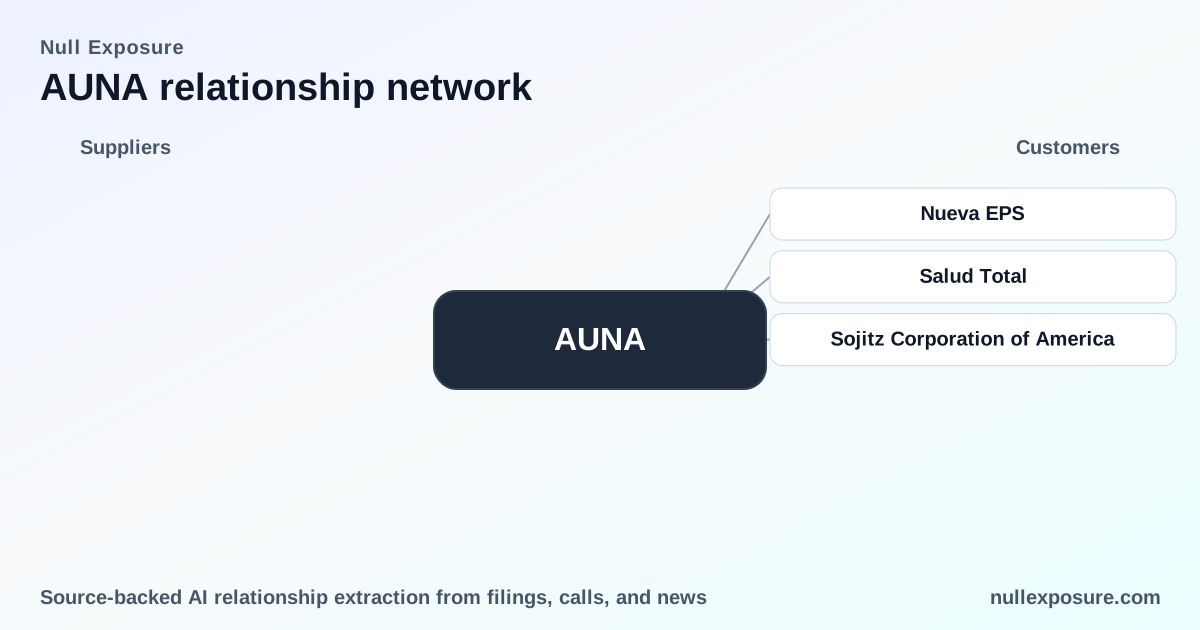
Auna’s customer relationships: payer dynamics, revenue concentration, and what investors need to know
Auna operates as an integrated healthcare operator in Latin America that monetizes primarily through fee-for-service patient care reimbursed by public and private payers, supplemented by direct-pay services and ancillary digital offerings. Revenue is driven by service volumes, payer contract coverage and collections velocity; Auna’s most material short-term sensitivity is the timing and quality of payer reimbursements rather than product pricing or subscriber churn. According to company financials through the latest quarter ending 2026-03-31, Auna reported trailing twelve‑month revenue of $4.385 billion and a slim profit margin of 2.23%, underscoring how cash collection and receivables management directly flow to the bottom line. For further context on Auna’s business model and monitoring tools, see https://nullexposure.com/.
Business model in one line: Auna captures value by providing clinical services and billing payers; operational economics hinge on payer mix, contract structure, and receivables performance.
Why these customer relationships matter
- Payer payment timing drives provisions and working capital. In the company’s Q2 2025 earnings call management highlighted that lower impairment provisions reflected timely receipt of outstanding payments from a major payer. This makes receivable dynamics a principal operational lever for margin improvement.
- New contracts convert to top-line growth when payment and network access are secured. A recently started PGP contract was cited as a near-term revenue catalyst in Colombia.
- Strategic partnerships can diversify exposure and support expansion outside core markets. A collaboration with an international trading / investment partner signals non-core partnership activity that could support capital or supply chain initiatives.
Key operating signals (company-level)
- Contracting posture: Auna operates with payer-dependent contracting, where a small set of large payers can materially affect cash flow and provisions when payments move. This is a company-level signal coming from management commentary on receivables and impairments.
- Concentration and criticality: Concentration risk is present—management singled out the largest intervening payer when discussing impairment reversals—so collections from a handful of payers matter disproportionately to working capital.
- Maturity and stability: Relationships with established national payers and an international corporate collaborator indicate mature contracting relationships rather than nascent, one-off partnerships.
- Collection sensitivity: Because impairment provisions fluctuate with receipts, collections cadence is a primary operational risk and lever for investors assessing short-term earnings volatility.
A closer look at every cited relationship Below I summarize each customer or partner Auna referenced in public calls, with the precise call citation for verification.
Nueva EPS — the largest intervening payer
Management flagged that timely receipt of outstanding payments from Nueva EPS materially reduced provisions for impairment losses in the quarter, implying Nueva EPS is a principal payer for which collections materially affect working capital and reported provisions. This comment was made on Auna’s Q2 2025 earnings call (transcript first reported March 8, 2026). According to that call, adjustments to impairment provisioning were directly tied to cash receipts from Nueva EPS, signaling a high degree of revenue and collection dependence on this payer.
Salud Total — new PGP contract driving near-term revenue
Auna announced that it began serving Salud Total in Colombia under a PGP contract effective July 1, and management expects this agreement to incrementally contribute to top-line growth in upcoming quarters. This was disclosed on the same Q2 2025 earnings call (transcript first reported March 8, 2026), where management explicitly identified Salud Total as a contract win and a source of expected revenue acceleration as the contract scales.
Sojitz Corporation of America — strategic collaboration outside core payer set
Management referenced a collaboration with Sojitz Corporation of America, indicating a strategic, non-payer relationship that could support supply chain, financing, or market expansion objectives. This mention came on Auna’s Q3 2025 earnings call (transcript first reported March 7, 2026). While the call did not provide transactional detail, the partnership signals Auna is engaging international corporate partners for strategic projects beyond routine payer billing.
What the relationship set implies for investors
- Earnings sensitivity to collections: Auna’s public comments tie impairment provisions and near-term earnings to payer payment timing; expect short-term earnings to track receivable receipts rather than service volumes alone.
- Concentration risk with offsetting growth levers: Large-payer dependence (Nueva EPS) creates concentration risk, but new contracts (Salud Total) and international partners (Sojitz) provide pathways to diversify revenue and reduce single-payer impact over time.
- Operational focus required: Management must maintain tight receivables management and active payer relationship governance to protect margins and reduce volatility from provisions.
Risks and monitoring checklist for analysts
- Track quarterly changes in provisions for impairment losses and reconcile them to cash receipts from named payers in earnings transcripts.
- Monitor the rollout and utilization metrics tied to the Salud Total PGP contract to confirm the translation of contract wins into realized revenue.
- Watch for further disclosures on the Sojitz collaboration—specifically, whether it involves capital deployment, sourcing, or market entry support that could change capital intensity or growth profile.
Conclusion and investor action Auna’s revenue profile is payer-driven and collection-sensitive, with clear evidence that a small number of relationships materially influence working capital and earnings. Investors should treat receivables performance and the operational execution of new payer contracts as primary drivers of short-term returns. For ongoing monitoring of customer-level risk and to access updated relationship intelligence, visit https://nullexposure.com/.
Key takeaway: Auna’s near-term financial performance will be decided by payer payments and how quickly newly contracted volumes (e.g., Salud Total) convert to cash rather than by marginal changes in pricing or product mix.