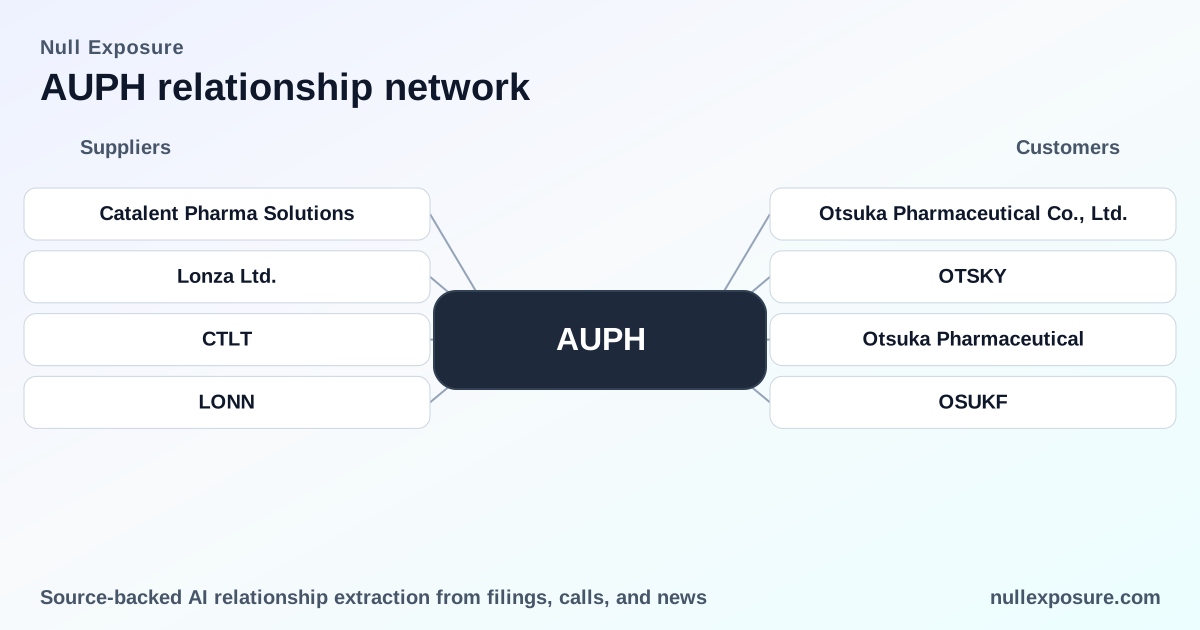
Aurinia Pharmaceuticals (AUPH): The Otsuka Customer Profile and What It Means for Investors
Aurinia Pharmaceuticals monetizes its platform primarily through sales of LUPKYNIS (voclosporin) and related manufacturing and supply agreements, selling directly to U.S. specialty pharmacies and a specialty distributor while supplying inventory and semi‑finished product to its ex‑U.S. commercialization partner, Otsuka. Revenue is driven by product sales, collaborative commercial arrangements and fee income from manufacturing services, with the Otsuka relationship central to Aurinia’s non‑U.S. reach and recurring international revenue. For investors evaluating customer concentration, commercial durability and operational risk, the Otsuka link is the single most material external customer relationship. Learn more at https://nullexposure.com/.
How Aurinia makes money and why the Otsuka link matters to valuation
Aurinia’s public filings and recent investor communications show a two‑pronged commercialization model: direct U.S. distribution through specialty pharmacies and a distributor, and territorial licensing/commercial supply to Otsuka for Japan and the E.U. The company also performs manufacturing and supply services tied to those agreements, which turns capacity and production into a revenue line in addition to finished‑product sales.
This structure gives Aurinia predictable unit economics in markets it controls, while outsourcing mid‑ and long‑tail international commercialization risk to Otsuka. That tradeoff reduces Aurinia’s marketing spend outside the U.S. but concentrates a portion of international revenue and inventory flow through a single partner, making Otsuka strategically important to growth and geographic diversification.
Operational constraints and what they signal about risk and resilience
Aurinia’s relationship signals and disclosures imply a defined operating posture:
- Geographic concentration in the U.S. for direct sales is a clear company‑level signal: financial reporting and filings record substantial U.S. revenue and explicit sales to two specialty pharmacies and a specialty distributor in the U.S., underpinned by third‑party logistics arrangements that handle order‑to‑cash. This operational design supports efficient U.S. distribution but raises exposure to U.S. payer dynamics and specialty pharmacy channel changes.
- Seller and service provider roles coexist: Aurinia both sells finished product and performs manufacturing/supply services for partners, which diversifies revenue sources but also anchors operational complexity in manufacturing and supply chain management.
- Active, ongoing commercialization: The company classifies these flows as active; its disclosures and earnings commentary indicate current shipments of finished and semi‑finished product to partners and channels, not a terminated or dormant arrangement.
Collectively these constraints point to a mature commercial posture for LUPKYNIS: established U.S. channels, concentrated international partnership exposure, and an integrated manufacturing‑to‑supply chain that is material to near‑term cash flow and operational execution.
Line‑by‑line: every relationship mention in the record
Below are all relationship entries from the review, presented as concise, investor‑facing summaries with source context.
-
Otsuka Pharmaceutical Co., Ltd. (10‑K, FY2024) — Aurinia states in its FY2024 Form 10‑K that it sells LUPKYNIS inventory to Otsuka for the European and Japanese markets, confirming a formal commercial supply relationship outside the U.S. (Aurinia FY2024 10‑K).
-
Otsuka Pharmaceutical Co., Ltd. (Biospace press release, Q3 and nine months 2024) — A Biospace press release summarizing Aurinia’s Q3/9‑month 2024 results reports sales of semi‑finished product to Otsuka to support continued commercialization in Otsuka’s territories, indicating ongoing supply of intermediate goods (Biospace, 2024 results press release).
-
Otsuka Pharmaceutical Co., Ltd. (MarketScreener, FY2025 event coverage) — MarketScreener noted that Aurinia sells LUPKYNIS primarily to specialty pharmacies and a specialty distributor, and directly to its ex‑U.S. partner Otsuka, restating the mix of direct U.S. channels and partner shipments (MarketScreener, 2025).
-
OTSKY (MarketScreener earnings flash, FY2026) — An earnings flash reiterated that Aurinia sells LUPKYNIS primarily to specialty pharmacies, a specialty distributor and directly to Otsuka, reflecting the company’s quarter‑level revenue composition disclosed in early FY2026 commentary (MarketScreener, FY2026 earnings flash).
-
Otsuka Pharmaceutical Co., Ltd. (MarketScreener, FY2025 presentation note) — Coverage of upcoming presentation activity repeated that Aurinia’s sales flows include direct shipments to Otsuka, used to contextualize clinical data presentations alongside commercial activity (MarketScreener, 2025).
-
Otsuka Pharmaceutical Co., Ltd. / OTSKY (MarketScreener duplicate, FY2026) — A duplicated MarketScreener entry again references direct sales to Otsuka in company commentary around FY2026 results, underscoring the recurring disclosure of that partner relationship (MarketScreener, FY2026).
-
Otsuka Pharmaceutical (SAHM Capital commentary, Jan 2026) — SAHM Capital’s analysis cited Aurinia’s progress in its autoimmune pipeline and reiterated the collaboration with Otsuka to expand global reach, framing Otsuka as a strategic commercialization collaborator for pipeline expansion (SAHM Capital, January 16, 2026).
-
Otsuka Pharmaceutical Co., Ltd. (TradingView SEC 10‑K summary, FY2026) — A TradingView summary of Aurinia’s SEC filing described a collaboration and licensing agreement with Otsuka covering development and commercialization in several territories and a commercial supply agreement that includes inventory provision and manufacturing services (TradingView SEC 10‑K synopsis).
-
Otsuka (Investing.com earnings transcript, FY2026 / Q4 2025 call) — During an earnings call transcript archived on Investing.com, management referenced Otsuka as its partner in Europe and Japan when discussing international market feedback, demonstrating active coordination with the partner on market performance (Investing.com earnings call transcript, Q4/2025).
-
Otsuka / OSUKF (TradingView SEC 10‑Q summary, FY2025) — A TradingView SEC 10‑Q summary reported net product sales of LUPKYNIS to two U.S. specialty pharmacies, a specialty distributor, and to collaboration partner Otsuka for Japan and other international markets, reinforcing the split of direct and partner channels (TradingView SEC 10‑Q synopsis, FY2025).
-
OSUKF (TradingView duplicate, FY2025) — A duplicate TradingView 10‑Q entry repeats the same disclosure of U.S. channel sales and partner shipments to Otsuka, mirroring the prior 10‑Q summary and providing additional corroboration (TradingView SEC 10‑Q synopsis, FY2025).
Key takeaways for investors
- Otsuka is Aurinia’s principal international commercial partner: the relationship covers inventory supply, semi‑finished product and a licensing/commercialization framework—this is central to Aurinia’s international revenue pathway (10‑K and contemporaneous press coverage).
- Revenue is split between direct U.S. channels and partner flows, which reduces Aurinia’s non‑U.S. commercialization burden but creates concentration risk tied to Otsuka’s commercial execution.
- Aurinia also acts as a manufacturer/service provider, adding topline diversification but increasing operational dependency on production capacity and third‑party logistics.
- Financial profile supports commercialization: Aurinia reports positive operating margins and meaningful gross profit on the latest reported trailing twelve‑month numbers, indicating the commercial model is translating to cash generation; however, international growth is dependent on partner performance (Aurinia reported financials, latest quarter).
For a deeper customer map and to monitor changes in Aurinia’s partner exposures, visit https://nullexposure.com/ for integrated relationship intelligence and ongoing updates.
Investors should treat the Otsuka partnership as both a growth enabler and a concentration risk: it widens geographic reach without proportional SG&A but consolidates international revenue through a single external counterparty whose commercial performance is material to Aurinia’s international trajectory.