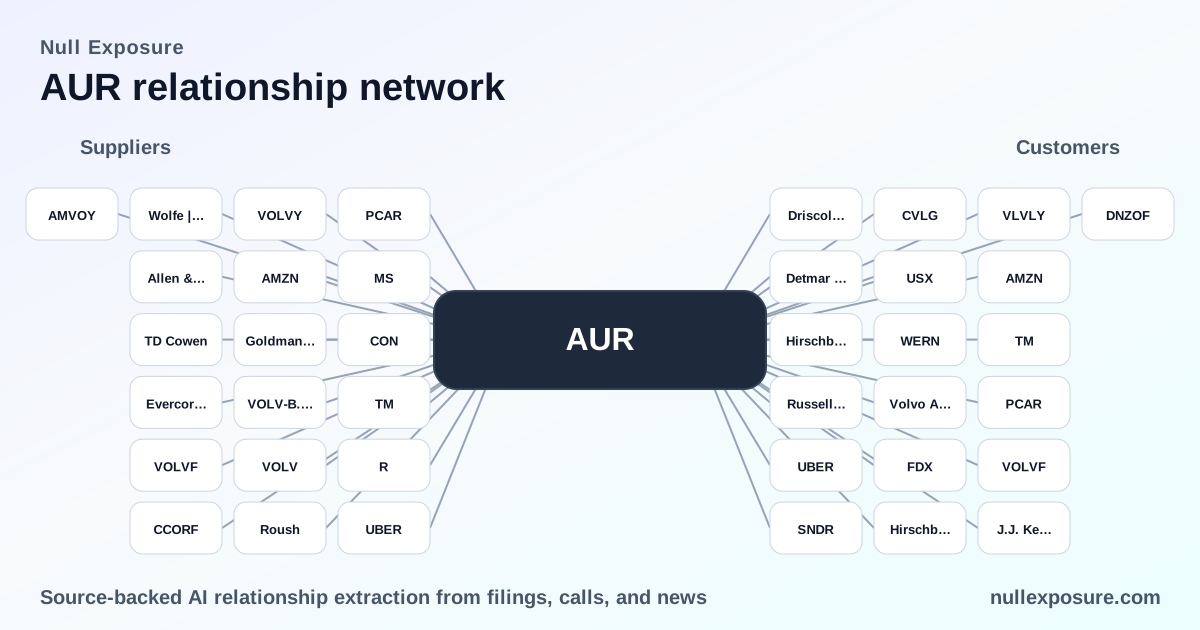
Aurora Innovation (AUR): Customer Map and Commercial Traction
Thesis: Aurora sells the Aurora Driver as a service — primarily a subscription-based, fee-per-mile commercial product for freight (Aurora Driver for Freight) and an emerging rides offering (Aurora Driver for Rides). The company is monetizing through multi-year commercial partnerships, endpoint operations (terminals/lanes), and a multi‑OEM supply strategy that lets Aurora deliver driverless capability while third parties operate and manage fleets. For investors, the key questions are contract economics (subscription + usage), customer concentration, and the speed at which pilots convert into recurring, scalable revenue. Learn more or access our broader coverage at https://nullexposure.com/.
Operating model and commercial constraints
- Aurora positions the Aurora Driver as a Driver-as-a-Service (DaaS) product delivered through subscription offerings (Aurora Driver for Freight and Aurora Driver for Rides), with revenue recognized on commercial loads since mid-2025. Company filings and recent earnings calls frame the business as a services-led model rather than upfront hardware sales.
- Pricing signals and corporate disclosures indicate a usage-aligned revenue mix: the firm expects to earn fees on a per-mile basis or comparable usage metric, which ties revenue growth directly to commercial mileage and lane density.
- Go-to-market is multi-OEM + partner-driven: Aurora supplies the driver stack and integrates across OEM platforms (Volvo, PACCAR/International, Toyota) while carrier partners supply operational capacity and clients.
- Geography is U.S.-first with global aspirations — commercial operations launched in the U.S. with stated intent to expand internationally where regulation and roadways align.
- Relationship posture: Aurora is the seller/operator-of-technology, actively in commercial stage; the company reported recognizing revenue from driverless loads in 2025 and describes these customer relationships as active services engagements in SEC filings and earnings commentary.
Customer roster — who Aurora is actually hauling for (and what that implies) Below I list every customer relationship cited in recent public results and explain the commercial role in plain language, with the source noted for each entry.
-
Hirschbach / Hirschbach Motor Lines / Hirschbach Motor Line
Aurora is operating driverless freight for Hirschbach on multiple Texas lanes and is expanding endpoint operations (Laredo) to support additional customers; management cites Hirschbach as an early adopter and a partner in scaling lanes. Source: Aurora earnings calls (Q3 & Q4 2025) and multiple news reports (FY2025–FY2026). -
Russell Transport
Aurora executed an agreement to run driverless hauls tendered via the McLeod integration, with Russell Transport moving freight on the Fort Worth–El Paso lane. Source: Aurora earnings call (Q3 2025) and StockTitan overview (FY2025). -
Detmar Logistics
Detmar selected Aurora for autonomous transport of frac sand in the Permian Basin and signed a commercial agreement to deploy up to 30 trucks, positioning Aurora in energy-sector logistics. Source: company 8‑K / media coverage and Investing.com (FY2025–FY2026). -
Driscoll’s
Aurora is setting up endpoint operations to support Driscoll’s loads beginning from Hirschbach-operated endpoints in Laredo, indicating expansion into refrigerated/time‑sensitive supply chains. Source: Aurora earnings call (Q4 2025). -
FedEx (FDX)
Aurora is hauling goods autonomously for FedEx on high-volume Texas corridors (I‑45, Dallas–Houston), representing a strategic enterprise customer and a validation point for night and day operations. Source: Dallas Innovates, ABC7, and StockTitan SEC 8‑K (FY2022–FY2025–FY2026). -
Uber Freight / Uber (UBER)
Aurora signed a multi-year collaboration to offer Aurora Driver on the Uber Freight network through 2030 and lists Uber Freight as a launch customer for driverless freight service in Texas. Aurora also cites leveraging Uber as part of a rides strategy. Source: TechCrunch (FY2024) and TheTrucker / earnings commentary (FY2025–FY2026). -
U.S. Xpress (USX / USX variant)
Aurora announced a collaboration with U.S. Xpress to explore deployment of Aurora Driver within its Variant division, signaling interest from large national carriers. Source: CCJDigital and FreightWaves (FY2022). -
Werner Enterprises / Werner / WERN
Werner is a named partner and customer for pilot and commercial hauling lanes (Dallas–Houston, Fort Worth–El Paso, Fort Worth–Phoenix), and Aurora opened terminals to support a Werner pilot. Source: FreightWaves, Dallas Innovates, StockTitan (FY2022–FY2025–FY2026). -
Covenant Logistics (CVLG) / CVLG
Aurora described a collaboration to explore optimizing Covenant’s long‑haul operations with Aurora Driver technology, an early commercial pilot announced in 2022. Source: FreightWaves (FY2022). -
Schneider (SNDR)
Schneider is listed among customers generating revenue in Q4 2025 across driverless and supervised loads, indicating industrial carrier adoption in Aurora’s earliest commercial revenue. Source: Aurora 8‑K disclosure / StockTitan (FY2026). -
Volvo Autonomous Solutions / Volvo / VOLVF / VLVLY
Volvo Group and Volvo Autonomous Solutions are foundational OEM partners integrating Aurora Driver into the Volvo VNL Autonomous truck and cooperating on hub‑to‑hub operations and pilot production. Source: FreightWaves, The Robot Report, DC Velocity (FY2021–FY2024–FY2025). -
PACCAR / Paccar / PCAR / PCAR Inc.
Aurora collaborates with PACCAR as part of its multi‑OEM approach to secure truck supply and aesthetic integration across fleets. Source: Future Transport News and FreightWaves (FY2021–FY2022). -
Toyota / TM
Aurora partnered with Toyota (and Denso) to equip Sienna minivans with Aurora Driver, supporting the company’s rides ambitions and OEM co‑development. Source: The Robot Report and CarAndBike (FY2021–FY2022). -
Denso (DNZOF)
Mentioned as a Toyota supply‑chain partner in early ride trials; part of the OEM ecosystem Aurora leverages for rides. Source: The Robot Report (FY2021). -
Amazon.com Inc. / AMZN
Analysts and market reports list Amazon among deep‑pocketed partners referenced as strategic backers or interested parties, underscoring access to potential large shippers. Source: MoneyShow / analyst commentary (FY2025). -
J.J. Keller
Aurora engaged J.J. Keller to validate safety and regulatory observations during early operations, using a recognized compliance specialist for program validation. Source: TheTrucker (FY2024). -
International (Navistar / NAV)
Aurora’s hardware is being integrated with International LT Series Class 8 trucks as part of the multi‑OEM fleet expansion. Source: DC Velocity (FY2025). -
Russell Transport (explicit listing separate from broader mentions)
As noted above, Russell uses McLeod TMS to tender Aurora-powered autonomous loads on pilot lanes, representing TMS integration traction. Source: StockTitan overview (FY2025). -
Hirschbach Motor Lines / Hirschbach Motor Line (variants)
Media repeatedly cites Hirschbach as a launch customer and a carrier planning aggressive scale (public reports reference plans to scale Aurora-powered fleet to hundreds of trucks). Source: InsiderMonkey, ACT‑News, TheTrucker (FY2025). -
USX (U.S. Xpress duplicate)
Earlier noted; included in media summaries of carrier engagements and historical pilot announcements. Source: CCJDigital (FY2022).
Notes on revenue and commercial scale
- Aurora reported $1 million of revenue in Q4 2025 attributed to driverless and vehicle-operator supervised commercial loads across a roster that includes Hirschbach, Uber Freight, Werner, FedEx, Schneider, and Volvo Autonomous Solutions, confirming early monetization and cross‑customer usage. Source: Aurora 8‑K and Q4 2025 earnings commentary (FY2026 disclosure).
Key takeaways for investors and operators
- Early traction is real but concentrated: pilots and lane launches show enterprise validation (FedEx, Werner, Uber Freight, Hirschbach), but reported commercial revenue to date is small relative to the company’s valuation and runway needs. Source: Aurora filings and earnings calls (2025).
- Business model aligns revenues to usage: the combination of subscription DaaS + per‑mile fees ties Aurora’s commercialization directly to lane density and carrier adoption; investors should model revenue ramp from increasing miles rather than large upfront hardware sales. Source: company filings (DaaS description) and earnings commentary.
- Supply-side risk mitigated by multi‑OEM strategy: partnerships with Volvo, PACCAR/International, and Toyota reduce single‑supplier concentration for truck supply, supporting scalable fleet deployment. Source: earnings calls and trade reporting (FY2021–FY2025).
If you want a concise, machine‑checked compendium of Aurora partner evidence and filings for modeling assumptions, visit https://nullexposure.com/ for structured investor briefs and primary‑source links.