Aura Biosciences: what the customer signals tell investors about commercial traction
Aura Biosciences operates as a clinical-stage oncology company built around a proprietary virus-like particle (VLP) platform and its lead investigational product AU-011. The firm monetizes by advancing clinical assets to licensing, milestone and service revenue events with strategic partners, and ultimately through product commercialization; current public financials show zero trailing twelve-month revenue and sustained operating losses, reflecting a development-stage commercial posture rather than product sales. For a concise view of customer links and how they translate to commercial optionality, visit https://nullexposure.com/.
What the customer mentions collectively indicate about commercial posture
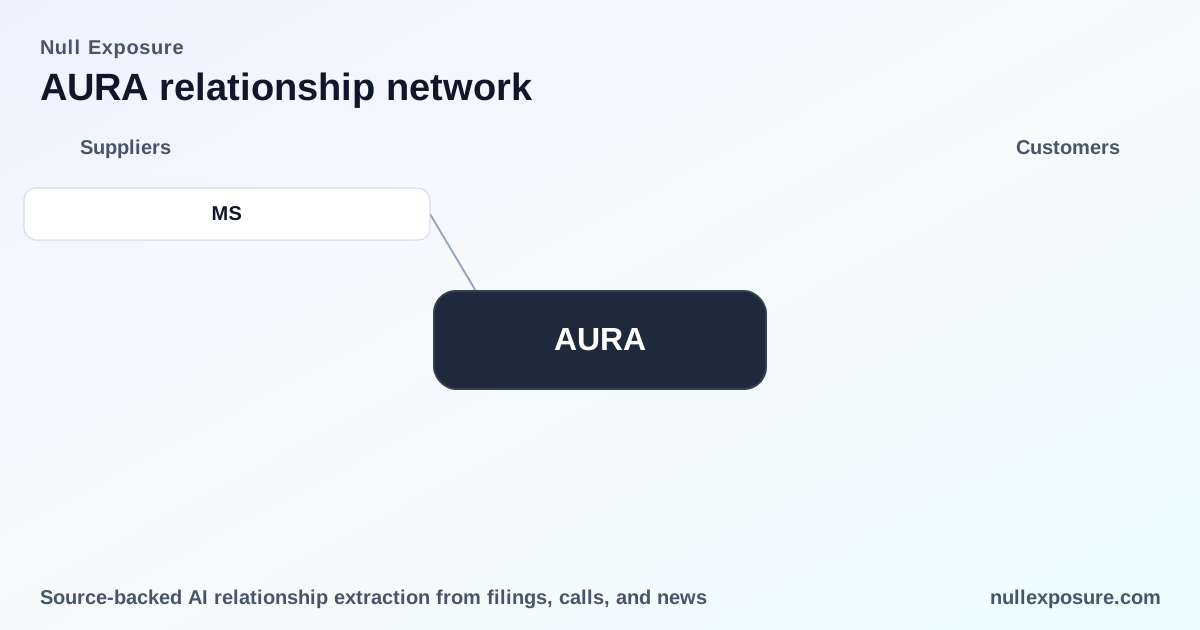
The set of customer mentions pulled for the ticker AURA is small and heterogeneous. There is no concentrated, high-value published supplier/customer contract evident in this signal set; instead the mentions are a mix of a retailer partnership callout and several references to an entirely different "Aura" (Aura Minerals). Because the sources contain no formal contract excerpts or milestone schedules, the intelligence supports a view of early-stage commercial exposure: partnership mentions exist but are not tied to recurring revenue or material commercial disclosures in the public record gathered here.
Direct relationship notes — every mention in the record
COST (Costco) — retailer partnership mention
Costco’s Q4 2025 earnings call included a line listing “Aura” as one of several new national brand partnerships across nonfood categories, indicating a branded retail relationship or distribution arrangement was recognized at the retailer level. According to the COST 2025 Q4 earnings call (reported March 2026), Aura was named alongside Fabletics, True Classic, and La‑Z‑Boy. This is a one-line public mention with no contract value disclosed, but it signals retail channel visibility in a large national account.
SITM (SiTime / contract payment) — a material cash payment recorded
SiTime’s FY2026 disclosure referenced a payment of $42.2 million to Aura for dye deliveries, representing a one-time, material cash outflow to an entity named Aura. InsiderMonkey’s coverage of SiTime’s FY2026 commentary (March 2026) records that payment language. This indicates a single large transactional relationship reported by the buyer; however, the note does not provide recurring revenue evidence or clarify the business identity behind the recipient named Aura.
MTA (Metalla) — reference to Aura Minerals (mining company)
Metalla’s November 4, 2025 press release cited production and royalty details for Aura Minerals Inc., noting third-quarter production figures and royalty accruals tied to Aranzazu. The PR Newswire release (Nov 4, 2025) explicitly names Aura Minerals Inc., a mining company, which is a separate corporate entity from Aura Biosciences. This appears in the results because the name “Aura” matches the search scope; it does not reflect a biotech commercial customer for Aura Biosciences but is nonetheless part of the mention set.
GROY (Gold Royalty) — additional references to Aura Minerals
A SimplyWallSt piece on Gold Royalty references Aura Minerals’ production ramp and near-term revenue implications for royalty holders, noting a quarter‑over‑quarter production increase at Borborema. SimplyWallSt coverage (March 2026) again refers to Aura Minerals, reinforcing that several entries in the mention set relate to the mining company rather than to Aura Biosciences.
Interpreting name collisions and signal quality
The results point to two distinct phenomena:
- A retailer-level brand mention (COST) that potentially represents consumer-facing channel activation for an entity named Aura.
- Several finance/royalty news items (MTA, GROY) and a payment disclosure (SITM) that reference other firms named Aura (notably Aura Minerals) or a large one-off payment to an entity called Aura.
Given the mixed identity of these mentions, the intelligence set offers low confidence for inferring recurring customer revenue attributable to Aura Biosciences. The SITM payment is material as reported by the buyer, but the source text does not definitively tie that payment to Aura Biosciences’ product portfolio or to an ongoing commercial program disclosed by Aura Biosciences.
What this means for investors and operators
- Commercial maturity: The public record here is consistent with a development-stage company—no recurring revenue or product sales are documented in these customer mentions, and company financials show TTM revenue of zero and negative profitability metrics.
- Concentration and criticality: There is no evidence of concentrated, high-criticality customer contracts for Aura Biosciences in this set; the Costco mention suggests channel experiments, while other items are name-collisions with Aura Minerals.
- Contracting posture: With no contract excerpts or milestone schedules present, treat the company’s commercial posture as partnership-and-milestone driven, not volume-selling.
- Signal quality: The mix of results underlines the importance of entity disambiguation when evaluating customer relationships for companies with common names.
Key takeaways:
- No recorded recurring revenue for Aura Biosciences in the customer mentions captured here.
- One retail channel mention (COST) provides branded distribution visibility but lacks contract detail.
- Several high-profile mentions reference Aura Minerals, not Aura Biosciences, creating noise that must be filtered for investor diligence.
If you want a consolidated, disambiguated view of customer linkages and contract-level signals for AURA, we provide coverage and entity-resolved relationship analysis at https://nullexposure.com/.
Actionable risk checklist for operators
- Validate any buyer that cites “Aura” to determine corporate identity before assuming revenue attribution.
- Prioritize disclosure of partner names and contract terms in investor communications to reduce ambiguity.
- If retail rollouts exist (as Costco’s mention suggests), quantify channel economics and cadence of product availability to convert brand mentions into revenue projections.
Bottom line
The current customer-signal set for ticker AURA is sparse and mixed: one retailer partnership mention that could indicate channel presence, one large payment reported to an entity named Aura, and multiple references that actually pertain to Aura Minerals (a different company). For investors, the dominant conclusion is that commercialization remains nascent and public customer evidence is limited and noisy, requiring direct confirmation from company filings or partner disclosures to build revenue forecasts or to size contract risk.