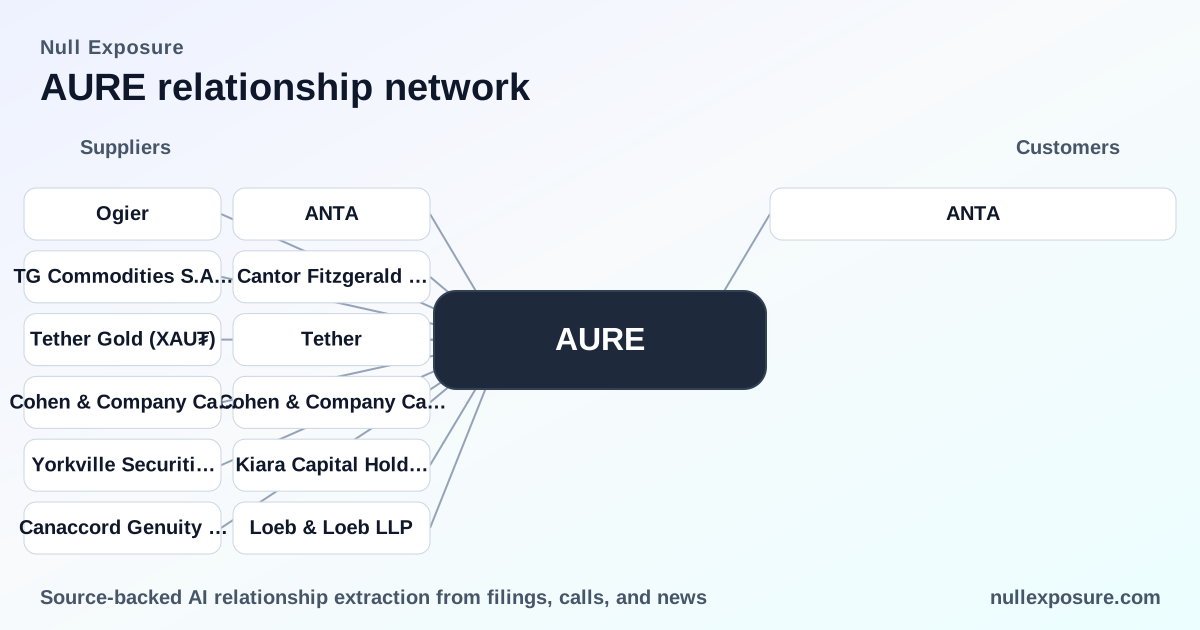
Aurelion (AURE): A compact wealth manager monetizing balance-sheet assets through related‑party collateralization
Aurelion (ticker AURE) is a Hong Kong–focused wealth and asset manager that earns advisory and asset‑management fees and is now monetizing on‑balance precious‑metal reserves by lending unencumbered Tether Gold to its parent for a technology fee. This maneuver converts a non‑income-bearing reserve into a revenue stream while transferring funding default risk to the parent entity, creating a concentrated, high‑impact customer relationship that investors should treat as both an earnings accelerant and a counterparty concentration risk.
For deeper relational analytics, visit https://nullexposure.com/.
Quick company snapshot investors need to hold in mind
Aurelion is a NASDAQ‑listed capital markets firm operating out of Hong Kong with a small public float and a tight shareholder base. Key financials: market capitalization ~$76.1M, trailing revenue ~$1.78M, EBITDA negative ~$12.6M, and diluted EPS −2.65 (TTM). The company carries a high beta (2.43) and a wide spread between its 52‑week low and high (USD 1.5–14.6), reflecting episodic investor interest and operational volatility.
- Revenue scale is modest relative to market cap (Price/Sales ~42.7), indicating valuation is driven by expectations or illiquidity rather than current recurring cash flows.
- Profitability is negative on a TTM basis (gross loss reported), so outside monetization events such as the Tether Gold arrangement are material to near‑term cash generation.
- Corporate footprint is small and concentrated: insiders hold ~23% and institutions ~14.5%, which amplifies governance and related‑party dynamics.
How Aurelion’s operating model shifts with the Tether Gold transaction
The newly disclosed arrangement changes Aurelion’s operating posture in specific ways that matter to investors:
- Contracting posture: the company is executing a related‑party collateral arrangement with its parent where Aurelion lends reserve assets and receives a technology fee in return; this is a service‑for‑collateral model rather than a simple third‑party arm’s‑length loan.
- Concentration: the counterparty is the parent company, creating single‑counterparty exposure that compresses diversification and raises correlation risk between funding outcomes and group performance.
- Criticality: the transaction converts a static reserve (Tether Gold) into an active funding lever; the strategic importance of that reserve to liquidity and to fee income elevates its materiality for the business.
- Maturity of the relationship: the public chronology shows this as a recently announced FY2025/FY2026 initiative, indicating early‑stage operational execution rather than a long‑standing revenue stream.
These are company‑level signals: no external contractual constraints were included in the reporting available for this review.
Customer and partner relationships (every reported mention)
Below I cover each reported relationship mention in the public record for AURE. Each entry is concise and sourced to the underlying reporting.
ANTA — StockTitan mention (reported Mar 9, 2026)
Aurelion will lend its unencumbered Tether Gold holdings to Antalpha Platform Holding Company (trading as ANTA) and will receive a technology fee while Antalpha assumes default risk on funding derived from that collateral, effectively transferring credit exposure away from Aurelion. This was reported by StockTitan on March 9, 2026. (Source: StockTitan, March 9, 2026.)
Antalpha Platform Holding Company — StockTitan duplicate mention (reported Mar 9, 2026)
The same StockTitan coverage frames Antalpha as the parent counterparty that will accept Tether Gold collateral and provide funding; Aurelion’s compensation structure is framed as a technology fee for use of gold reserves. This reinforces that the counterparty is a related‑party parent rather than an unaffiliated lender. (Source: StockTitan, March 9, 2026.)
ANTA — CoinCentral coverage (reported Mar 9, 2026)
CoinCentral noted that Antalpha will offer Tether Gold‑backed loans and assume full default risk on customer funding while Aurelion supplies the unencumbered Tether Gold as collateral and collects a technology fee, suggesting a business model pivot to licensing balance‑sheet assets to the group for monetization. (Source: CoinCentral, March 9, 2026.)
ANTA — ManilaTimes/GlobeNewswire placement (reported Oct 14, 2025)
According to a GlobeNewswire placement carried by ManilaTimes on October 14, 2025, Aurelion planned to lend unencumbered Tether Gold (XAU₮) to Antalpha in exchange for a technology fee, indicating the arrangement was communicated publicly in FY2025 and subsequently covered by market outlets. (Source: ManilaTimes / GlobeNewswire, October 14, 2025.)
What the relationship set means for investors: clear benefits and concentrated risks
The transaction is strategically logical: Aurelion monetizes idle digital‑gold reserves without retaining funding default risk. The company converts an on‑balance asset into fee income while outsourcing credit exposure to Antalpha. That dynamic produces immediate benefits: potential recurring technology fees and improved near‑term cash flow visibility without taking direct lending risk.
Simultaneously, the structure introduces material investor considerations:
- Counterparty concentration risk is elevated. The parent company assumes default risk, so Aurelion’s earnings and liquidity profile become entwined with Antalpha’s credit profile and funding execution.
- Related‑party economics require transparency. With insiders and the parent materially connected, governance quality and disclosure completeness become valuation drivers.
- Revenue durability is uncertain but convertible. The shift turns a reserve into a contractual income stream; if the arrangement is durable, it materially improves revenue visibility for a company that reported low trailing revenue and negative EBITDA.
- Market perception and volatility are likely to persist. Aurelion’s small market cap and elevated beta will continue to amplify the market reaction to further execution details, repayment performance, and any expansion of similar transactions.
Bottom line and what to watch next
Aurelion’s Tether Gold collateralization with Antalpha is a high‑impact, high‑concentration monetization: it meaningfully changes the company’s cash‑flow profile while increasing dependence on a single related counterparty. Investors evaluating AURE should prioritize the following near‑term disclosures and metrics:
- Detailed terms of the technology‑fee arrangement and payment cadence.
- Credit and liquidity metrics for Antalpha, since Antalpha assumes default risk.
- Any governance safeguards or independent valuation protocols applied to the Tether Gold collateral.
- Evidence of repeatability (additional counterparties or scale) to reduce concentration risk.
For structured relational analytics and to track how this and similar arrangements evolve across the capital markets, review ongoing coverage at https://nullexposure.com/.
Aurelion is small, nimble, and now tactically dependent on a parent‑level collateralization strategy — that tradeoff defines its near‑term risk/reward profile.