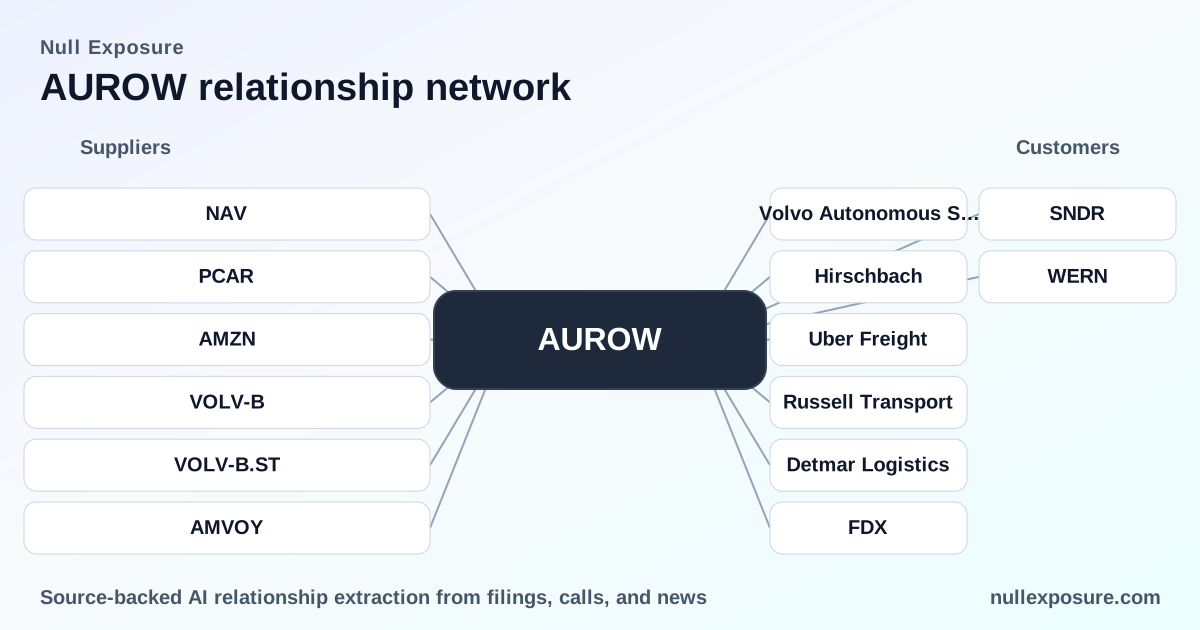
Aurora Innovation (AUROW): Customer relationships driving early commercial freight revenue
Aurora sells self-driving technology under a Driver-as-a-Service model, monetizing through subscriptions and fee-per-mile usage for freight and rides customers; the company launched commercial freight operations in Texas in April 2025 and has begun recognizing revenue from live loads. For investors evaluating customer exposure, the key read is that Aurora is transitioning from pilots to paid operations with a small but growing cohort of carrier partners that validate route-level commercialization while concentration and scale remain material risks.
Explore more on customer relationships at NullExposure.
Why customers matter now: revenue, validation, and concentration
Aurora’s go-to-market is explicitly service-oriented: Aurora Driver for Freight and Aurora Driver for Rides are positioned as subscription services priced on a fee-per-mile basis, meaning revenue scales directly with utilization rather than one-time software sales. The company reported recognition of commercial revenue beginning in June 2025 and disclosed quarterly freight load revenue totals that reflect very early monetization — nominal in absolute size but strategically important as proof of concept with large carriers.
This setup creates several corporate-level signals for investors:
- Contracting posture: Aurora expects customers to subscribe and pay by usage (fee-per-mile), aligning its economics with carrier mileage rather than capital equipment sales. This is a company-level characteristic drawn from Aurora's commercialization disclosures.
- Geographic rollout: Operations started in Texas (largest U.S. freight market) with stated ambitions for global expansion into Canada, Europe, Japan, Australia and New Zealand. The early commercial footprint is therefore North America-first, with global intent.
- Relationship maturity: Customer relationships are in active early-commercial stage—the company is executing route-specific, operational contracts rather than research-only pilots.
- Business segment: Revenue is earned through transportation services, signaling ongoing operational and logistics execution as the core delivery requirement rather than pure software licensing.
If you want a concise portal into Aurora’s customer-facing disclosures, visit the NullExposure research hub.
NullExposure homepage
Customer roll call from recent earnings calls — what Aurora told investors
Below are each of the reported customer relationships mentioned in Aurora’s Q3 and Q4 2025 earnings commentary. Each entry is a plain-English takeaway tied to the earnings-call disclosure.
Hirschbach — Q3 2025 (aurow-2025q3-earnings-call)
Aurora reported expanding driverless operations for Hirschbach with the Fort Worth to El Paso launch, identifying Hirschbach as one of Aurora’s earliest adopters and a value partner in freight commercialization. According to the Q3 2025 earnings call, this lane extension is positioned as a core example of moving from pilot to recurring operations.
Hirschbach — Q4 2025 (aurow-2025q4-earnings-call)
In Q4 2025 Aurora said it is establishing endpoint operations in Laredo specifically to support Driscoll’s with Hirschbach, signaling operational scaling and logistical coordination at border endpoints. That detail came from management’s Q4 2025 remarks about route and endpoint infrastructure.
Detmar Logistics — Q4 2025 (aurow-2025q4-earnings-call)
Aurora announced a new opportunistic agreement with Detmar Logistics in Q4 2025, describing the relationship as an additional carrier engagement in its growing commercial program. The Q4 commentary labels this as an opportunistic commercial agreement rather than a multiyear strategic alliance.
Volvo Autonomous Solutions — Q3 2025 (aurow-2025q3-earnings-call)
Management listed Volvo Autonomous Solutions among customers contributing to the company’s reported $1 million of revenue in Q3 2025 across driverless and supervised commercial loads, indicating Volvo’s participation in live commercial activity. That inclusion was noted on the Q3 earnings call revenue breakdown.
Volvo Autonomous Solutions — Q4 2025 (aurow-2025q4-earnings-call)
Volvo Autonomous Solutions again appears in the Q4 2025 revenue mix that totaled $1,000,000 across driverless and vehicle-operator supervised loads, showing continued engagement into the next quarter per the Q4 earnings call.
Uber Freight — Q3 2025 (aurow-2025q3-earnings-call)
Uber Freight was named among carriers generating commercial load revenue in Q3 2025, confirming Uber Freight is part of Aurora’s early commercial book of business as discussed on the Q3 earnings call.
Uber Freight — Q4 2025 (aurow-2025q4-earnings-call)
Aurora repeated Uber Freight in the Q4 2025 revenue disclosure, indicating sustained activity across the quarter as stated in management’s Q4 remarks.
Russell Transport — Q3 2025 (aurow-2025q3-earnings-call)
Aurora said it executed an agreement with Russell Transport (a McLeod customer) to run driverless hauls on the Fort Worth–El Paso lane, documenting rapid commercial conversion shortly after the partnership announcement in Q3 2025.
FedEx (FDX) — Q3 2025 (aurow-2025q3-earnings-call)
FedEx was included in the list of commercial load customers that produced part of the company’s $1 million of Q3 2025 revenue, underscoring that Aurora is operating loads for major networked shippers, as disclosed in the Q3 call.
FedEx (FDX) — Q4 2025 (aurow-2025q4-earnings-call)
FedEx again appears in Aurora’s Q4 2025 revenue attribution, confirming continued commercial activity and revenue recognition from shipments for the carrier during the quarter.
Schneider — Q3 2025 (aurow-2025q3-earnings-call)
Schneider was cited among carriers contributing to Q3 2025 commercial revenue, showing engagement from a large, asset-based North American carrier according to the Q3 call.
Schneider — Q4 2025 (aurow-2025q4-earnings-call)
Schneider is likewise listed in the Q4 2025 revenue group, indicating ongoing operational loads for the carrier per the Q4 earnings commentary.
Werner (WERN) — Q3 2025 (aurow-2025q3-earnings-call)
Aurora disclosed that Werner’s safety team and a seasoned driver traveled to Texas to assess the Aurora Driver’s performance, reflecting carrier-led validation and safety review activity noted on the Q3 call.
Werner (WERN) — Q4 2025 (aurow-2025q4-earnings-call)
Werner is again cited in the Q4 2025 revenue mix that totaled $1,000,000 for the quarter, showing that Werner moved from evaluation to commercialized loads within Aurora’s reported period.
Werner (WERN) — Q3 and Q4 duplication note
Aurora’s transcripts list Werner/WERN multiple times across Q3 and Q4 disclosures; each mention corresponds to either assessment activity (Q3) or revenue attribution (Q4) as described on the respective earnings calls.
What investors should read into these relationships
- Validation over scale: The customer roster includes tier-one carriers and shippers (FedEx, Schneider, Werner, Volvo Autonomous Solutions, Uber Freight), which provides strong validation for Aurora’s product in operational contexts; however, reported revenue is still concentrated and small in absolute terms.
- Route-level commercialization: Multiple remarks reference the Fort Worth–El Paso lane and Laredo endpoints, signaling that Aurora is commercializing route-by-route with focused endpoint investments rather than nationwide blanket deployments.
- Revenue model and operational dependency: The company’s DaaS/fee-per-mile posture links economic outcomes directly to carrier utilization; success therefore depends on both technical performance and carriers’ willingness to transition operational volume to Aurora-managed driverless loads.
- Operational and counterparty risk: Early-stage revenue concentrated across a handful of carriers introduces customer concentration risk and exposes Aurora to the operational cadence and safety evaluations of each partner.
Bottom line — where the risk/reward sits
Aurora has converted pilots into paid freight activity and recorded measurable, albeit small, revenue from a cohort of established carriers. The commercial model is subscription/usage-based and rewards scale; the near-term investment case hinges on rapid expansion of miles under contract without margin-diluting giveaways. For investors, monitor quarterly cadence of fee-per-mile pricing, lane rollouts beyond Texas, and whether the current carrier cohort scales volumes materially next year. These are the variables that will convert carrier validation into durable top-line growth.
Key takeaway: Aurora’s customer list delivers high-quality validation; revenue remains nascent and concentrated, making execution on scaling miles and endpoint operations the primary value driver and principal near-term risk.