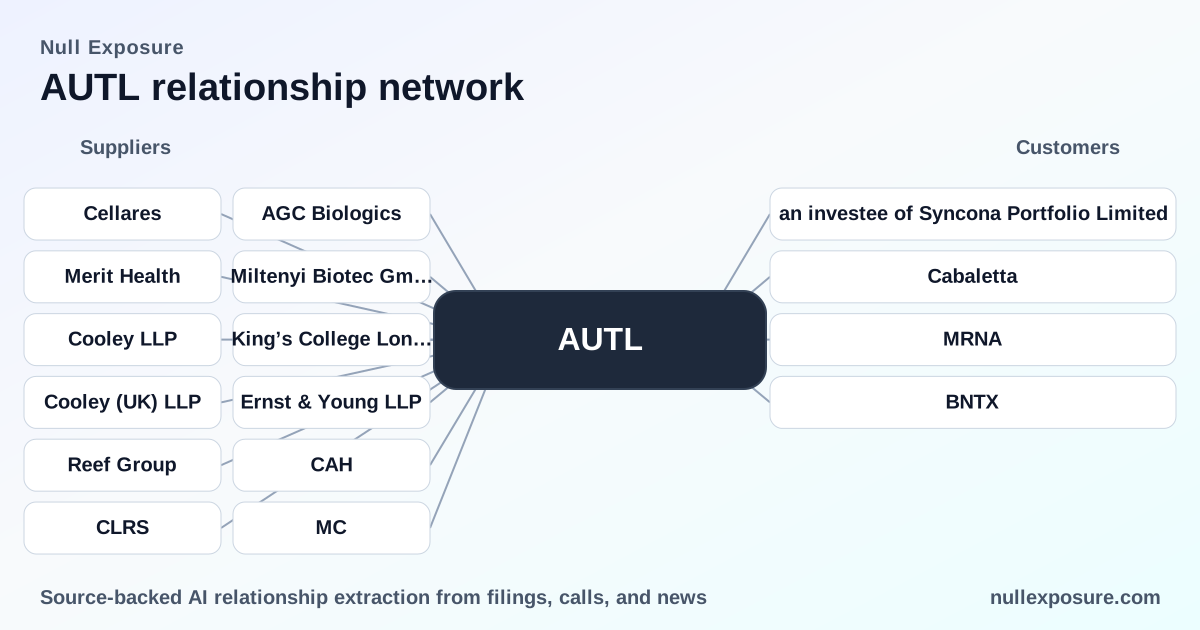
Autolus Therapeutics: Customer Relationships that Drive a Clinical-Stage Biotech Re‑rating
Autolus is a clinical‑stage T‑cell therapy company that monetizes through two principal channels: commercial sales of its approved product AUCATZYL (obe‑cel) and license fees/milestone payments from partners that exploit Autolus binders and technologies. The company’s near‑term cash conversion and valuation sensitivity are driven by licensing deals (large, lumpy receipts) and early commercial traction with AUCATZYL, which together determine whether Autolus transitions from research dependence to recurring product revenue.
For a concise view of the signals used here, see NullExposure’s customer evidence hub: https://nullexposure.com/
What the customer map looks like — concentrated and contractually driven
Autolus operates with a licensing‑first contracting posture where proprietary binders and platform IP are licensed to large biopharma partners under exclusive, sublicensable agreements. This model produces step‑function revenue events (upfront, option exercise, clinical milestones) rather than steady, subscription‑style income. At the same time, commercialization of AUCATZYL introduces payer relationships and geographic access dynamics as a separate revenue stream.
- Concentration: License revenue has been highly concentrated historically, with BioNTech underwriting the bulk of recognized license income through 2024. This presents single‑counterparty risk to near‑term license cash flow.
- Criticality: The company’s core product (AUCATZYL) is now a commercial asset and therefore critical to demonstrating a sustainable revenue base beyond licensing.
- Maturity and stage: Relationships combine mature, contractually active license agreements with large partners and nascent commercial payer access, creating asymmetric operational and execution risk.
For actionable signal detail, Autolus’ customer evidence is accessible at https://nullexposure.com/ — a useful complement for modelers and operators.
How each named relationship matters to investors
BioNTech (BNTX)
Autolus recognized that 100% of its license revenue in 2024 was generated from BioNTech, reflecting an exclusive license and option agreement that transferred rights to certain binders and in‑vivo product exploitation to BioNTech. This agreement is a material revenue driver and defines a large portion of Autolus’ licensing cash flow profile. (Autolus 2024 Form 10‑K; filing summary, reported 2026.)
BNTX (ticker duplicate of BioNTech)
The separate entry for BNTX reiterates the same legal and financial nexus: BioNTech is the contractual licensee and the dominant source of license revenue recognized by Autolus in the 2024 fiscal year, and that relationship drove the majority of reported licensing income. (Autolus 2024 Form 10‑K; reported 2026.)
Moderna (MRNA) — license and milestone receipts (FY2025/FY2026)
Autolus licensed a proprietary binder to Moderna in 2022 and has recognized licensing income tied to that arrangement, including a $1 million license revenue component recorded in Q4 2025 for a clinical milestone and product development activity linked to mRNA‑2808 that uses the Autolus binder. These receipts are examples of how partner biology programs deliver discrete revenue events to Autolus. (InsiderMonkey Q4 2025 earnings call transcript, May 2026; Quiver Quant Q3 2025 report, March 2026.)
MRNA (ticker duplicate of Moderna)
This duplicate entry mirrors the Moderna evidence: Autolus’ binder was licensed to Moderna and that license produced milestone recognition and program linkage in 2025, reinforcing the firm’s licensing monetization pathway. (Quiver Quant and company earnings commentary, 2025–2026.)
Cabaletta
For the year ended December 31, 2023, Cabaletta accounted for a substantial share of Autolus’ license revenues, forming part of the cohort that generated 76% of license income that year. This reflects prior licensing relationships that materially supported revenue before the 2024 BioNTech concentration. (Autolus 2024 Form 10‑K; disclosure referencing FY2023 license revenue composition.)
An investee of Syncona Portfolio Limited
Autolus reported that an investee of Syncona Portfolio Limited was a co‑contributor to the 76% of license revenues in 2023, indicating that institutional venture relationships contributed material licensing receipts in that period. This highlights the company’s historical revenue dependence on a small group of licensing partners. (Autolus 2024 Form 10‑K; FY2023 revenue breakdown referenced.)
National Health Service (NHS) — UK payer access and commissioning
Autolus disclosed that AUCATZYL will be available through routine commissioning by the NHS, signaling public payer acceptance in the United Kingdom and an operational step toward sustainable commercial volumes in that geography. NHS commissioning materially affects market access and uptake curves for a high‑cost cell therapy. (Market coverage cited on StockTwits reporting of company statements, May 2026.)
Contracting posture, concentration and what investors should model
- Licensing is the structural monetization channel: Autolus’ contracts are structured as exclusive, sublicensable licenses (explicit in the BioNTech agreement), producing discrete upfronts and milestones rather than continuous royalties at present. This is explicitly documented in the BioNTech License and Option Agreement language. (Autolus 2024 Form 10‑K.)
- Revenue concentration is acute: The company‑level signal that 100% of license revenues in 2024 were from BioNTech is a material concentration flag; investors must stress‑test scenarios where partner‑sourced license receipts pause or delay. (Autolus 2024 Form 10‑K.)
- Commercialization dynamics are becoming material: FDA approval of AUCATZYL (noted in company disclosures) and NHS commissioning are converting Autolus’ exposure from partner licensing to payer negotiation, distribution and manufacturing scale; these factors should be modeled as separate revenue channels with different margin and timing profiles. (Autolus 2024 Form 10‑K; public reporting on FDA approval and NHS commissioning, 2024–2026.)
- Relationship maturity is mixed: Some relationships are active, contractually explicit licenses (BioNTech, Moderna), while others were historical contributors (Cabaletta, Syncona investee) that shaped 2023 receipts. Treat partner receipts as lumpy with asymmetric downside.
Investor implications and risk checklist
- High licensing concentration: A single large licensee provided the bulk of recorded license revenue in 2024; downgrade scenarios should stress for deferred milestone receipts and the time to replace partner cash flows.
- Transition to product sales: AUCATZYL’s FDA approval and NHS commissioning create a runway to recurring revenue but introduce operational execution risk (manufacturing scale, reimbursement).
- Partner pipeline optionality: Deals like the Moderna license demonstrate growth optionality when partners advance programs that use Autolus binders; milestone timing will be the key value driver.
- Model volatility: Forecasts should separate predictable commercial revenue curves from stochastic license/milestone events.
Key takeaways:
- BioNTech is the single most material licensing counterparty through 2024.
- Moderna and other licensees provide episodic milestone revenue and program leverage.
- AUCATZYL’s commercial adoption (FDA/NHS) is the clean path to recurring revenue, but execution risk is front and center.
For a structured view of these customer signals and how they map to revenue scenarios, visit NullExposure’s customer evidence portal: https://nullexposure.com/
Autolus’ investor case is a classic biotech pivot: convert licensing cash into durable product sales while managing concentration and execution risk. Investors and operators should price in lumpy license receipts, pathway‑dependent commercialization outcomes, and the potential for partner programs to alter the cash‑flow profile materially.