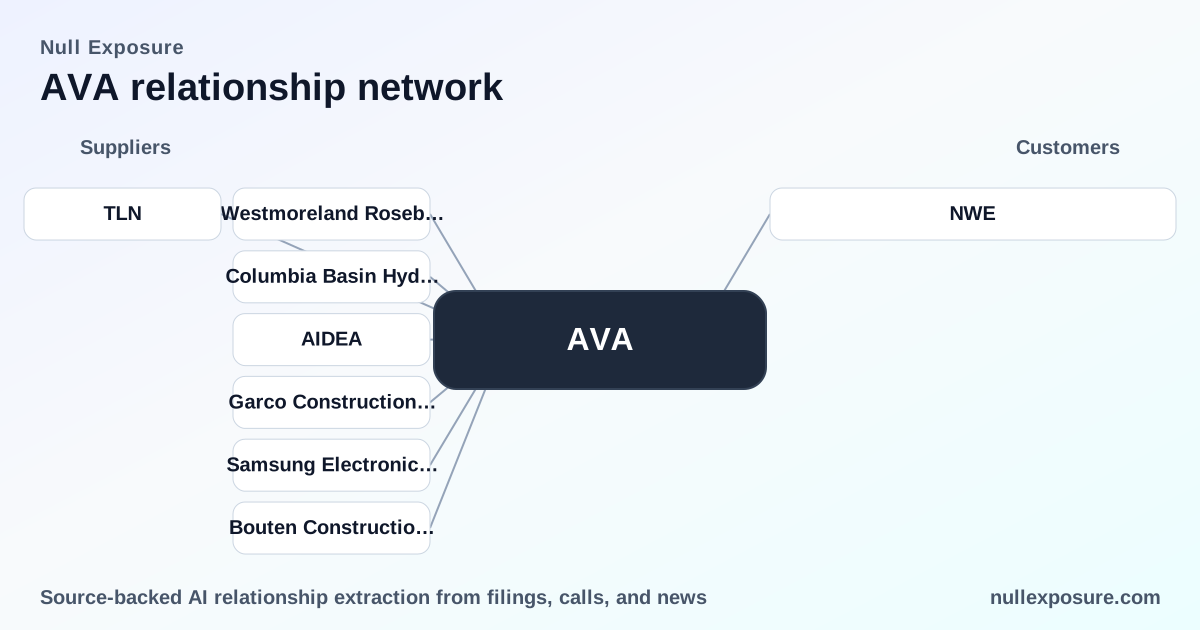
Avista (AVA): Customer relationships, asset transfers, and what investors should price in
Avista Corporation is a regulated electric and natural gas utility that monetizes through rate‑regulated retail sales and service availability charges, supplemented by power sales and smaller non‑utility activities. Revenue is driven by a blend of fixed monthly availability fees and usage‑based delivery charges, with the company operating under an obligation-to-serve framework across a concentrated Pacific Northwest footprint. For active research on counterparty exposures and contract structure, visit https://nullexposure.com/.
Overview of how Avista sells and the economics investors must model Avista’s business model is fundamentally regulatory: the company sells energy as the seller of record to residential, commercial and governmental customers inside defined service territories in Washington, Idaho, Oregon and Montana. The rate base / regulatory process constrains pricing flexibility but supports stable cash flow and dividend capacity; revenue recognition splits into having service available (fixed) and delivered energy (usage‑based), which shapes sensitivity to consumption cycles and weather.
How Avista contracts with customers and counterparties Avista’s customer posture is characterized by long‑standing regulated obligations and a mix of counterparty types:
- Contracting posture: Regulated, obligation-to-serve contracts with fixed monthly availability components and usage‑based charges that create predictable, recurring revenue. The company’s standard arrangements prevent unilateral rate changes without regulatory approval, making revenue durable but regulated.
- Counterparty mix: A broad set of retail customers that include governmental entities (municipal and state customers are explicitly noted in disclosures) and a large base of individual residential customers, indicating low single‑counterparty concentration but high essentiality.
- Geographic concentration: Operations are North America‑focused, primarily the Pacific Northwest; this creates regional regulatory and resource‑ adequacy exposures rather than global market exposure.
- Role and lifecycle: Avista operates primarily as a seller of electricity and natural gas and maintains an active customer base across core utility products and services, reflecting a mature utility franchise.
A mid‑report datapoint and resource for deeper signal extraction: https://nullexposure.com/.
Publicly documented relationships and what each disclosure means Below I list every relationship entry surfaced in the public feed. Each entry is presented as a plain‑English takeaway with a concise source note.
-
NorthWestern / NWE — Washington State Standard report (FY2024) Avista agreed to transfer its Colstrip ownership to NorthWestern, with NorthWestern acquiring all 222 megawatts from Avista effective January 1, 2026, at no direct cost to NorthWestern. This represents a definitive asset transfer that reduces Avista’s coal generation ownership. Source: Washington State Standard coverage of the Colstrip transactions (article cited in March 2026).
-
NorthWestern / NWE — InsiderMonkey Q1 2026 earnings call transcript (FY2026) NorthWestern stated on its earnings call that it acquired the Avista portion to achieve resource adequacy at 222 MW, indicating the acquisition was driven by capacity and reliability planning rather than a cash purchase. Source: NorthWestern earnings call transcript published by InsiderMonkey (Q1 2026).
-
NorthWestern — TradingView news summary (FY2026) Market media summarized Avista’s Colstrip transfer as a recent transfer of coal-fired Colstrip units to NorthWestern, noting the operational and ownership shift in FY2026 reporting. Source: TradingView news synopsis referencing Avista’s SEC reporting (May 2026).
-
NorthWestern — AI Journ coverage of NorthWestern 2025 financial results (FY2026) NorthWestern’s FY2026 reporting reiterates that definitive agreements with Avista and Puget for Units 3 and 4 closed on January 1, 2026 for $0, emphasizing the zero‑cost accounting of the transfer as disclosed by the acquirer. Source: AI Journ article summarizing NorthWestern’s 2025 financial results (reported March 2026).
-
NorthWestern — Avista Form 10‑K (FY2024), doc ava-2024-12-31 (first entry) Avista’s FY2024 Form 10‑K explicitly states that Avista entered an agreement in January 2023 to transfer its ownership in Colstrip Units 3 and 4 to NorthWestern on December 31, 2025, documenting the contractual timeline and planned transfer in company filings. Source: Avista 2024 Form 10‑K (filed for FY2024).
-
NorthWestern — Avista Form 10‑K (FY2024), doc ava-2024-12-31 (duplicate entry) The 10‑K reiteration appears twice in the public feed; both entries confirm the same contractual commitment to transfer Colstrip Units 3 and 4 to NorthWestern at the end of 2025. The company filing provides the controlling disclosure for the transaction. Source: Avista 2024 Form 10‑K (FY2024).
What these relationships mean for Avista’s customer economics and investor model The recurring public disclosures concentrate on the Colstrip Units 3 and 4 transfer to NorthWestern and the associated 222 MW capacity. Key implications for valuation and risk:
- De‑risking of thermal asset ownership: The transfer removes Avista’s ownership exposure to that coal asset, which reduces operational and regulatory complications tied to coal generation on the balance sheet.
- No immediate cash benefit: Multiple sources state the transfer executed for $0, so investors must not assume a cash windfall; the move is an allocation of asset ownership and associated obligations rather than a monetization event.
- Resource adequacy externalities: NorthWestern’s rationale—securing 222 MW for resource adequacy—indicates the capacity value remains, but Avista sheds operational responsibility and future provisioning obligations tied to those units.
- Regulatory and rate base effects: Because Avista’s revenues are rate‑regulated, the removal of ownership potentially alters rate base and future recovery profiles; the regulatory process will determine whether stranded costs, recoveries or other adjustments affect earnings.
Key takeaways for investors
- Avista is a regulated utility with stable, usage‑linked cash flows driven by availability fees and energy delivery charges. Dividend yield and operating margin reflect mature utility economics.
- The Colstrip transfer materially changes the company’s generation asset mix without producing upfront cash; this is a strategic de‑risking of coal exposure rather than a monetization.
- Counterparty profile is broad and government‑inclusive, signaling revenue durability through municipal and governmental customers and high essentiality of service.
- Geographic concentration in the Pacific Northwest concentrates regulatory and resource risks, requiring investors to model region‑specific load and policy scenarios.
Investment risks and monitoring checklist
- Regulatory rulings on cost recovery or stranded asset treatment tied to the Colstrip transfer.
- Changes in regional resource adequacy planning that could re‑allocate capacity requirements or obligations.
- Weather and usage patterns that alter the balance between fixed availability revenue and usage‑based revenue.
Conclusion For equity and credit investors, Avista’s core earnings narrative remains stable and regulatory‑driven, while the Colstrip transfer is an important one‑off that reduces fossil fuel ownership and shifts capacity obligations to NorthWestern without producing cash proceeds. Monitor regulatory filings and subsequent rate‑making decisions to quantify any recoveries or charge‑offs that result from the transfer.
Explore the full relationship signals and filings at https://nullexposure.com/ to support your diligence.