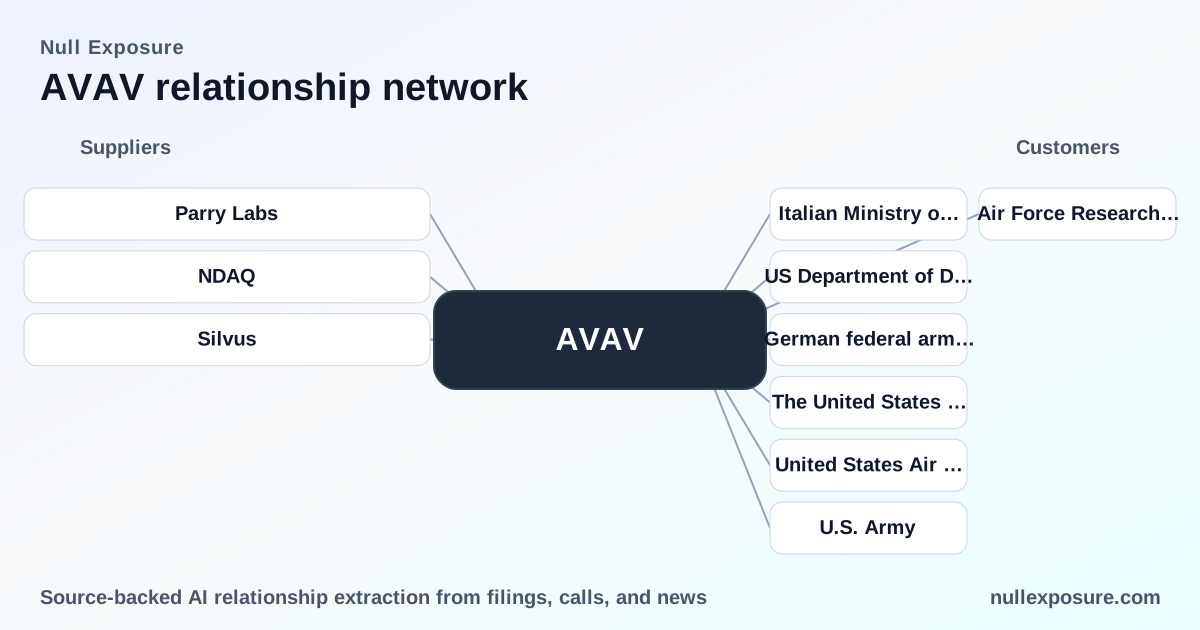
AeroVironment (AVAV): Customer Footprint and Contract Drivers for Investors
AeroVironment designs, manufactures and supports uncrewed systems and related services for defense and allied governments, monetizing through product sales (loitering munitions, UAVs, UGVs), task orders and service contracts including foreign military sales and research tasking. Revenue is driven by large, repeat government awards and follow-on production orders; profitability depends on program scale, manufacturing execution and continued DoD and allied procurement. For a focused view of AeroVironment’s customer relationships, visit https://nullexposure.com/ for additional research and sourcing.
What the customer mix tells you about the business model and risk profile
AeroVironment operates with a government-first contracting posture: the company supplies systems directly to U.S. defense agencies, participates in foreign military sales and serves allied governments. Company filings indicate that roughly three quarters of revenue in FY2025 came from U.S. government agencies, which makes government funding both the growth driver and concentration risk for investors. International sales are material and recurring — non-U.S. customers accounted for a majority of revenue in recent years (52%, 62% and 53% across FY2023–FY2025), and foreign markets such as Ukraine represented a non-trivial share of FY2025 sales.
AeroVironment’s operating model combines manufacturing scale and service delivery: the company operates a national manufacturing footprint to support production and also provides field services, training and ISR support. That dual hardware-plus-services approach reduces single-program dependency but reinforces the strategic importance of maintaining secure supply chains and contract performance discipline for margin stability.
Key structural signals for investors:
- Concentration: High reliance on U.S. government spend (company report for year ended April 30, 2025).
- Criticality: Government contracts are sizeable and programmatic — these are not ad-hoc one-offs but production and task-order flows that drive near- to medium-term revenue visibility.
- Contract posture: AeroVironment sells as prime and subcontractor and participates in foreign military sales channels (company filing language).
- Segments: Revenue is split across hardware (air and ground systems), services (training, ISR support) and manufacturing operations — all of which carry different margin and working-capital profiles.
If you want a compiled view of these relationships and primary sources for modeling, see more at https://nullexposure.com/.
Contract-level read: every relationship in the record, one by one
Italian Ministry of Defense
AeroVironment secured a $46 million contract with the Italian Ministry of Defense to supply systems and/or services referenced on the company’s FY2025 Q4 earnings call (March 2026). This is a concrete example of AVAV’s foreign military sales and allied-government penetration (AVAV earnings call, 2025Q4).
U.S. Department of Defense (Red Dragon program)
Management cited Red Dragon, a fully autonomous GPS-denied one-way attack UAS, as directly aligned to U.S. Department of Defense requirements on the FY2025 Q4 earnings call, underscoring AVAV’s role in next-generation lethal-attack and autonomous munition programs (AVAV earnings call, 2025Q4).
German federal armed forces
AeroVironment won a contract to deliver 41 uncrewed ground vehicles (UGVs) to the German federal armed forces, as disclosed on the FY2025 Q4 earnings call — a European production and delivery engagement that highlights AVAV’s UGV market entry and allied-government sales (AVAV earnings call, 2025Q4).
United States Air Force — $75M task order (Finviz summary)
The U.S. Air Force awarded a $75 million task order to UES, a division of AeroVironment, to support defense modernization efforts under programs to advance biotechnology and smart materials (Finviz news, March 2026).
The United States Air Force — $25M three‑year AFRL transition contract
UES, AeroVironment’s unit, received a three-year, $25 million award from the U.S. Air Force to transition human health and performance technologies from research to field deployment, demonstrating AVAV’s push into human-performance and transition-to-field work (ASDNews, April 7, 2026).
The United States Air Force — FRESH $75M task order (ASDNews)
ASDNews reported that the Air Force awarded a $75 million task order under the FRESH program at Wright-Patterson AFB for biotechnology, materials science and related modernization work, expanding AVAV’s AFRL engagements (ASDNews, January 28, 2026).
U.S. Army — $186M Switchblade delivery order
AeroVironment announced receipt of a $186 million delivery order from the U.S. Army for Switchblade 600 Block 2 and Switchblade 300 Block 20 loitering munitions systems, representing a significant production-scale award for precision strike products (StockTitan / company release, March 2026).
United States Navy — JUMP 20‑X ISR delivery
AV was selected to deliver JUMP 20‑X to the U.S. Navy as part of an ISR modernization initiative, positioning the company in naval ISR mission sets beyond organic aviation customers (Naval News, April 2026).
U.S. Marine Corps 22nd Marine Expeditionary Unit — ISR services delivery
AeroVironment has delivered advanced ISR support services to the U.S. Marine Corps 22nd Marine Expeditionary Unit, illustrating AV’s expeditionary ISR operational capability in forward-deployed maritime environments (Naval News, April 2026).
U.S. Naval Forces Southern Command / U.S. 4th Fleet — ISR services delivery
The company has provided ISR support services to U.S. Naval Forces Southern Command / U.S. 4th Fleet, reflecting region-specific operational deployments for maritime domain awareness (Naval News, April 2026).
Korean Navy — ISR services delivery
AeroVironment has delivered ISR support services to the Korean Navy, evidencing AV’s regional allied footprint and cross-national operational deployments (Naval News, April 2026).
U.S. Army’s Aviation and Missile Technology Consortium (AMTC) — $97.4M award
AeroVironment secured $97.4 million under the Army’s AMTC to support aviation and missile technology efforts, a program-level award reinforcing AV’s engagement in Army modernization pathways (Yahoo Finance, May 2026).
U.S. Army — P550 long‑range reconnaissance UAVs ($117M)
Under a $117 million contract, AV is to deliver P550 long-range reconnaissance UAVs to the U.S. Army, a production award that expands the company’s long-range ISR product placements with Army customers (Yahoo Finance, May 2026).
U.S. Army — production contract for long‑range reconnaissance drone systems (UAS Magazine)
The Army awarded a production contract for long-range reconnaissance drone systems, confirming continued procurement from AV for wide-area ISR platforms (UAS Magazine, May 2026).
Air Force Research Laboratory (AFRL) — Task Order TO‑03
Under Task Order 0003 (TO-03), AV will develop advanced polymers, responsive materials and modeling techniques to enhance Air Force assets, an R&D and transition engagement with AFRL that expands AV’s materials and biotech research footprint (ASDNews, March 2026).
RCAT — ecosystem partnership mention
RCAT reported an expanded partnership with AeroVironment to integrate AV’s Black Widow™ and FANG™ systems into broader mission-system architectures, indicating ecosystem-level collaboration and third-party integration activity (247wallst, March 2026).
Investor takeaways and positioning
- Revenue concentration to government customers is material and structural: FY2025 filings put U.S. government share at around 75% of revenue, which supports revenue visibility but concentrates political and budgetary risk.
- Product mix balances production orders and task-order R&D: Large production deliveries (Switchblade, P550, UGVs) and AFRL/UES task orders create a pipeline spanning near-term manufacturing revenue and medium-term R&D-funded opportunities.
- Geographic diversification exists but is programmatic: International allied sales (Italy, Germany, Korea, etc.) provide offset to U.S. budget cycles but introduce export and FMS complexities.
- Operational execution is critical: Manufacturing footprint and program execution will determine margin realization on large awards; investors should track backlog-to-revenue conversion and contract performance metrics reported each quarter.
For a consolidated feed of contract announcements and to benchmark AVAV against peer program awards, refer to the coverage hub at https://nullexposure.com/.