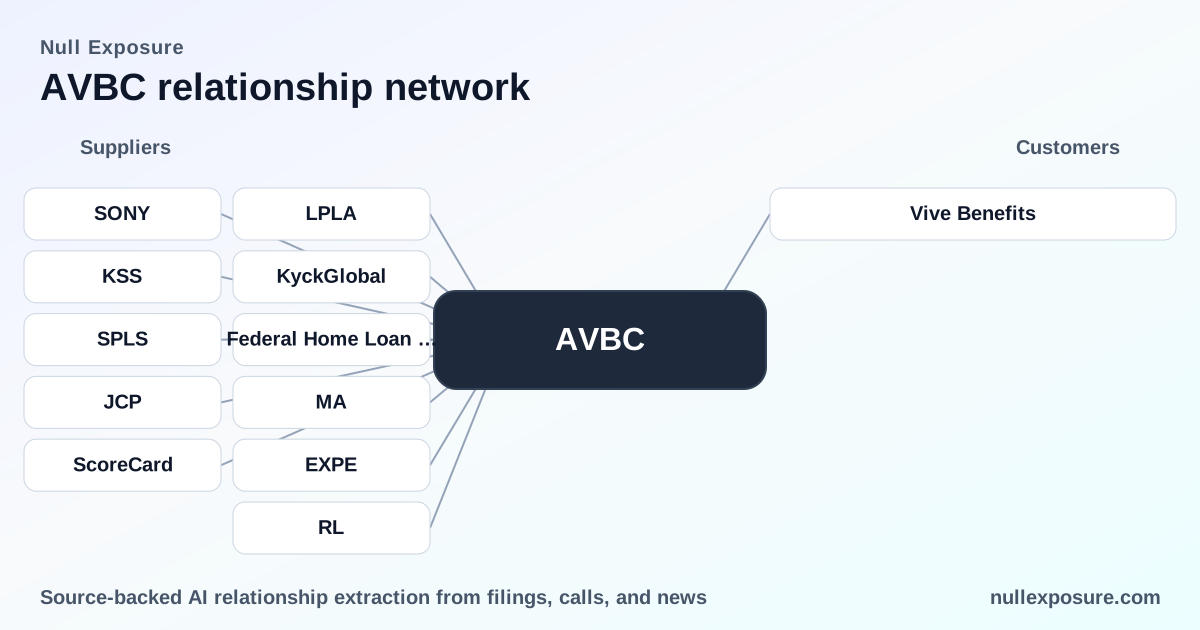
Avidia Bancorp (AVBC) — Customer relationships that drive community banking economics
Avidia Bancorp operates as the bank holding company for Avidia Bank, a regional New England commercial and retail bank that earns net interest and fee income through deposit gathering, consumer and commercial lending, and balance-sheet management. The business model is classic community banking: deposit-centric funding, local loan origination, and marquee customer partnerships that extend lending capacity and fee income. Investors should focus on partnership-driven loan origination, balance-sheet utilization, and borrower concentration as the principal commercial levers for AVBC’s return profile. For additional company-level context and raw records, visit https://nullexposure.com/.
Why customer relationships matter for a regional bank
Avidia’s margin and capital deployment decisions are directly driven by customer flows and contractual lending conduits. Partnerships that provide committed capital or referral channels convert into predictable loan flow and low-cost funding, which improves net interest margin and reduces originations volatility. Given Avidia’s market capitalization of roughly $377 million and a conservative balance-sheet profile, individual customer relationships that add recurring loan volume are operationally meaningful.
Snapshot of the company’s public metrics
Avidia reports modest profitability and conservative asset returns: Revenue TTM ≈ $104M, EPS $0.76, Return on Equity ~5.0%, and a trailing P/E around 26.8 with Price-to-Book roughly 1.0. These numbers reflect a small regional bank where lending partnerships can materially influence growth and capital deployment.
The customer relationships you need to know
Vive Benefits — an extension of Avidia’s lending distribution
Vive Benefits and Avidia Bank expanded their partnership with a $5 million revolving credit facility to fund loans to Vive members. This arrangement provides Avidia with a steady channel for consumer (or small commercial) loans originated to a defined membership base, converting a marketing/partner relationship into on-balance-sheet lending and interest income. (Framingham Source, October 3, 2020 — https://framinghamsource.com/index.php/2020/10/03/vive-and-avidia-bank-expand-their-partnership/)
What that partnership means for the business
- Scalable loan flow, limited capital commitment: A $5 million revolver is a modest but strategic commitment for a community bank with Avidia’s scale; it can be rotated repeatedly, producing fee and interest income while keeping capital efficiency high.
- Originations channeling: Partner-originated loans reduce customer acquisition cost and diversify the bank’s origination mix beyond branch walk-ins or brokered relationships.
- Credit concentration and underwriting discipline: Partnerships that direct loans to membership groups require consistent underwriting and monitoring protocols; Avidia’s performance against partner-driven credit will influence provisioning and net charge-offs.
Operating posture and business-model constraints (company-level signals)
No explicit contractual constraints were returned in the customer relationship results, so these are company-level signals that investors and operators should weigh:
- Contracting posture — conservative, relationship-oriented: As a regional bank, Avidia operates with balance-sheet lending and standard credit facilities rather than thin, transactional arrangements. This posture favors longer-tail customer relationships over high-frequency digital conduits.
- Concentration — localized but meaningful: Market cap, share structure, and the regional footprint point to moderate customer concentration risk; a handful of partnerships and local commercial relationships can move growth and asset quality.
- Criticality — material to origination and funding: Customer partnerships that supply committed lending volume are strategically critical because they feed earning assets directly and reduce variance in loan pipelines.
- Maturity — established banking franchise with targeted partnerships: Avidia’s model is mature in the sense of conventional community banking, but selective partnerships (like Vive Benefits) represent a tactical lever to accelerate loan growth without major distribution investments.
These signals translate to an operating model where customer relationships serve as both growth accelerants and risk focal points; the bank’s ability to underwrite, price, and monitor partner-originated loans will determine whether partnerships are dilutive or accretive to return on equity.
Investment implications and risk checklist
- Revenue upside is incremental but tangible: Small committed facilities (e.g., $5M) add repeatable interest income and can compound if replicated across multiple partners.
- Credit quality is the dominant risk: Partner channels can change borrower mix; enforcement of underwriting standards is essential to protect capital cushions given Avidia’s modest ROE and book value metrics.
- Capital and liquidity management: With Price-to-Book ≈ 1.0 and limited scale, Avidia must manage regulatory capital and deposit retention carefully if partner-driven loan growth accelerates.
- Valuation context: A trailing P/E near 27 with forward P/E around 15.8 suggests the market expects either higher earnings growth or margin improvement to justify current multiples; repeatable customer partnerships are one pathway.
Bottom line for investors and operators
Avidia converts select partnerships into on-balance-sheet lending that improves earnings visibility and reduces originations friction. The Vive Benefits facility is a concise example: a modest revolver that creates continuous loan flow without large upfront investment. Watch for replication of these arrangements, the bank’s underwriting consistency across partner channels, and their effect on provisioning and capital ratios.
For deeper signals and follow-on monitoring of customer relationships across regional financials, explore more analysis tools and filings at https://nullexposure.com/.
Conclusion: Avidia’s customer partnerships are not headline-scale deals, but they are high-leverage operational levers for this franchise — the combination of disciplined underwriting and steady partner-sourced loan volume will determine whether the company lifts ROE toward peer levels.