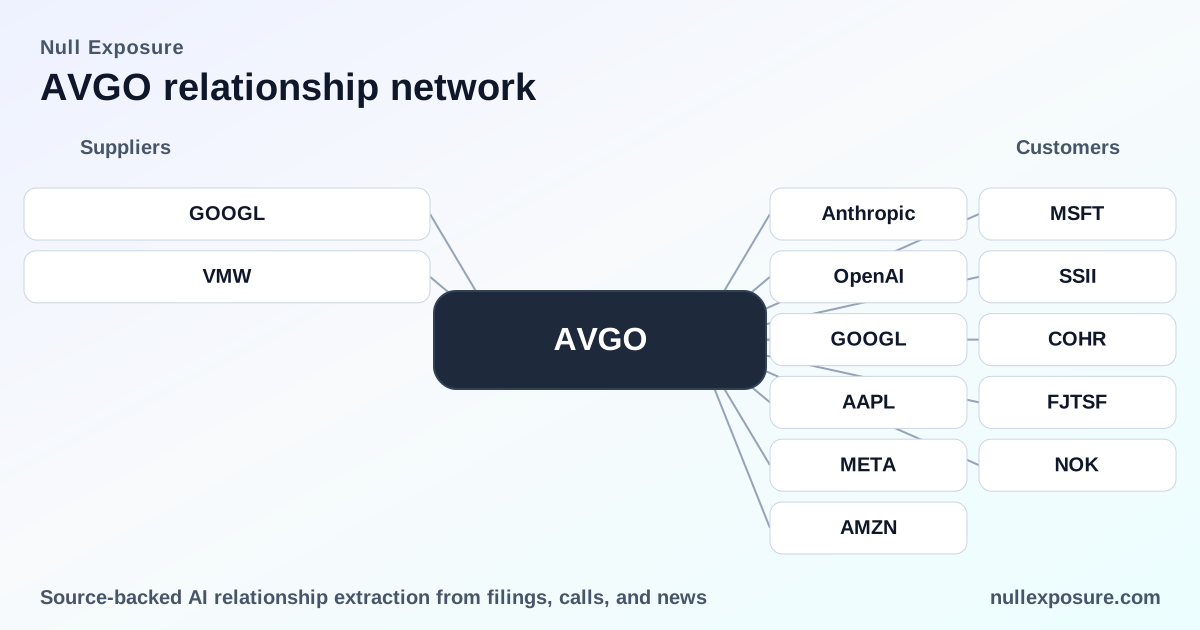
Broadcom's customer map: hyperscalers, OEMs and the revenue mechanics behind AVGO's AI surge
Broadcom designs and supplies semiconductor components and infrastructure software to hyperscalers, OEMs, distributors and enterprise service providers, monetizing through high-volume silicon contracts, custom AI accelerator programs, networking ASIC sales and recurring software/service agreements (including VMware). Its revenue mix is driven by a handful of large, long-tenured customers and channel partners that both scale demand quickly and concentrate commercial risk. For investors, the core thesis is simple: Broadcom is the prime beneficiary of hyperscaler AI capex, but the payoff comes with customer concentration and channel dependence that deserve active monitoring. For a concise commercial intelligence feed and to track changes to these relationships, see https://nullexposure.com/.
Why the roster matters to returns and risk
Broadcom’s competitive position is defined by two structural advantages: custom silicon scale (multi-year TPU and accelerator programs with hyperscalers) and broad distribution into OEMs and value-added resellers. That mix delivers rapid topline leverage when hyperscalers accelerate purchases, while distributors and OEM relationships smooth industrial cycles — at the cost of material customer concentration (Broadcom reports top-five customers account for roughly 40% of revenue) and geographic exposure in Asia. The company’s contracting posture is therefore multi-year, collaborative and strategic for the hyperscalers, and channel-driven and transactional for OEM and distributor flows.
Relationship roll call — who is buying Broadcom and what they buy
Below I summarize every customer relationship surfaced in the coverage, with a short plain-English takeaway and the original source reference.
OpenAI
OpenAI is identified as a major custom-silicon customer, referenced in Broadcom’s earnings commentary and press coverage as taking multi-gigawatt scale XPU deployments with orders discussed in 2026. (AVGO Q4 2025 earnings call; InsiderMonkey / SiliconANGLE coverage, Mar–Apr 2026.)
Anthropic
Anthropic placed a high-volume order for Ironwood TPU racks (reported as a $10 billion order in Q3 2025 remarks) and is executing a one-gigawatt TPU deployment cadence in 2026. (AVGO Q4 2025 earnings call; InsiderMonkey reporting, FY2026.)
Google / Alphabet (GOOGL / GOOG)
Google is a strategic partner on TPU development with a long-term TPU and networking supply agreement extending through 2031, and continued demand for seventh-generation Ironwood TPUs. (247WallSt article / ProactiveInvestors and Broadcom commentary, FY2026 / Mar 2026.)
Apple
Apple is cited as using the same TPU infrastructure in cloud AI deployments, positioning Broadcom’s TPU work as broadly adopted across leading cloud customers. (AVGO Q4 2025 earnings call, Mar 2026.)
Meta Platforms (META)
Meta is publicly listed among Broadcom’s high-volume custom accelerator customers and is described in earnings-coverage as shipping custom accelerators and under active multi-year programs. (Finviz / Yahoo SG coverage and InsiderMonkey Q1 2026 earnings commentary, Mar 2026.)
Amazon Web Services / Amazon (AMZN)
AWS is named as one of the cloud providers that Broadcom supports in designing customer AI processors and scaling them to silicon production. (SiliconANGLE coverage, Mar 4, 2026.)
Microsoft (MSFT)
Microsoft is included alongside other hyperscalers as a Broadcom customer for AI processor design and production. (SiliconANGLE coverage, Mar 2026.)
Cohere
Cohere is mentioned as a user of TPU infrastructure for cloud AI compute alongside Apple and SSI, indicating adoption among AI cloud providers beyond the hyperscalers. (AVGO Q4 2025 earnings call, Mar 2026.)
SSI (SSII)
SSI is referenced as a customer example using TPU-based AI cloud computing in Broadcom’s public remarks. (AVGO Q4 2025 earnings call, Mar 2026.)
DXC Technology (DXC)
DXC is described as the first global managed-service provider to contract as a VMware Cloud Service Provider partner under Broadcom’s program, illustrating Broadcom’s software channel strategy. (DXC web release on VMware transformation, FY2025.)
Synaptics (SYNA)
Synaptics acquired Broadcom’s Wi‑Fi assets in January 2025 and is using those assets to push into AI-native edge devices, illustrating an asset-level commercial relationship post-divestiture. (Finviz / Bitget reporting, FY2026.)
Extreme Networks (EXTR)
Extreme cites Broadcom as a strategic partner that supports component qualification and industry introductions — a channel-level relationship for networking and silicon. (NetworkWorld / InsiderMonkey earnings coverage, FY2026.)
Juniper Networks (JNPR)
Juniper’s new QFX5250 switch leverages Broadcom’s Tomahawk 6 silicon for intra-data-center switching, showing Broadcom’s role in networking platforms. (Fierce Network / NextPlatform coverage, FY2025–2026.)
Nokia (NOK)
Nokia’s 7220 IXR-H6 switching platform is powered by Broadcom’s TH6 silicon, reflecting Broadcom’s embedded role in telecom switch architectures. (Nokia earnings transcript excerpt / Morgan Stanley note, FY2026.)
Arista Networks (ANET)
Arista — like peers — relies on Broadcom-verified components, highlighting Broadcom’s entrenched role in hyperscaler-directed networking infrastructure. (Ad-hoc news coverage of Arista results, FY2026.)
Celestica (CLS)
Celestica is among first to prototype a liquid-cooled switch using Broadcom Tomahawk 6 modules and has qualified Broadcom-sourced DDR memory, indicating close supplier engagement. (TradingView / Celestica earnings call excerpts, FY2026.)
Super Micro (SMCI)
Supermicro’s MicroBlade platform integrates Broadcom networking controllers (BCM57414), demonstrating Broadcom’s reach into OEM server networking. (Supermicro press release / PR Newswire, FY2026.)
Fujitsu (FJTSF)
Fujitsu is reported as the first OEM to adopt certain Broadcom engineering samples, signaling early OEM engagements outside the U.S. hyperscaler market. (Yahoo SG / Finviz coverage, FY2026.)
KKR
Private equity firm KKR acquired Broadcom’s End-User Computing unit in a $4 billion deal, a transaction that reflects Broadcom’s portfolio reshaping on the software/service side. (InformationWeek / PR reporting, FY2026.)
ePlus (PLUS)
ePlus is recognized as a Broadcom Premier Solution Provider and VMware channel partner, representing a reseller route for Broadcom’s software stack. (PR Newswire release, FY2025.)
VMware (VMW)
VMware Cloud Foundation and VMware Private AI Services are sold through Broadcom and authorized Broadcom partners, confirming Broadcom’s go-to-market for its software-enabled services. (QuiverQuant news item, FY2025.)
ScanSource (SCSC)
ScanSource noted a prior loss of Broadcom business, illustrating that Broadcom’s channel decisions have material P&L implications for resellers. (InsiderMonkey transcript excerpt, FY2026.)
Western Union (WU)
Western Union publicly referenced Broadcom’s VMware pricing and service changes as a factor in its infrastructure decisions, an example of how Broadcom’s commercial terms affect long-standing customers. (SDxCentral reporting, FY2026.)
Lumentum (LITE)
Lumentum and Marvell are called out as DSP suppliers that both partner with and compete against Broadcom in optical module ecosystems, highlighting competitive dynamics within parts of Broadcom’s end markets. (Finterra market note, FY2026.)
Operational constraints and what they signal for investors
Broadcom’s public disclosures and coverage point to several company-level constraints that shape both upside and risk:
- High customer concentration and materiality: Broadcom reports top-five end-customers contributing roughly 40% of net revenue, so large orders from hyperscalers amplify revenue but also concentrate downside risk.
- Channel dependence: Distributors and OEMs account for a substantial majority of semiconductor sales (distributors were ~48% of net revenue in FY2025–24), which smooths volatility but makes Broadcom sensitive to distributor inventory cycles.
- Geographic exposure: Asia, and specifically China, represents a meaningful portion of shipments (about 17% of net revenue in FY2025), which introduces geopolitical and supply-chain risk.
- Mature, multi-year relationships: Many customer ties are long-standing and the result of collaborative development, creating revenue visibility but also contractual dependency on a few large partners.
These constraints reinforce a dual investment thesis: structural upside tied to hyperscaler AI demand and persistent concentration and channel risks that require active monitoring of order disclosures, multi-year contract terms and geographic shipment patterns.
Investor implications and recommended monitoring
Broadcom’s commercial momentum is anchored by TPU and custom-accelerator wins with Google, OpenAI, Anthropic and Meta — the very customers driving large-scale AI capex. Investors should track two vectors closely: (1) hyperscaler order timing and disclosed multi-year agreements (including the Google TPU deal through 2031) and (2) channel revenue trends and distributor inventory changes, which will signal whether growth is durable or front-loaded. For a structured feed on these relationship changes, see our platform at https://nullexposure.com/.
Bottom line: Broadcom’s business model turns few, very large customers into outsized revenue, which fuels upside in an AI-driven cycle but keeps downside concentrated. Investors should position for asymmetric upside while keeping exposure to the firm’s top-customer and channel dynamics under continuous review.