Atea Pharmaceuticals (AVIR): Partner-driven cash inflection and partner concentration define the investment case
Atea Pharmaceuticals is a clinical-stage antiviral developer that monetizes primarily through strategic collaborations with large pharmaceutical companies—upfront payments, development milestones and potential royalties on commercial products—while continuing to fund internal R&D. For investors, the company's value hinges on its ability to convert clinical programs into licensed partnerships and to extract large, non-recurring payments that materially strengthen the balance sheet and extend runway. Learn more at NullExposure.
How Atea’s business actually makes money
Atea operates as a research-led biotech: it advances antiviral candidates through clinic-focused development and then transfers commercialization risk to larger partners through licensing and co-development agreements. This contracting posture produces three predictable revenue levers for the company: upfront license fees, development and regulatory milestones, and eventual commercial royalties. Given Atea’s clinical-stage profile and FY2025 figures (TTM revenue ~$192M, market cap ~$456M), large one-time collaboration payments materially affect investor outcomes and valuation.
Deal anatomy: partnerships rather than products
Atea’s operating model is structured around partner-led execution. That means:
- Contracting posture: Atea negotiates licensing and co-development agreements where counterparty obligations (development, manufacturing, commercialization) sit with larger, more mature pharma companies.
- Concentration: Revenue volatility is elevated because a small number of large partners can drive the majority of cash inflows.
- Criticality: Partner relationships are critical to commercialization and scale; losing or failing to conclude such deals would directly compress runway.
- Maturity: As a clinical-stage company, Atea’s revenues are predominantly collaboration-derived rather than product sales, which is typical for its maturity profile.
These characteristics explain why a single upstream payment can transform near-term financing dynamics and should be central to investor diligence.
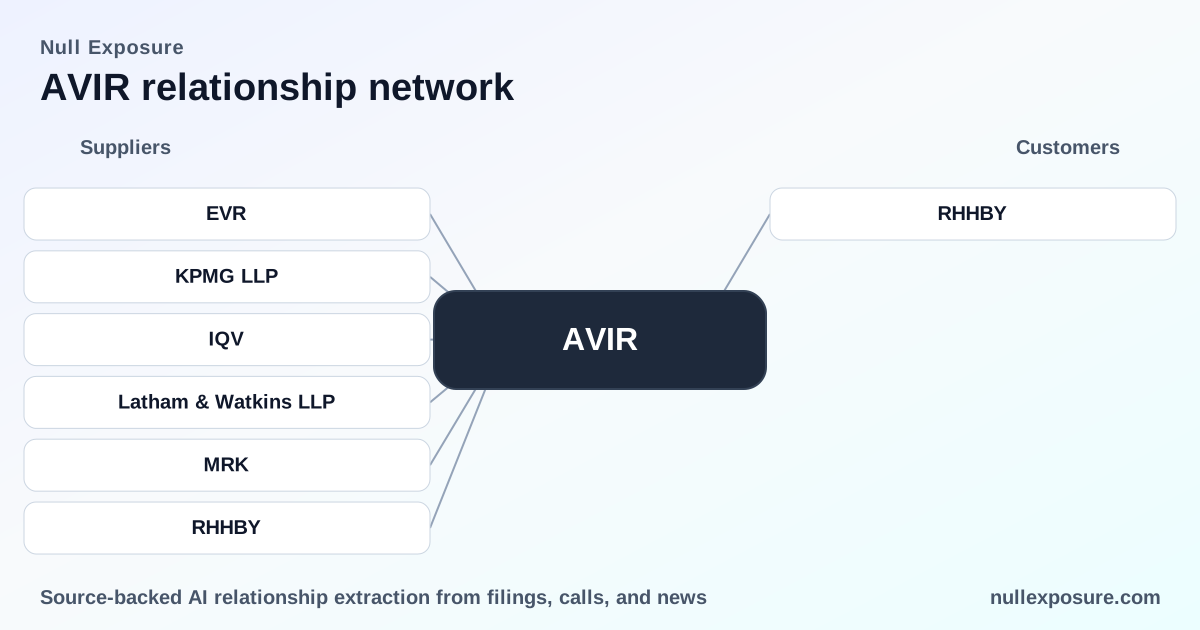
All customer relationships in the public record (as captured)
Atea’s customer relationship feed includes two entries that reference the same collaboration but are recorded under slightly different names. Each entry below is presented verbatim from the source capture and followed by a plain-English summary.
RHHBY (inferred symbol) — FY2020
BioSpace reported that Roche committed an upfront payment of $350 million to Atea as part of a COVID‑19 antiviral collaboration; the article references the FY2020 deal structure. Source: BioSpace coverage of the Roche–Atea collaboration (article: “Roche and Atea teaming on COVID‑19 antiviral drug”; first seen March 9, 2026) — https://www.biospace.com/roche-and-atea-teaming-on-covid-19-antiviral-drug.
Roche — FY2020
The same BioSpace piece notes that Roche is paying Atea an upfront payment of $350 million in connection with the companies’ COVID‑19 antiviral collaboration recorded for FY2020. Source: BioSpace report on the Roche–Atea partnership (see article linked above).
(These two records are duplicates in the capture; both describe the Roche upfront payment tied to the FY2020 collaboration.)
Why the Roche upfront is strategically important
The $350 million upfront cited in the public record is not an academic detail—it is a transformational cash event relative to Atea’s scale. For context, Atea’s trailing‑twelve‑month revenue is roughly $192 million and market capitalization is roughly $456 million (latest public figures). An upfront of this size accomplishes two investment-relevant outcomes:
- Extends runway and reduces near-term financing risk because it supplies immediate non-dilutive cash.
- De-risks program economics in the sense that early payments shift some of Atea’s R&D risk onto a large partner, improving prospects for sponsor-backed progression.
Investors should treat such collaboration payments as both liquidity events and evidence of external validation from major pharma buyers.
What investors should watch in partner relationships
- Concentration risk: Atea’s reliance on a small number of large partners creates idiosyncratic downside if counterparties change strategic priorities.
- Upfront versus milestone mix: A higher proportion of upfront cash reduces reliance on future milestone attainment; Atea’s historical $350M upfront for Roche is a clear example of beneficial deal structure.
- Counterparty execution: The partner’s willingness and capacity to advance clinical programs (regulatory strategy, manufacturing scale, and commercial commitment) determines eventual royalties—partners are execution engines.
- Balance-sheet impact: Large upfronts materially affect liquidity and valuation multiples for a company without marketed products.
Key implications for risk/reward
- Upside: Large partner payments validate Atea’s programs and provide financing tailwinds that reduce dilution risk; significant upfronts accelerate value realization even absent approved products.
- Risk: Concentration of revenue sources and dependency on counterparties for commercialization remain structural risks. Investors should stress-test scenarios where collaborators scale back or reprioritize.
- Catalysts to watch: New licensing deals, milestone captures, and regulatory readouts that trigger payouts will move the valuation more than routine operational metrics.
Bottom line — what the Roche relationship signals for AVIR investors
The public record confirms a material collaboration with Roche that included a $350 million upfront tied to a COVID‑19 antiviral program in FY2020. That single deal illustrates Atea’s core go-to-market model: develop promising antivirals through clinical stages and monetize progress via large pharma partnerships. For investors evaluating AVIR, the central questions are whether Atea can replicate Roche‑scale deals, diversify its partner base, and translate collaboration revenue into long-term commercial economics.
For a deeper screening of partner concentration and deal cadence across small-cap biotechs, visit NullExposure.
Bold takeaways: Atea is partner-dependent, large upfronts materially shift its financial profile, and Roche’s $350M payment is a strategic validation that substantially altered Atea’s cash position relative to its size.