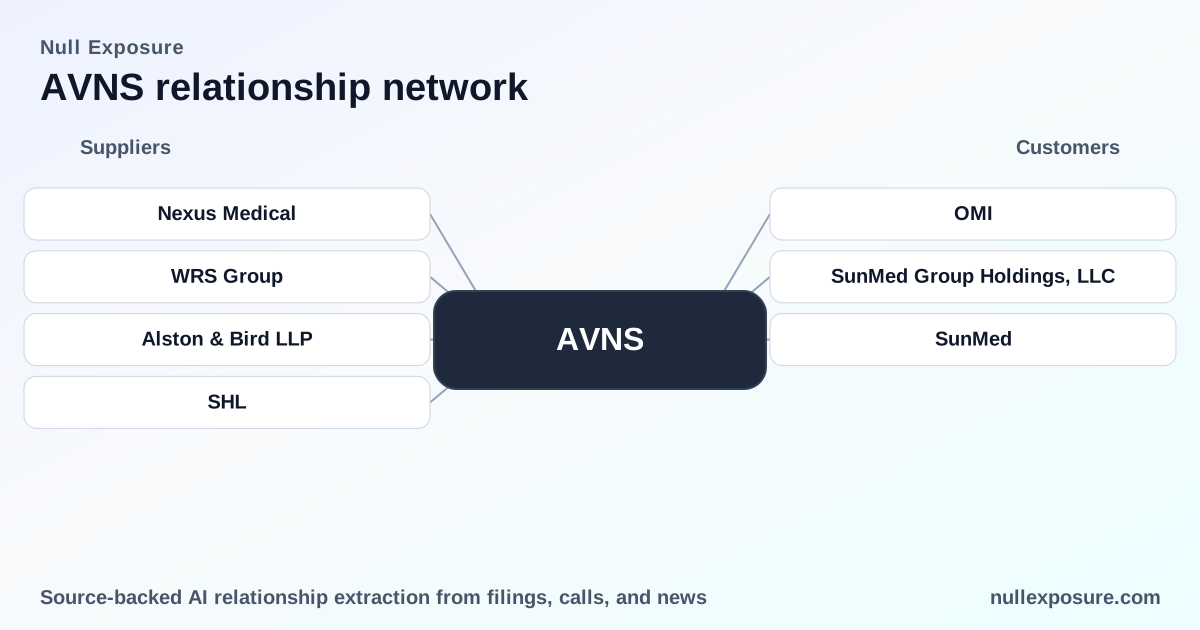
Avanos Medical (AVNS): How customer ties shape the recovery and risk profile
Avanos Medical is a medical-device manufacturer that sells enteral feeding, pain management, and post-operative care products primarily through wholesale distributors and group purchasing organizations (GPOs). It monetizes by manufacturing proprietary consumables (feeding tubes, enteral systems, neonatal products) and contracting multi-year supply arrangements and GPO agreements that generate recurring product sales and distributor rebates; services and rental lines have been selectively divested to refocus the company on higher-margin implantable and consumable franchises. For investors, the thesis is straightforward: Avanos’ cash flows derive from concentrated, contract-backed product sales routed through distributors and GPO channels, which creates steady revenue but concentrates counterparty and rebate exposure. Learn more at https://nullexposure.com/.
What Avanos sells and how the customer base funds it
Avanos generates revenue primarily from consumable medical devices sold to hospitals and long‑term care providers. The company reports that three product families each contributed more than 10% of consolidated net sales, and that distribution channels account for roughly half of North American sales and more than half of global sales. Contracting posture relies on a mix of three‑year supply agreements and GPO contracts that are typically renewed on a three‑year cadence and include sales‑based fees recorded as reductions to net sales.
- Key commercial drivers: proprietary consumables with recurring use, distributor rebate mechanics (material), and GPO channel economics (short contract renewal cycles but broad reach).
- Business-model consequences: concentration by product and channel creates steady revenues but increases exposure to distributor negotiation and rebate pressure; divestitures in recent years have sharpened the product mix toward core franchises.
Public relationships that matter (what the record shows)
Owens & Minor — legacy transaction and industry positioning
Multiple industry pieces recall that Owens & Minor acquired Halyard Health’s surgical and infection prevention business in 2018, a transaction that materially reshaped Halyard and preceded the rebrand to Avanos. This history is relevant because it explains Avanos’ strategic pivot from broader hospital consumables toward higher-margin, focused medical-device franchises. (Sources: MassDevice and Medical Design & Outsourcing, referencing FY2018 transaction.)
SunMed Group Holdings / SunMed — asset sale of Respiratory Health (FY2023)
Avanos sold its Respiratory Health business to SunMed Group Holdings in 2023, a strategic divestiture executed for cash consideration reported at approximately $110 million. This sale reduced non-core product exposure and funded a transformation that included later exits of certain product lines and rental businesses. (Sources: PR Newswire announcement, PlasticsNews coverage; transaction noted in subsequent SEC commentary reported on TradingView.)
American Industrial Partners — strategic buyer interest (FY2026)
A financial press release in May 2026 reported that affiliates of American Industrial Partners were investigating an acquisition of Avanos for $25.00 per share in cash, signaling private‑equity interest and a potential change in ownership. That process is material to customers and counterparties because a take‑private outcome would likely accelerate portfolio rationalization and distribution strategy changes. (Source: FinancialContent press release, May 2026.)
How the company-level constraints shape customer risk and contract design
Avanos’ public disclosures and the extracted constraint signals point to a consistent commercial architecture. Presenting these as company-level signals, not tied to any single relationship unless explicitly named:
- Contracting posture: Avanos uses supply agreements that typically run three years and GPO arrangements renewed on similar multi‑year cycles; performance obligations are usually limited to shipment or delivery on purchase orders. This produces predictable near-term revenue but leaves renewal and pricing risk concentrated at multi‑year intervals.
- Contract mix (long and short term): The firm operates both longer-term supply agreements and GPO-driven, effectively short-term renewals where fees are recorded as reductions of net sales; GPO‑channel sales accounted for about 28% of global net sales in 2024 when including wholesale distributor flows.
- Concentration and materiality: Avanos reports that MIC-KEY, Corpak, and NeoMed product lines each represented more than 10% of consolidated net sales, and distributor sales constitute approximately 50–54% of net sales globally—this is a concentrated product and channel footprint that makes distributor and GPO relationships commercially critical.
- Relationship role and maturity: The company’s typical counterparty is a distributor or end‑user buyer, with distributors responsible for roughly half of North American shipments; relationships are operationally mature in the sense of repeat purchases, but commercially exposed to renewal negotiations and rebate mechanics.
Investment implications — what operators and investors should price in
- Revenue stability with concentrated downside. The recurring nature of consumable sales and multi‑year supply arrangements supports steady cash conversion, but concentration in a handful of product lines and heavy reliance on distributors/GPOs amplifies downside if rebate pressure or contract renewals turn adverse.
- Strategic clarity from divestitures and buyer interest. The Sale of Respiratory Health to SunMed and later portfolio pruning underline management’s intent to focus the company; the AIP buyout interest signals potential acceleration of that agenda under private ownership, which can unlock value if execution tightens margins and reduces complexity.
- Counterparty and execution risk. Because Avanos records fees to GPOs as a reduction to net sales and distributes through third parties for roughly half of North American sales, operational execution (supply reliability, pricing discipline, distributor relationships) is the dominant risk vector for revenue continuity.
- Valuation context. Market multiples and operating metrics (EV/Revenue ~1.7; EV/EBITDA ~9.8 per recent figures) imply investors are pricing recovery and margin improvement, but those assumptions rest on stable distributor/GPO dynamics and successful product‑line focus.
Conclusion: what to watch next
- Monitor contract renewals with major GPOs and top distributors, and any disclosures about changes to rebate structures.
- Track follow‑through on the AIP process for signs of binding offers or due‑diligence findings that would alter strategic direction.
- Watch for further portfolio transactions that either monetize non‑core assets (as with SunMed) or deepen focus on MIC‑KEY/Corpak/NeoMed franchises.
For a concise, investor-focused view of how these customer dynamics affect credit and valuation, visit https://nullexposure.com/.
Bold takeaway: Avanos’ earnings power is driven by concentrated, recurring consumable sales routed through distributors and GPOs — a structure that supports predictability but concentrates counterparty and rebate risk.