Anteris (AVR): Customer relationships that shape a thin-revenue, high-conviction clinical story
Anteris Technologies markets and sells ADAPT™ regenerative tissue to device manufacturers and distributors and monetizes through: (1) unit sales of tissue products, (2) limited field licenses tied to specific manufacturing uses, and (3) capital raises and strategic equity placements that fund its DurAVR transcatheter heart valve (THV) program. The business is therefore a hybrid commercial/clinical developer: revenue today is concentrated and spot-driven, while capital partnerships (notably with Medtronic) are central to executing the pivotal trial and scaling manufacturing. For deeper coverage of AVR relationships, see NullExposure’s analysis hub: https://nullexposure.com/.
Why customers matter for the investment case
Anteris’s commercial footprint is narrow and highly concentrated around a few counterparties. Revenue recognition is largely at a point in time upon delivery, consistent with spot sales of tissue products, while specific partners hold limited, field-of-use licenses that constrain how ADAPT™ is commercialized. That structure means customer contracts are simultaneously revenue-driving and strategically constraining: a small set of buyers determine near-term sales and an even smaller set of capital providers determine the pace of clinical and manufacturing scale-up.
- Concentration: The company reports major customers accounting for 10%+ of revenue—this is a material concentration that amplifies counterparty risk. (Company filings, FY2024).
- Contracting posture: Net sales of ADAPT tissue are recognized at delivery (point-in-time); the 4C relationship is governed by a Supply & License Agreement with renewal mechanics. (FY2024 Form 10-K).
- Geography: Management targets North America and Europe as initial markets, so commercial traction will be measured across those regions. (FY2024 Form 10-K).
If you evaluate AVR as an operator or investor, the combination of concentrated commercial revenue and outsized reliance on financing events is the core structural narrative.
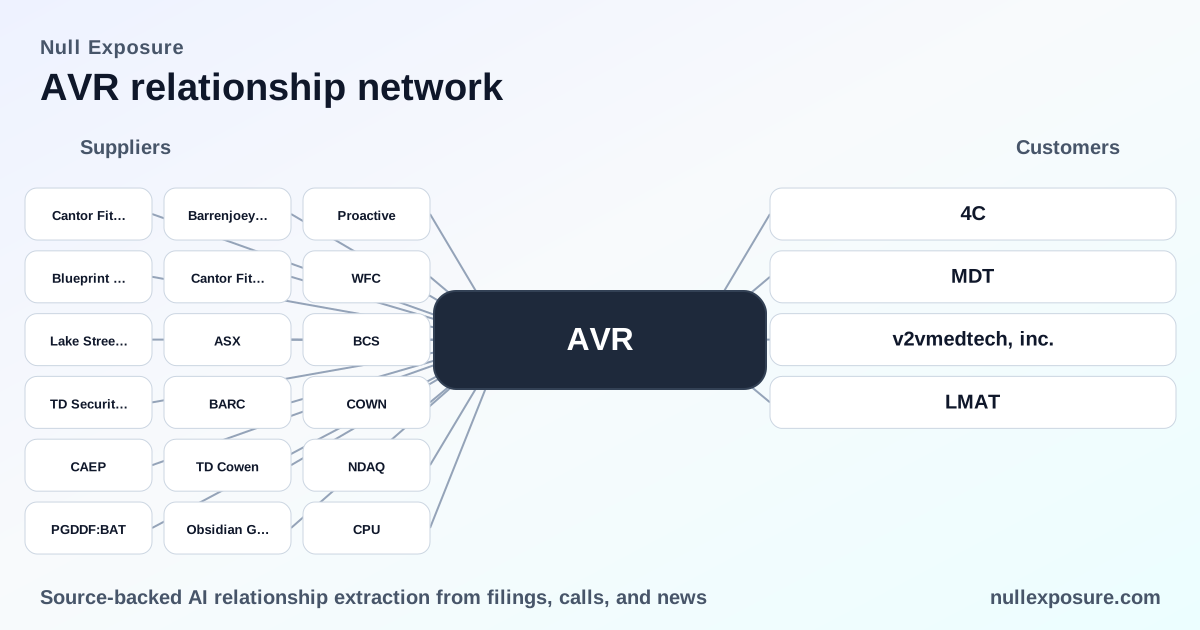
Customer map: four relationships you need to know
4C — a strategic supply and license partner
Anteris supplies ADAPT™ tissue to 4C under a Supply and License Agreement that governs sales and grants a limited sterilization-method license tied to 4C’s device production; pricing is executed via purchase orders with unit pricing that reflects anticipated annual volume. 4C is an active, contractual buyer and licensee of ADAPT™, and the agreement’s initial term is set to expire June 1, 2026 with automatic one-year renewals. (FY2024 Form 10-K)
Medtronic plc (MDT) — capital partner and minority strategic investor
Medtronic purchased shares in a private placement and participated in a concurrent public offering; Anteris closed a private placement of 15,652,173 shares at $5.75 per share to a Medtronic subsidiary, with up to $90 million of shares agreed to be sold to Medtronic at the same public offering price. Medtronic’s role is primarily a financing and strategic alignment – not a customer for ADAPT™ tissue under the disclosed items – and its equity stake materially de-risks near-term financing requirements. (GlobeNewswire press releases, Jan 21–22, 2026)
LeMaitre (LMAT / LeMaitre Vascular Inc.) — legacy distributor and licensee
Anteris sold its CardioCel™ and VascuCel™ patch business to LeMaitre in 2019 and granted LeMaitre an exclusive IP license for cardiovascular patch use; historically, LeMaitre was a principal buyer/distributor of ADAPT™-based patches. Manufacturing for LeMaitre ceased in January 2025 in line with contractual arrangements, reducing a prior source of distributed patch revenue and concentrating Anteris’s sales profile. (FY2024 Form 10-K; GlobeNewswire corporate update, Mar 13, 2025)
v2vmedtech, inc. — program-level beneficiary of proceeds
Anteris has stated it will use financing proceeds to support its DurAVR pivotal trial, manufacturing expansion and development initiatives “for v2vmedtech, inc.”; v2vmedtech is presented in public reporting as a development focus supported by proceeds rather than as a large current revenue source. (SahmCapital reporting on the Jan 21, 2026 financing announcement)
Operational constraints and what they imply for investors
The public record and the company’s disclosures yield several company-level signals that frame risk and upside.
- Spot-heavy revenue model with select licensing: Net sales are recognized at delivery, indicating a transactional revenue pattern for tissue units; concurrently, at least one partner (4C) operates under a multi-year Supply & License Agreement that adds a licensing dimension to revenues. (FY2024 Form 10-K)
- Material customer concentration: The company discloses customers individually accounting for 10%+ of revenue, which heightens counterparty risk and ties recovery of commercial margins to a small set of buyers. (FY2024 Form 10-K)
- Distributor and licensee dynamics: LeMaitre historically functioned as a distributor and licensee; that relationship’s manufacturing cessation in 1Q2025 removes a prior source of distributed sales and shifts the company further toward direct supply relationships and strategic capital partners. (FY2024 Form 10-K; GlobeNewswire, Mar 2025)
- Geographic focus: Management’s commercial priority is North America and Europe, so regulatory and reimbursement dynamics in those regions will be decisive for adoption of ADAPT-enabled devices. (FY2024 Form 10-K)
- Stage and product concentration: Management views the business as a single commercial/clinical segment centered on ADAPT tissue and the DurAVR THV program; the company is in an active but development-weighted stage where near-term revenues are small relative to the capital needed to progress pivotal trials. (FY2024 Form 10-K)
These constraints produce a clear operational profile: a clinically-focused medical-technology developer with narrow current commercial flows and outsized exposure to financing and strategic partners.
For real-time relationship tracking and to review related filings and press releases, visit NullExposure: https://nullexposure.com/.
Valuation, capital structure and the strategic picture
Anteris reports modest TTM revenue (~$1.9 million) against a wide operating loss; market capitalization is approximately $596 million. The January 2026 equity transactions with Medtronic are strategic — they supply meaningful capital to fund the DurAVR global pivotal trial and manufacturing expansion while delivering a reputable industrial partner that can accelerate clinical and commercial pathways. Value for equity investors will be driven less by near-term tissue sales and more by clinical milestones, manufacturing scale-up, and partnership execution. (Company filings; GlobeNewswire, Jan 2026)
Bottom line: what investors and operators should watch next
- Track commercial volumes to 4C and any restart or expansion of manufacturing for legacy partners; these will move near-term revenues.
- Monitor clinical milestones and manufacturing KPIs funded by Medtronic’s capital—those milestones will determine valuation re-rating.
- Evaluate counterparty concentration: loss or material renegotiation with any major buyer would disproportionately harm revenue and operating leverage.
Anteris is a classic capital-dependent medtech story: small current revenues; concentrated customers; strategic equity partnerships that underwrite clinical scale-up. For a running dossier of filings and relationship intelligence, check NullExposure’s coverage at https://nullexposure.com/.