Avnet (AVT): Distribution, services and a growing role in power semiconductors
Avnet is a global electronic component distributor and solutions provider that monetizes through product resale, value-added supply-chain services, and technical/commercial support contracts with component manufacturers and OEMs. The company generates revenue by purchasing components for resale, acting as an agent for supply-chain engagements, and charging for engineering, logistics and commercial support tied to suppliers’ product lines—a mix that yields thin distribution margins offset by higher-margin services and recurring supply agreements. For investors, Avnet’s balance of scale, global footprint and service capabilities positions it as a strategic partner for both large OEMs and smaller design firms. Learn more on the NullExposure homepage: https://nullexposure.com/.
One-line investment thesis for customer exposure
Avnet’s customer relationships are commercially defensive and operationally critical: the business captures low-margin transactional volume across a broad global footprint while leveraging technical services and vendor partnerships to sustain higher-margin revenue streams and deepen customer stickiness.
What the NVTS relationship signals about Avnet’s strategy
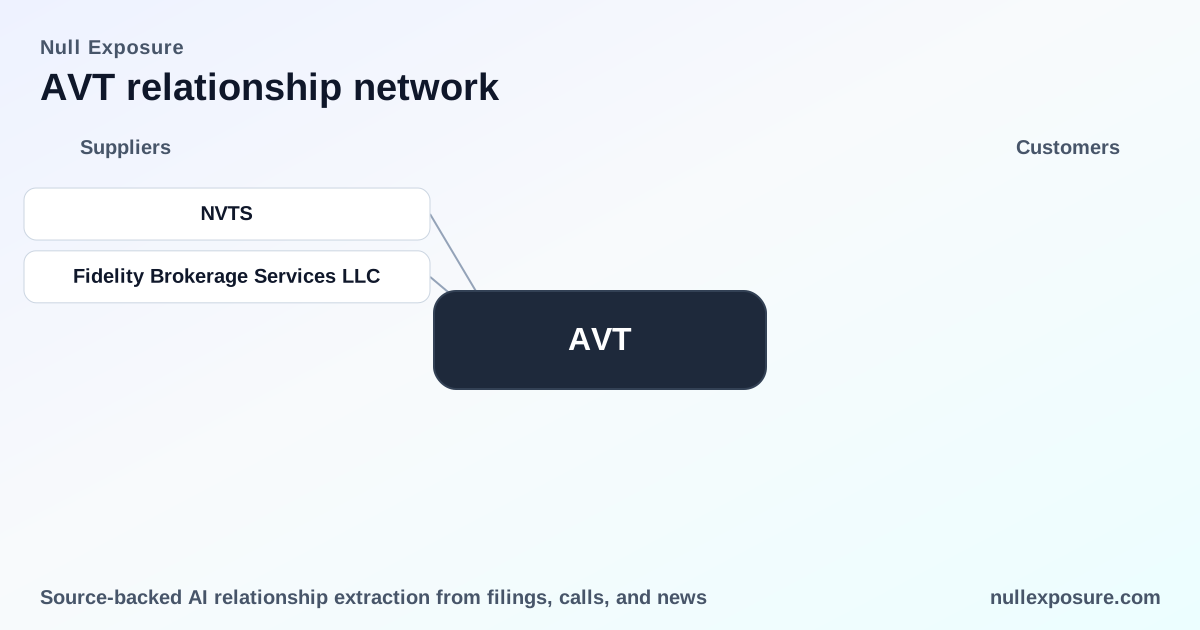
Avnet signed a commercial support arrangement with NVTS that positions Avnet to provide technical and commercial support for NVTS’ GaN and SiC products across regions. According to a Finviz report dated March 10, 2026, the deal has Avnet acting as a regional technical and go‑to‑market extension for NVTS’ power-semiconductor lines, reinforcing Avnet’s role as a value-added channel partner for emerging high-growth component categories. This relationship underscores Avnet’s move to capture margin uplift from customers in power electronics while leveraging its global distribution and engineering salesforce.
Customer relationships in the record (complete coverage)
- NVTS — Avnet provides technical and commercial support for NVTS’ GaN and SiC product lines across multiple regions, effectively serving as a market-facing partner to scale NVTS’ power-semiconductor distribution and adoption. Source: Finviz news coverage, March 10, 2026.
Company-level constraints and what they reveal about Avnet’s operating model
The available constraints read as consolidated signals about Avnet’s customer base, geographic mix, and role complexity. Treat these as company-level characteristics rather than attributes of any single partner.
- Counterparty mix: broad by scale. Avnet serves startups, small businesses, mid-market customers and large enterprise OEMs and EMS/ODM partners. That diversified customer scale reduces single-counterparty concentration risk while requiring flexible contracting and credit underwriting processes to manage varied payment profiles (evidence from company descriptions and filings).
- Global footprint with regional concentration. Public figures reflect a regional split where Asia accounts for roughly 47% of revenues, EMEA about 29%, and Americas about 24% (figures shown in Avnet filings reporting Total Avnet $22,200.8 with Asia $10,491.2 and EMEA $6,409.6). This makes Avnet exposed to Asia-driven semiconductor cycles and supply-chain dynamics, while retaining a broad international customer reach across 140+ countries.
- Multiple relationship roles. Avnet acts as a seller (component distributor), buyer (inventory acquirer), and service provider (supply-chain agent and technical support) in different contracts, which gives it diverse revenue channels but also introduces inventory and performance obligations that require active working-capital management.
- Active and mature engagement. The company’s century-long presence and current filings position Avnet as an active, mature market participant operating in distribution and supply-chain services rather than an early-stage intermediary; investors should view customer contracts as generally established and operational rather than experimental.
- Segment focus: distribution with services overlay. Avnet’s core business remains electronic-component distribution, complemented by supply‑chain services and engineering support that yield higher-margin pockets and strengthen customer retention.
How these constraints translate into investor-relevant risks and advantages
- Advantage — scale and channel stickiness. Avnet’s ability to serve a full spectrum of customers and to act as a technical/commercial extension for suppliers (as with NVTS) creates durable channel relationships and recurring service revenue that improve lifetime customer value.
- Risk — regional concentration and inventory exposure. With nearly half of revenues tied to Asia, macroeconomic or supply disruptions in APAC will meaningfully pressure volume and working capital; inventory held for supply-chain service engagements amplifies this exposure.
- Advantage — margin uplift from specialist product categories. The NVTS engagement around GaN and SiC—both high-growth power-semiconductor categories—demonstrates Avnet’s ability to secure partnerships in higher-margin, technology-led segments, improving average revenue per customer where technical support is required.
- Risk — credit and counterparty diversity. Serving startups alongside global OEMs reduces single-buyer concentration but increases exposure to credit variability and the need for disciplined sales financing and receivables management.
Operational posture and contracting implications
Avnet’s operating model requires flexible contracting (reseller agreements, agency contracts, supply-chain service agreements and technical support arrangements). Investors should model Avnet’s revenue as a mix of:
- Low-margin transactional resale (volume-driven),
- Medium-to-high-margin services and technical support that are contractually tied to suppliers and customers, and
- Agency-based logistics arrangements that carry lower margin but stable cash flow when executed at scale.
These contracting characteristics impose working-capital demands and operational complexity, but they also create multiple levers for margin expansion through service penetration and supplier exclusivity.
Portfolio implications and final read
The NVTS relationship is instructive: Avnet is actively monetizing technical go-to-market support for power-semiconductor suppliers, which is consistent with a strategic emphasis on higher-margin, specialised components. At the same time, the company-level constraints—broad customer mix, APAC revenue concentration and multi-role engagements—point to a business that balances scale-driven volume with service-led margin enhancements.
For investors evaluating customer relationships at Avnet, the primary conclusions are clear: diversified customer scale reduces counterparty concentration risk; APAC exposure is a material macro sensitivity; and supplier partnerships in new semiconductor segments are a proven growth vector.
If you want ongoing, structured monitoring of customer-relationship signals and how they impact risk and valuation, visit our platform for detailed coverage: https://nullexposure.com/.