Avalo Therapeutics (AVTX): Partnering the Pipeline to Market
Avalo Therapeutics operates as a clinical-stage biotechnology company that develops immunology-focused therapeutics for rare and underserved diseases. The firm monetizes primarily through licensing deals, selective asset divestitures and milestone/royalty arrangements, while product sales remain negligible today; near-term value for investors depends on partnership execution and non-dilutive monetization of pipeline assets. For a concise briefing on Avalo’s customer and partner footprint, visit https://nullexposure.com/.
Why partner deals define Avalo’s commercial profile
Avalo’s business model is typical of small biotechs: heavy R&D expense, limited product revenue, and reliance on third parties to shoulder later-stage development, manufacturing and commercialization. License transfers and asset sales are the functional revenue engine today, not product launch economics. That posture produces a contracting profile skewed toward exclusive licenses and downstream milestone/royalty streams rather than broad product distribution agreements.
Deal-by-deal read: the customer/partner relationships you need to know
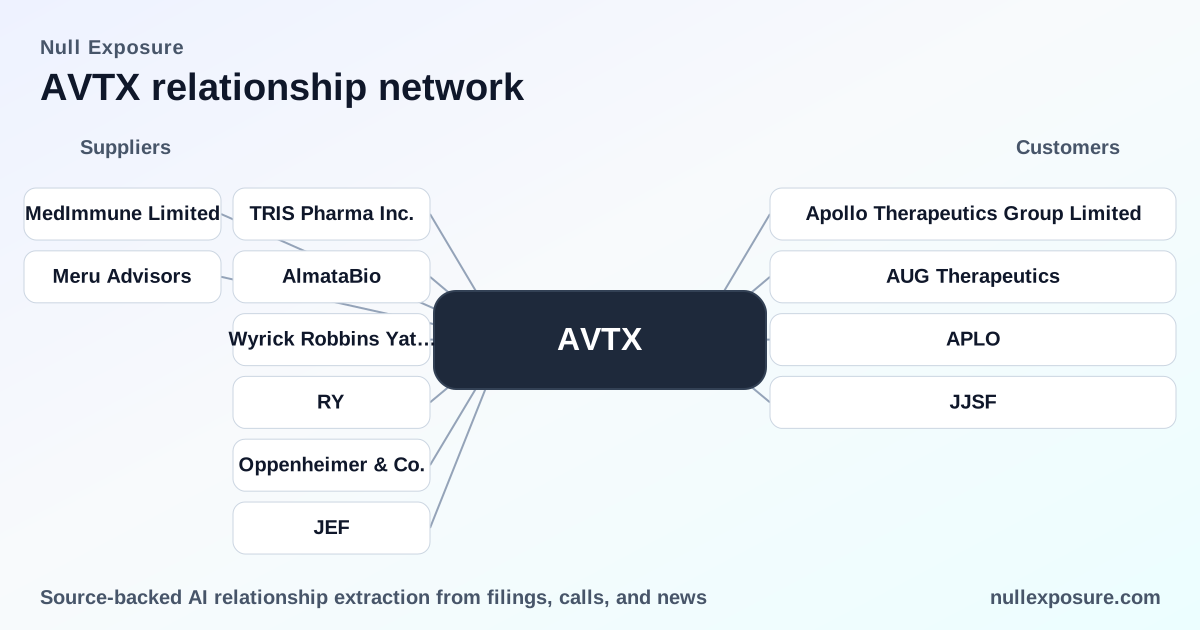
Apollo Therapeutics Group Limited — exclusive license for AVTX‑007
Avalo granted Apollo Therapeutics a worldwide, exclusive license to research, develop, manufacture and commercialize AVTX‑007 (camoteskimab). This is a conventional biotech licensing move that shifts late‑stage development and commercialization risk to a partner while creating potential milestone and royalty upside for Avalo. According to a GlobeNewswire press release in August 2022, the transfer was announced as a formal license agreement.
AUG Therapeutics — acquisition of three rare‑disease programs
Avalo sold AVTX‑801 (D‑galactose), AVTX‑802 (D‑mannose) and AVTX‑803 (L‑fucose) to AUG Therapeutics following a corporate restructuring and creditor default process. This set of asset sales materially reduces Avalo’s direct development obligations for those small‑molecule rare disease candidates and converts research programs into upfront and contingent cash flows. FierceBiotech reported the transfer and context in March 2026, noting the asset disposition followed a prior default and strategic sell‑off.
Apollo (APLO) — counterparty in revenue recognition contingencies
Avalo’s 2024 Form 10‑K documents situations in which Apollo (listed as APLO in Avalo’s filing) could be required to make payments to a third party (ES Therapeutics), and notes that Avalo will recognize revenue from those contracts only when the risk of reversal is resolved. This clause reflects conservative revenue recognition linked to third‑party indemnities or contingent obligations and underscores that license economics are subject to contractual conditions in Avalo’s public filings for FY2024.
J&J — contingent payment exposure in existing contracts
Avalo discloses in its 2024 10‑K that Johnson & Johnson (J&J) is a named counterparty in agreements that could trigger payments to ES Therapeutics; Avalo states it will only recognize revenue when a significant reversal is not probable. The inclusion of J&J in these clauses highlights counterparty concentration with large strategic partners and the accounting caution that follows.
JJSF — mirrored disclosure of contingent obligations
Avalo’s 2024 10‑K includes a parallel disclosure listing JJSF in the same contingent payment context; Avalo’s policy is to defer revenue recognition until the company no longer faces a meaningful risk of material revenue reversal. The filing treats JJSF in the same manner as the J&J and Apollo relationships, reinforcing that multiple contract counterparts are subject to the same conditional revenue framework.
What these relationships collectively reveal about Avalo’s operating constraints
- Contracting posture — partner‑centric, license‑first. Avalo’s transactions favor exclusive licensing and asset sales rather than building an internal commercial engine. That strategy preserves capital but limits near‑term product revenue and increases dependence on partner execution.
- Concentration and counterparty scale. Large, named partners such as Apollo and J&J create single‑counterparty significance for certain assets and contingent obligations; this elevates counterparty risk while also offering scale benefits if partners succeed.
- Revenue recognition and cash visibility. Avalo’s 10‑K statements on contingent payments demonstrate conservative accounting: revenue from partner arrangements is recognized only when collectability and reversal risk are resolved, which reduces booked revenue volatility but also obscures short‑term top‑line growth.
- Geographic and distribution footprint. Company disclosures indicate Millipred® sales historically routed through wholesale distributors in the United States, signaling a legacy dependence on channel partners for product flow and a North America distribution concentration.
- Maturity of commercial capability. The pattern of selling or licensing late‑stage assets suggests Avalo is not scaling a direct commercial organization; this accelerates capital preservation but limits upside capture from full product economics.
Financial context that matters to investors
Avalo’s trailing twelve‑month revenue is immaterial ($59,000) and operating margins are deeply negative, reflecting a classic clinical‑stage cost structure. Market capitalization sits in the hundreds of millions while institutional ownership is high—an investor base that prizes binary clinical and partnership outcomes. Avalo’s strategy converts science into partnerable commercial rights; therefore, investor returns are tied to licensing milestones, successful partner development and selective non‑dilutive asset monetization.
Risks and upside to weight
- Upside: Successful milestones and partner commercialization would create material licensing/royalty income without Avalo carrying commercialization cost. The Apollo license for AVTX‑007 and the AUG divestitures are concrete examples of value crystallization.
- Risk: Heavy reliance on counterparties and conservative revenue recognition dampens near‑term visibility; contract contingencies with large partners can delay revenue realization even when economic value is likely.
Investor takeaway and next steps
Avalo is a partner‑driven biotech: its near‑term valuation is a function of executed licenses, asset sales and contingent milestone realization rather than direct product sales. For investors evaluating the company, monitor partner development timelines (especially Apollo’s program for AVTX‑007), any milestone receipts from AUG‑related transfers, and updates to the revenue recognition posture in subsequent filings.
For further investor intelligence and to track how these partner dynamics evolve, visit https://nullexposure.com/.
Sources referenced in this note include Avalo’s Form 10‑K for FY2024 (revenue recognition and contingent payment disclosures) and public reporting: a GlobeNewswire press release (August 2022) on the AVTX‑007 license to Apollo and a FierceBiotech report (March 2026) on the sale of three rare‑disease assets to AUG Therapeutics.