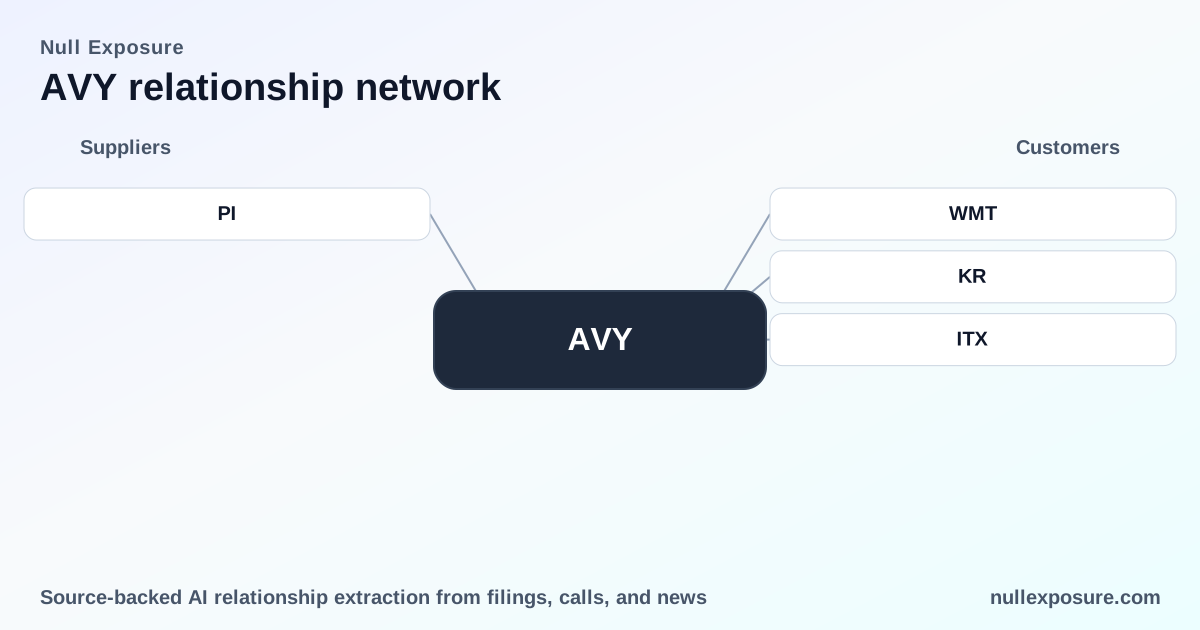
Avery Dennison (AVY): Customer Relationships Driving the RFID Growth Story
Avery Dennison operates as a global manufacturer and solutions provider for labeling, RFID inlays, apparel branding and related services, monetizing through product sales in its Materials Group and solution, software and services revenue in its Solutions Group. Revenue comes from high-volume product sales combined with strategic solutions contracts—notably recent rollouts of RFID-based visibility for major grocers—which are positioned to drive a revenue ramp in 2026. For deeper coverage and ongoing relationship signals, visit https://nullexposure.com/.
How Avery Dennison actually makes money from customers
Avery Dennison’s business model is twofold and deliberately integrated: high-margin manufacturing and high-leverage solution sales. The Materials Group sells pressure-sensitive label materials and related substrates at scale to label converters and CPG customers; the Solutions Group sells tags, RFID inlays, data-management services and related equipment that drive recurring commercial relationships and implementation fees. This dual posture creates a classic product-plus-service monetization profile—large-volume, product-driven cash flows complemented by solutions contracts that lift margins and create switching costs.
The company’s strategic activity—equity stakes and preferred-partner arrangements—signals a move from commoditized labels toward higher-value digital identification. Those commercial moves convert technical differentiation (RFID inlays, software-enabled visibility) into visible revenue ramps with large retail customers.
What the customer footprint signals about risk and operating posture
- Avery Dennison is a global operator: international operations account for the substantial majority of net sales, with Asia, EMEA and the U.S. each representing material shares of revenue. Geographic diversification reduces single-market exposure while increasing operational complexity.
- Customer concentration is low: no individual customer represented 10% or more of net sales in recent years, indicating low single-customer dependency as a structural feature of the business.
- Contracting posture blends product supply and services: substantially all revenue is derived from product sales (Materials Group), while Solutions Group revenue reflects services, software and equipment that deepen account engagement and increase lifetime value.
- Criticality and maturity: long-standing manufacturing scale is paired with accelerating commercial adoption of RFID solutions—this is an incumbent manufacturer executing a strategic, value-accretive pivot into digital identification. That positions the company for outsized growth if grocery and apparel rollouts scale as management outlines.
Customer relationships that matter (what investors should track)
Below I cover every relationship flagged in the recent coverage and provide concise takeaways investors and operators need to monitor.
Walmart — a major fresh-grocery ramp
Avery Dennison announced a major partnership with Walmart to deploy RFID solutions across fresh grocery categories (bakery, meat, deli), and management highlighted that the fresh grocery rollout is expected to accelerate adoption with revenues ramping through 2026. According to earnings call remarks in late 2025 and management commentary published in early 2026, the Walmart program is a potential multi-hundred-million-dollar growth vector as the rollout scales. (Sources: AVY Q3 and Q4 2025 earnings call transcripts cited March 2026; subsequent coverage on FinViz and InsiderMonkey in March–May 2026.)
Why it matters: Walmart’s scale both validates Avery’s RFID tech and creates a highway for broader retailer adoption; this relationship is a central revenue catalyst for 2026 guidance.
Kroger — strategic collaborator in food RFID
Avery Dennison described a strategic collaboration with Kroger that is “ramping up as expected,” with management pointing to continued strong growth in food categories tied to that partnership. The Kroger engagement is presented as an adjacent, parallel rollout to the Walmart initiative and underpins the company’s momentum in grocery visibility solutions. (Source: AVY Q3 2025 earnings call, reported March 2026; trade coverage in March 2026.)
Why it matters: Multiple large grocers running pilots and rollouts reduces execution risk and supports scale economics for inlay manufacturing and services.
Wiliot — preferred inlay partner and strategic investment
Avery Dennison took a $75 million stake in Wiliot and will serve as Wiliot’s preferred inlay design, manufacturing and commercial partner, deepening the company’s access to ambient IoT sensor technology and expanding its product roadmap for item-level sensing. Coverage in May 2026 linked the Wiliot investment to recent Walmart activity and to broader supply-chain sensing initiatives. (Source: DCVelocity coverage, May 2026.)
Why it matters: The Wiliot partnership converts strategic R&D exposure into commercial manufacturing and go-to-market exclusivity, accelerating product differentiation for retail customers.
Inditex Group — loss-prevention and visibility rollout
Management referenced a rollout with Inditex focused on loss prevention and visibility solutions, indicating Avery Dennison’s Solutions Group is winning enterprise apparel customers for security and inventory accuracy. This relationship was described in management commentary during the company’s recent earnings dialogue. (Source: InsiderMonkey transcript of AVY earnings commentary, May 2026.)
Why it matters: Apparel customers like Inditex push higher-margin tagging and software services and validate the Solutions Group’s international reach.
TransAct Technologies (TACT) — licensing of BOHA! software
TransAct Technologies acquired a perpetual license to the BOHA! software it previously licensed from Avery Dennison, demonstrating Avery’s role as a software-originator and licensor of retail printing/labeling tools. The transaction was reported in mid-2025 corporate filings and PR coverage. (Source: PR Newswire / FinancialContent coverage, August 2025 / reported in March 2026 dataset.)
Why it matters: Licensing outcomes convert intellectual property into cash and illustrate the company’s ability to monetize software assets beyond hardware and inlays.
CCL Industries — past divestiture (Office & Consumer Products)
Avery Dennison sold its Office and Consumer Products division to CCL Industries in 2013, a historical strategic move that reshaped Avery’s portfolio toward industrial and solutions-focused segments. This corporate history is noted in recent company coverage and analyst write-ups. (Source: StockInvestor coverage mentioning the 2013 divestiture, referenced in May 2026.)
Why it matters: The divestiture explains Avery Dennison’s present focus on materials and solutions for commercial customers rather than consumer office products; it underpins today’s strategic clarity.
Investment implications and tactical signals to watch
- Growth driver: Walmart and Kroger rollouts are the clearest near-term catalysts for Solutions Group revenue—monitor quarterly revenue attribution and supply-chain backlog to track conversion of pilots into recurring sales.
- Margin mix: As product sales scale and Solutions revenue grows, operating margin expansion is the likely next phase; watch gross margin by segment in quarterly reports.
- Operational risk: Global manufacturing footprint supports scale but creates sensitivity to trade and tariff dynamics across APAC, EMEA and the U.S.; management commentary on regional volume shifts is critical.
- Partnerization payoff: The Wiliot stake and TransAct licensing show management’s willingness to convert innovation into commercial partnerships and licensing revenue, improving optionality beyond pure manufacturing.
For a concise signal feed and relationship monitoring tailored to investors and operators evaluating AVY customer exposures, visit https://nullexposure.com/.
Bold final takeaway: Avery Dennison is executing a transition from large-scale label manufacturer to a solutions-led partner for major retailers—Walmart and Kroger rollouts are the immediate revenue levers, while strategic partnerships like Wiliot broaden the firm’s long-term moat.