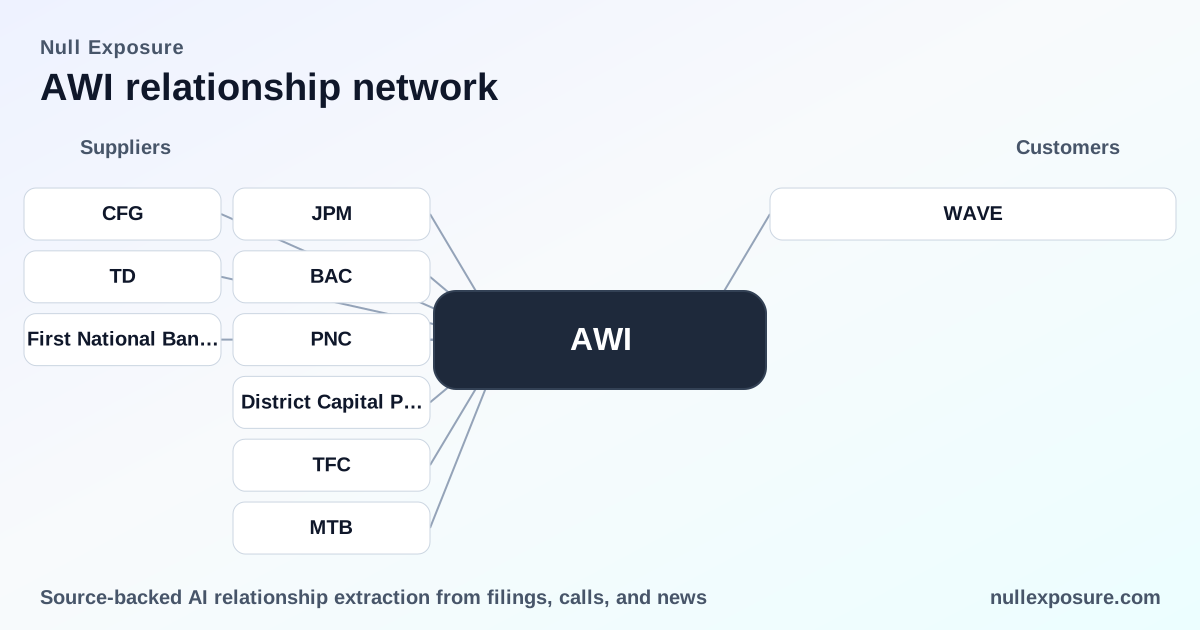
Armstrong World Industries (AWI): Customer Relationships and Commercial Risk Profile
Armstrong World Industries designs, manufactures and sells roofing systems and related building products, monetizing through product sales to distributors, home centers and direct customers across North America and Latin America. Revenue is driven by distribution channels (≈65% to distributors) and volume sales to large home centers (≈10% of net sales), with payment terms that emphasize short-term cash conversion. For investors evaluating counterparty exposure, the company’s customer mix concentrates economic sensitivity in a handful of large resellers while maintaining transactional contract structures that limit long dated receivable risk. For an enterprise-grade view of counterparty concentration and disclosures, see https://nullexposure.com/.
Quick investment thesis
AWI operates as a channel-driven industrial manufacturer: margin leverage depends on distribution economics and pricing in a consolidated building-products retail market, while cash conversion benefits from predominantly short-dated payment terms. The core investment case rests on stable demand for renovation and new construction balanced against concentrated customer relationships where consolidation among large buyers can compress pricing power.
What the filings and reporting reveal about specific partners
Below I cover every customer relationship mentioned in the available results with a concise takeaway and a readable source note.
WAVE
Armstrong purchases grid products from WAVE for resale and also provides selling, promotional and administrative services to WAVE for which it receives reimbursement; those services amounted to $26.5 million in 2024. This is a two‑way commercial relationship combining product supply and service revenue, representing a mid‑range spend relationship on AWI’s books. According to AWI’s 2024 Form 10‑K and related disclosures (FY2024), AWI both sources product from and invoices services to WAVE.
GMS, Inc.
AWI identifies customer consolidation risk highlighted by the acquisition of GMS, Inc. by The Home Depot, which the company cites as a structural exposure that can influence margin growth and profitability through concentrated purchasing channels. A TradingView news summary of AWI’s SEC filing (May 2026) captured the company’s explicit concern about consolidation at large distributors and home centers (FY2026 commentary).
Foundation Building Materials, Inc.
AWI also calls out consolidation among distributors via Lowe’s acquisition of Foundation Building Materials as a strategic risk to commercial dynamics—this consolidation is grouped with GMS as an example of structural customer consolidation that could affect margins and negotiating leverage. This observation comes from the same TradingView report summarizing AWI’s SEC filing commentary on customer consolidation (May 2026).
How these relationships fit AWI’s operating model and what investors should infer
The company-level constraints described in AWI’s disclosures form a clear operational picture:
- Contracting posture — short-term, transaction-oriented. AWI reports normal payment terms of 45 days or less and sales arrangements that lack material financing components. This results in faster cash conversion and limited long-term receivable duration, lowering liquidity risk from customers.
- Concentration and counterparty type — large enterprise customers are central. AWI sells heavily through building materials distributors and home centers (explicitly naming Lowe’s and The Home Depot as examples), so a relatively small set of large buyers exerts pricing influence and represents meaningful demand concentration.
- Criticality and role — distributors and resellers dominate. Distributors accounted for nearly 65% of consolidated net sales in 2024, and sales to large home centers were nearly 10% of consolidated net sales; AWI’s primary commercial role is as a supplier to distribution channels that resell to contractors, architects and end‑users.
- Geography — North America with Latin American exposure. The company primarily serves the United States, Canada and Latin America, creating regional demand drivers and currency/market risk profiles tied to NA and LATAM construction cycles.
- Maturity and spend profile — mixed but material relationships. Distributors represent mature, recurring commercial arrangements; the disclosed reimbursements from WAVE (~$26.5M in 2024) show mid‑tens‑of‑millions counterparty economics for certain partners rather than pure low‑value transactional flows.
These constraints combine to produce a working model where AWI’s cash flow durability depends on distribution channel health and concentrated buyer bargaining, yet its short payment terms and product resale model limit long-term credit exposure.
Key takeaways for investors
-
Channel concentration is a primary risk: distributors and a handful of large home centers drive the majority of revenue, creating negotiating leverage for buyers when consolidation occurs. (TradingView summary of AWI SEC commentary, May 2026.)
-
Short-term receivables reduce rollover risk: standard payment terms of 45 days or less support cash flow resilience in a cyclical construction environment (AWI 2024 disclosures).
-
Some counterparty relationships are material on a mid-sized scale: the company receives service reimbursements from WAVE in the tens of millions (AWI disclosure capturing 2024 figures), reflecting bilateral commercial ties beyond simple product sales.
-
Geographic diversification is moderate: core revenue is North America with Latin American exposure, which cushions single‑market swings but keeps results sensitive to NA construction cycles.
-
Operational implications: AWI’s negotiating position is vulnerable to buyer consolidation but supported by strong receivable management; investors should watch consolidation events among distributors and home centers as a leading indicator for margin pressure.
Risk indicators and monitoring checklist
- Monitor large buyer M&A and consolidation announcements (Home Depot, Lowe’s, GMS, Foundation) for shifts in procurement leverage and price pressure.
- Track AP/AR days and any deviation from the stated 45‑day payment norm as an early signal of distribution stress.
- Watch reimbursements and service-related cash flows tied to named counterparties (e.g., WAVE) for changes in the magnitude or terms of those arrangements.
Bottom line: where this sits in a portfolio
AWI is a channel-dependent industrial with disciplined cash conversion but concentrated customer risk. The company’s disclosures are explicit about distributor dominance and the downside from consolidation among large buyers. For due diligence, price the stock with an emphasis on margin sensitivity to buyer consolidation events and keep an active watch on significant counterparty transactions and M&A in the wholesale/home‑center ecosystem.
For a repeatable framework to monitor AWI’s counterparty exposure and receive structured alerts tied to these relationship disclosures, see https://nullexposure.com/.