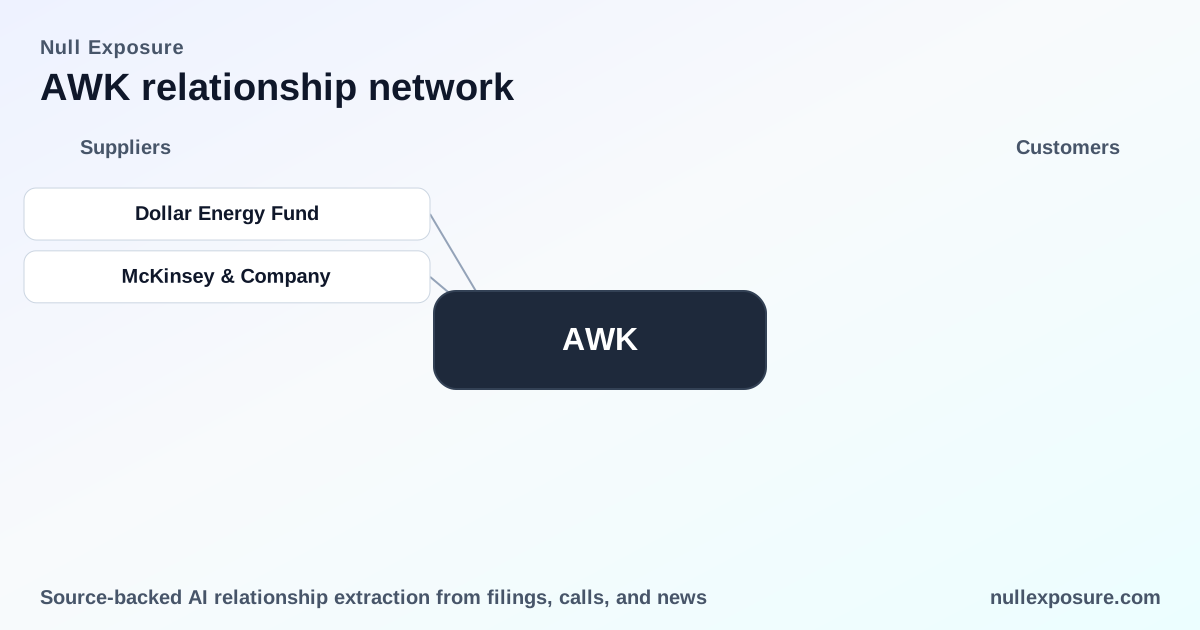
American Water Works (AWK): Customer Relationships and What They Mean for Investors
American Water Works is a regulated water and wastewater utility that monetizes through a combination of regulated tariff-based revenue and long-term service contracts. The company serves roughly 3.5 million active customers across multiple states, billing primarily through metered, usage-based charges plus base rates set by public utility commissions, and supplements that regulated stream with long-term fixed-fee contracts—notably government installations—providing predictable cash flows and an extended revenue runway. For investors, the value proposition is stable, regulated earnings with concentrated operational exposure to U.S. utility regulation and pockets of long-duration contractual revenue. Explore more counterparty analysis at Null Exposure.
A recent customer transaction that changed regional exposure
American Water closed the sale of its regulated operations in New York to a subsidiary of Liberty Utilities, the regulated utility arm of Algonquin Power & Utilities, for $608 million in cash. This transaction reduces AWK’s footprint in a regional market while crystallizing proceeds that can be redeployed or used to deleverage the balance sheet. According to Smart Water Magazine reporting on March 9, 2026, the sale was completed and recorded in FY2022 (reported source: Smart Water Magazine, March 9, 2026 — https://smartwatermagazine.com/news/american-water/american-water-sells-its-regulated-operations-new-york-liberty).
Every customer relationship surfaced in the record
- Algonquin Power & Utilities / Liberty Utilities (AQNA): American Water sold its regulated New York operations to a Liberty Utilities subsidiary for $608 million in cash, reducing its New York operating footprint and transferring those customers and associated regulated assets to Algonquin’s regulated utility arm. Reporting on this transaction appeared in Smart Water Magazine on March 9, 2026 (Smart Water Magazine, March 9, 2026 — https://smartwatermagazine.com/news/american-water/american-water-sells-its-regulated-operations-new-york-liberty).
How AWK’s customer structure shapes cash flow and risk
American Water’s customer mix and contracting posture drive both stability and concentrated regulatory exposure. Key business-model characteristics are visible across corporate filings and public disclosures:
- Long-duration contracts coexist with regulated retail billing. The company operates long-term, fixed-fee contracts to operate and maintain water and wastewater systems for the U.S. government on military installations, including multi-decade terms referenced as up to 50 years in some programs. These contracts create durable revenue lines that are highly predictable; the company reported remaining performance obligations (RPOs) in the billions as of year-end 2024. According to the company’s 2024 filing, RPOs for government-related contracts were reported at $7.4 billion as of December 31, 2024.
- Revenue is largely usage-based under regulatory oversight. The majority of regulated customers are metered and billed for consumption, with public utility commissions (PUCs) setting rates that typically include both a base charge and a volumetric component—giving AWK a hybrid stability/variable revenue mix that tracks demand.
- Counterparty diversity includes government, individuals, and large enterprises. The customer base spans residential households, commercial and industrial accounts, municipal customers, and U.S. government installations, creating a layered counterparty set with differing credit and churn characteristics.
- Geographic concentration is national but regionally segmented. The regulated businesses serve customers in multiple states (the filings reference operations across 14 states), so regulatory regimes and regional growth dynamics materially affect local earnings.
- Regulated services are the critical revenue engine. Regulated water and wastewater operations accounted for the vast majority of operating revenue—reported as roughly 92% of total operating revenues for 2024—making customer relationships in the Regulated Businesses both critical and material to corporate performance.
What these structural features imply for investors
Investor implications follow directly from the operating model:
- Predictability from long-term contracts and regulation. Long-duration government contracts and PUC-regulated rate-setting provide a base of stable cash flows and lower cyclicality than many industrial peers; this supports American Water’s dividend policy and gives visibility into capital recovery under rate cases (company filings for 2024).
- Exposure to regulatory and demand risk. Because revenues depend on PUC decisions and customer consumption patterns, investors face regulatory risk (rate-setting outcomes) and volume risk (weather, economic activity), though these are partially offset by the base-rate structure.
- Concentration risk at the account level. The company notes that the loss of one or more large industrial or commercial customers could produce a material effect on particular Regulated Business results, indicating pockets of client concentration that investors should monitor.
- Strategic footprint management. The sale of New York regulated operations to Liberty Utilities for $608 million demonstrates AWK’s willingness to reshape its geographic exposure and monetize assets where strategic or capital-allocation logic dictates (Smart Water Magazine, March 9, 2026).
For a concise view into counterparty exposures and transaction signals, visit Null Exposure.
Short-term and medium-term risk checklist
- Regulatory outcomes: PUC decisions on rate cases drive near-term revenue adjustments.
- Demand elasticity: Volumetric billing links part of revenue directly to consumption trends.
- Contract tenure: Multi-decade government contracts reduce short-term volatility but lock in operational commitments and limit flexibility.
- Asset disposals and redeployments: Sales such as the New York transaction change regional cash flows and capital allocation priorities.
Bottom line: predictable utility economics with active portfolio management
American Water’s business is anchored in regulated monopoly economics and long-term service contracts, delivering predictable cash flows while remaining exposed to regulation and regional demand dynamics. The company’s recent divestiture of its New York regulated operations for $608 million is a concrete instance of portfolio optimization: it reduces regional exposure while returning cash to the corporate balance sheet. Investors should value AWK for stable earnings, modest growth tied to infrastructure investment and rate cases, and selective portfolio reshaping that manages regional regulatory complexity.
Key takeaways:
- Core revenue comes from regulated, usage-based billing plus base rates.
- Long-term government contracts provide sizable, predictable RPOs.
- The business is materially dependent on regulated operations (≈92% of revenue in 2024).
- Strategic transactions, such as the NY sale to Liberty (AQNA), actively reshape exposure.
If you want deeper counterparty-level analysis or a summarized exposure report for board- or portfolio-level review, Null Exposure provides tailored intelligence and visualization on customer relationships and transaction histories: https://nullexposure.com/.