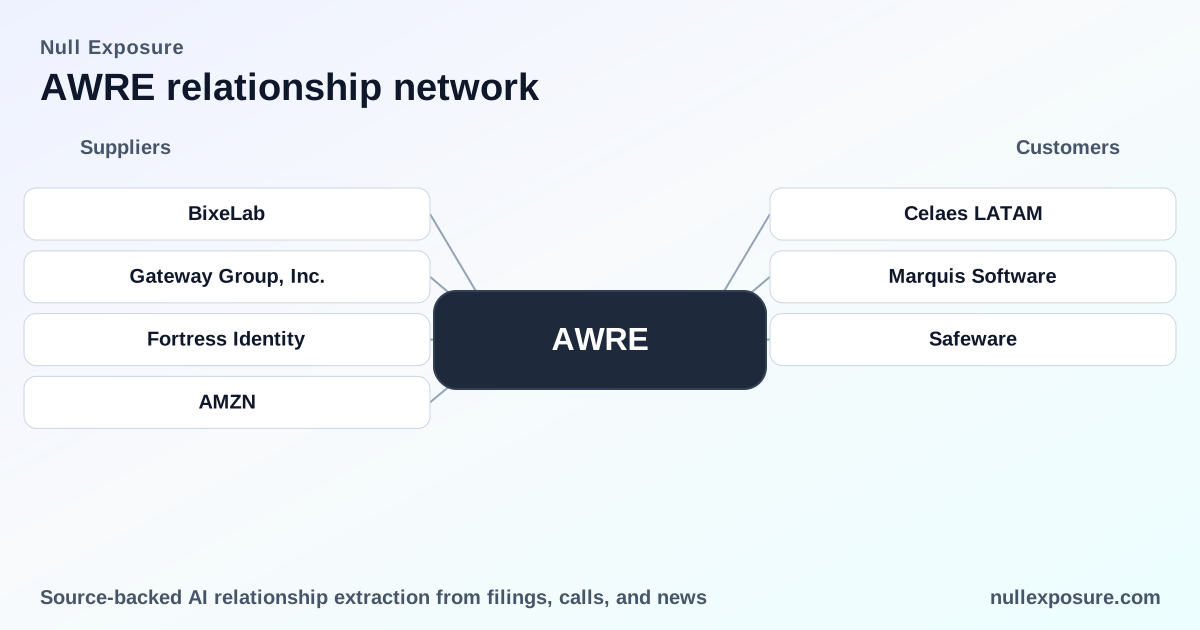
Aware Inc. (AWRE): Customer Landscape and What It Tells Investors
Aware Inc. provides biometric software and related services—sold as perpetual licenses, subscription licenses, and usage-based SaaS—to governments and large enterprises worldwide, monetizing primarily through software licenses, maintenance, and professional services. Revenue is a mix of recurring maintenance/subscription and transactional usage fees, with government business and channel partners driving distribution. For a concise repository of these customer relationships and signals, visit https://nullexposure.com/.
Why the customer roster matters for the investment case
Aware’s customer list reads like a credibility ledger: federal agencies, airport authorities, and a set of commercial identity customers that validate its Knomi and AwareID products. Government relationships provide credibility and large-ticket contracts, while commercial partners extend reach into financial authentication and travel/transportation. That mix creates stability in referenceability and episodic revenue from pilots and integrations, but also yields concentration in receivables and binary renewal risks tied to defense and federal procurement cycles.
Government anchors: scale, credit, and procurement posture
- Department of Homeland Security — Aware management explicitly lists the Department of Homeland Security among its “blue chip” government customers, underlining DHS as a core federal buyer for biometric programs referenced in the Q4 2025 earnings call transcript. (Investing.com, Q4 2025 earnings call)
- Department of Defense — The Department of Defense is likewise cited by management as a named government customer, reinforcing federal defense exposure and program-level credibility. (Investing.com, Q4 2025 earnings call)
- Department of Justice — Federal contract records show a smaller federal purchase attributed to the Department of Justice, reflecting transactional government procurement activity in 2024. (QuiverQuant financials, agency data 2024)
- Social Security Administration — A recorded federal grant/purchase from the Social Security Administration in 2024 indicates Aware’s biometric offerings have been purchased across multiple federal agencies. (QuiverQuant financials, agency data 2024)
Travel and border control: reference implementations with public visibility
- Greater Orlando Aviation Authority — Management identified a partnership with the Greater Orlando Aviation Authority supporting contactless passenger processing under the Biometric Exit Program, positioning Orlando as a flagship travel reference. (Investing.com, Q4 2025 earnings call)
- Orlando International Airport — Executives noted a successful biometric boarding test at Orlando International Airport during Q4, which the company cites as a direct-travel reference for its border and passenger-processing strategy. (Investing.com, Q4 2025 earnings call)
Commercial channel partners and OEMs: distribution and vertical reach
- Safeware — Aware’s AWARE Flood System sensors are offered through a competitively bid NACo Public Promise Procurement Safeware contract, demonstrating channel distribution for rugged IoT sensor deployments in public safety and county-level emergency management. (NACo event page, 2026)
- Celaes LATAM — Aware marketed biometric financial authentication solutions to Celaes LATAM (press activity dated 2022), illustrating commercial distribution into Latin American financial services via regional partnerships. (Simply Wall St citing company release, June 2022)
- PeopleCert — PeopleCert selected Aware’s Knomi product to counter proxy testing in credentialing contexts, reflecting a commercial use case in exam security and identity verification. (Finviz citing PR Newswire, FY2026 reporting)
- Marquis Software — Marquis Software publicly deployed Aware’s Knomi for combined face and voice authentication, exemplifying a vertical OEM or software partner embedding Aware’s biometric SDK into its product. (Simply Wall St citing company release, Oct 7)
The nature of these relationships — what investors should extract
Collectively, these entries show two clear commercial vectors: (1) federal and local government contracts for border security, identity, and public safety; and (2) commercial licensing and OEM/channel partnerships for authentication in finance, credentialing, and transportation. Government customers underpin credibility and long sales cycles, while channel partners generate broader distribution with lower customer concentration per account.
Relationship constraints and what they imply for revenue quality
At the company level, Aware’s disclosures and excerpts indicate several structural characteristics investors should factor into forecasts:
- Contracting posture: Aware runs a mixed contract model—long-term maintenance and multi-year contracts exist (remaining performance obligations >1 year were $0.3m at year-end 2024), complemented by fixed-term licensing and usage-based arrangements. This produces a blend of predictable recurring revenue and transaction-driven variability.
- Pricing and billing mechanics: The firm sells licenses as perpetual or fixed-term subscription, and its AwareID SaaS often uses usage- or transaction-based pricing, sometimes with minimum guarantees—this drives upside with volume but creates revenue variability tied to customer activity.
- Counterparty mix and criticality: A significant portion of revenue is derived from federal, state, and local governments and large enterprises, giving the business both credit stability and political/procurement timing risk.
- Geographic footprint: Sales are global with measurable North American and EMEA presence (United States and United Kingdom cited in disclosures), and distribution through integrators and OEMs supports international reach.
- Concentration dynamics: No single customer exceeded 10% of total revenue in 2024, yet two customers comprised 34% of net receivables at year-end 2024—this implies concentration in collections rather than top-line concentration, a working-capital risk to watch.
- Product maturity and segmentation: Revenue is split between software (licenses/subscriptions) and services (professional services, maintenance), meaning margins can vary materially by mix and the company's margin recovery depends on growing higher-margin software SaaS and license streams.
Relationship-by-relationship takeaways (concise)
- Department of Homeland Security — Federal procurement records and management comments position DHS as a named customer; small recorded federal purchase activity in 2024 corroborates ongoing transactional engagement. (Investing.com earnings call; QuiverQuant agency data 2024)
- Department of Defense — Management lists DoD among government customers, signaling defense-market access and potential for classified or programmatic work. (Investing.com earnings call, Q4 2025)
- Department of Justice — A documented 2024 federal purchase shows DOJ as a buyer on record, consistent with government contract revenue streams. (QuiverQuant financials, 2024)
- Social Security Administration — A recorded 2024 purchase from SSA illustrates reach into civilian identity systems at scale. (QuiverQuant financials, 2024)
- Safeware — Aware’s flood-sensor IoT solution is available through a NACo Safeware contract, demonstrating public-sector channel sales and a use-case outside core biometrics. (NACo event page, 2026)
- Celaes LATAM — Historical press activity shows Aware’s push into Latin American financial authentication via regional partners, underscoring commercial channel strategy. (Simply Wall St citing 2022 company release)
- Greater Orlando Aviation Authority — A formal partnership for contactless passenger processing under a DHS program provides a high-visibility travel reference for biometric boarding and border programs. (Investing.com earnings call, Q4 2025)
- Orlando International Airport — A public biometric boarding test at Orlando International now serves as a flagship reference for travel/border implementations. (Investing.com earnings call, Q4 2025)
- PeopleCert — A PeopleCert selection of Knomi to prevent proxy testing highlights a commercial deployment in credentialing and testing environments. (Finviz citing PR Newswire, FY2026)
- Marquis Software — Marquis publicly embedded Knomi for face+voice authentication, illustrating an OEM/integration route into enterprise security products. (Simply Wall St citing company release, Oct 7)
Investment implications and next steps
Aware’s customer mix gives it a defensible credibility advantage with governments and referenceable commercial deployments, but investors should price in working-capital concentration, program timing risk from federal procurement, and mixed margin outcomes depending on license vs. services mix. For a structured view of these customer relationships and how they evolve, explore the consolidated profile at https://nullexposure.com/.
For deeper diligence on how these customers convert into revenue and cash flow, review Aware’s latest SEC filings and earnings call transcripts and monitor receivables composition in quarterly reports.