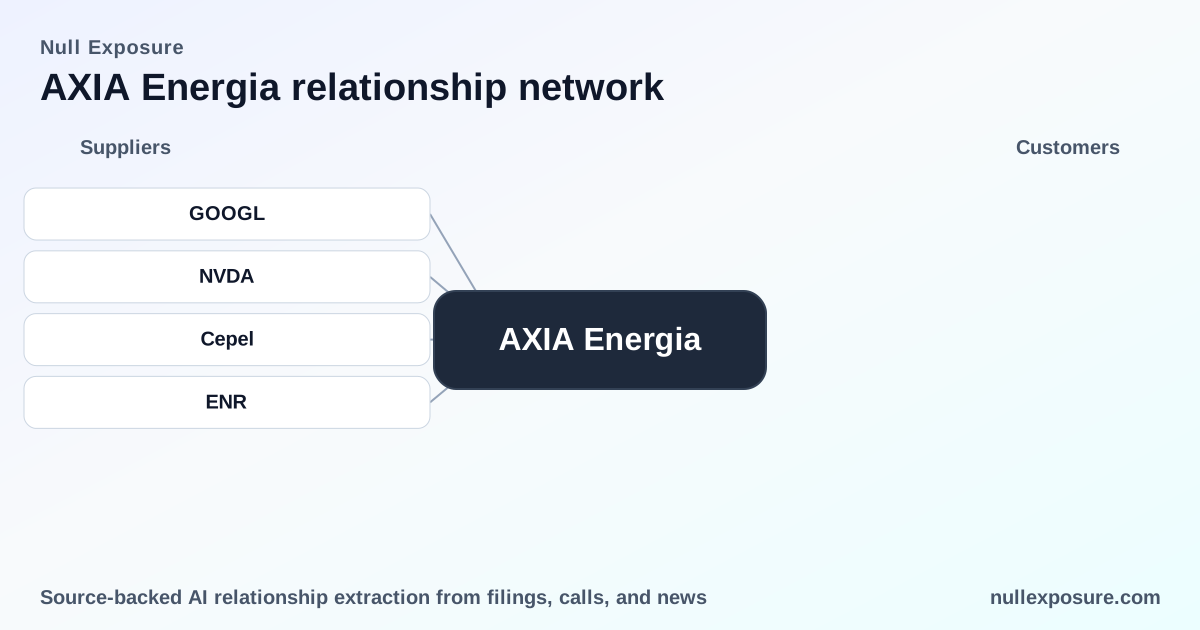
AXIA Energia: customer relationships and strategic signals investors should track
AXIA Energia operates large-scale renewable and regulated electricity assets in Brazil, monetizing through a mix of power generation sales, transmission tariffs and commercial electricity contracts to utilities and corporate buyers. With recurring regulated cash flows and substantial EBITDA scale, the company’s value proposition for counterparties is stability and grid-critical service rather than high-margin growth plays.
Explore the broader relationship map at https://nullexposure.com/ to see how single-line mentions like the one below can change an investment or operational thesis.
The business in one paragraph: how AXIA makes money and why that matters
AXIA is a utilities operator focused on renewable generation and transmission, reporting Revenue TTM of $41.3B and EBITDA of $10.6B, supporting a Market Capitalization near $28.0B. The company captures value through long-duration contracts and regulated tariffs that produce consistently high operating margins (Operating Margin TTM 60.9%), while net margins (15.9%) reflect depreciation and financing common to capital-intensive utilities. AXIA’s stability is its monetization model: cash flow predictability from generation and transmission makes counterparties and lenders comfortable with multi-year engagements.
Operating model and contract posture — what investors should infer
AXIA operates with the hallmarks of a mature utility: contracting posture is predominantly long-term and regulated, counterpart risk is concentrated geographically in Brazil, and service criticality is high because electricity supply is essential. These characteristics imply:
- Contract lengths are typically multi-year and favor predictability over pricing flexibility.
- Counterparty concentration is a company-level signal: a Brazil-centric footprint increases regulatory and currency exposure even as it simplifies market access and operational focus.
- Business maturity is advanced: low beta (0.33) and strong cash generation reflect defensive utility dynamics attractive to income-seeking investors.
These are company-level operating signals, not tied to a single partner. They shape counterpart negotiation leverage, refinancing risk, and the priority AXIA receives from service providers.
Relationship inventory — what the public signals show
There is a single explicit relationship mention in the records we reviewed. Below is a concise, plain-English read on that connection.
Huron Consulting Group (HURN)
Huron publicly referenced AXIA as an acquisition target: in its FY2026 earnings call transcript republished by InsiderMonkey on March 10, 2026, Huron described “the success of our 2024 acquisition of AXIA”, signaling that AXIA was acquired by Huron in 2024 and cited as a successful strategic integration. (Source: Huron FY2026 earnings call transcript, InsiderMonkey, March 10, 2026 — https://www.insidermonkey.com/blog/huron-consulting-group-inc-nasdaqhurn-q4-2025-earnings-call-transcript-1704001/)
This single-line affirmation carries a disproportionate signal: an acquisition reference in an earnings call implies AXIA has been part of a corporate transaction lifecycle and that integration outcomes are being tracked at the buyer’s executive level.
Why that Huron mention matters for investors and operators
- Strategic ownership or divestiture changes the counterparty landscape. If AXIA was acquired by a strategic buyer, AXIA’s contracting posture, access to capital, and counterparty priorities could shift rapidly — from standalone commercial negotiation to integration-driven procurements and consolidated vendor relationships.
- Operational criticality persists even after ownership change. Regardless of ownership, AXIA’s assets remain grid-critical and preserve long-term revenue characteristics that underpin credit and contract stability.
- M&A visibility reduces information asymmetry for investors. A buyer publicly confirming the acquisition and integration success is a positive signal on asset quality and can shorten due diligence timelines for counterparties and lenders.
Financial and market context that frames these relationships
AXIA’s public financials reinforce why counterparties value long-term exposure:
- Revenue TTM: $41.3B; EBITDA: $10.6B.
- Profit margin: 15.9%; Operating margin TTM: 60.9%.
- Market indicators: Market Cap ≈ $28.0B; EPS 0.66; Trailing PE 18.8; Analyst target price $13.7 (3 Buy ratings).
Two operational flags for relationship managers and investors:
- Low institutional ownership (≈1.7%) signals limited sell-side/owner scrutiny and suggests the company’s public narrative may be thinly covered, magnifying the informational impact of each confirmed partnership or transaction.
- Geographic concentration in Brazil introduces regulatory and currency exposure that should be modeled into contract counterparty risk and credit decisions.
Investment implications — what to watch next
- Monitor integration disclosures from Huron and AXIA leadership. Further disclosures will clarify whether AXIA operates as an independent customer-facing entity or as an integrated asset within a larger corporate structure — a distinction that changes counterpart bargaining power and contract continuity assumptions.
- Stress-test cash flows for regulatory and FX scenarios. Given the Brazil-centric operation, model regulated tariff adjustments and currency movement impacts on debt service and dividend capacity.
- Watch for vendor consolidation and procurement shifts. Post-acquisition integration typically drives supplier rationalization; incumbents should prepare for renegotiation cadence and potential contract consolidation.
Explore relationship intelligence and deeper signal extraction at https://nullexposure.com/ to see how single-source mentions translate into actionable counterparty risk and opportunity insights.
Bottom line
AXIA’s core value is stable, regulated cash flow backed by critical energy infrastructure. The Huron mention establishes a direct corporate event — an acquisition reference that materially affects how counterparties, lenders, and investors model future revenues and contractual stability. For investors and operators, the immediate priority is tracking follow-on integration statements and any contract novations or procurement consolidations that follow an acquisition narrative.