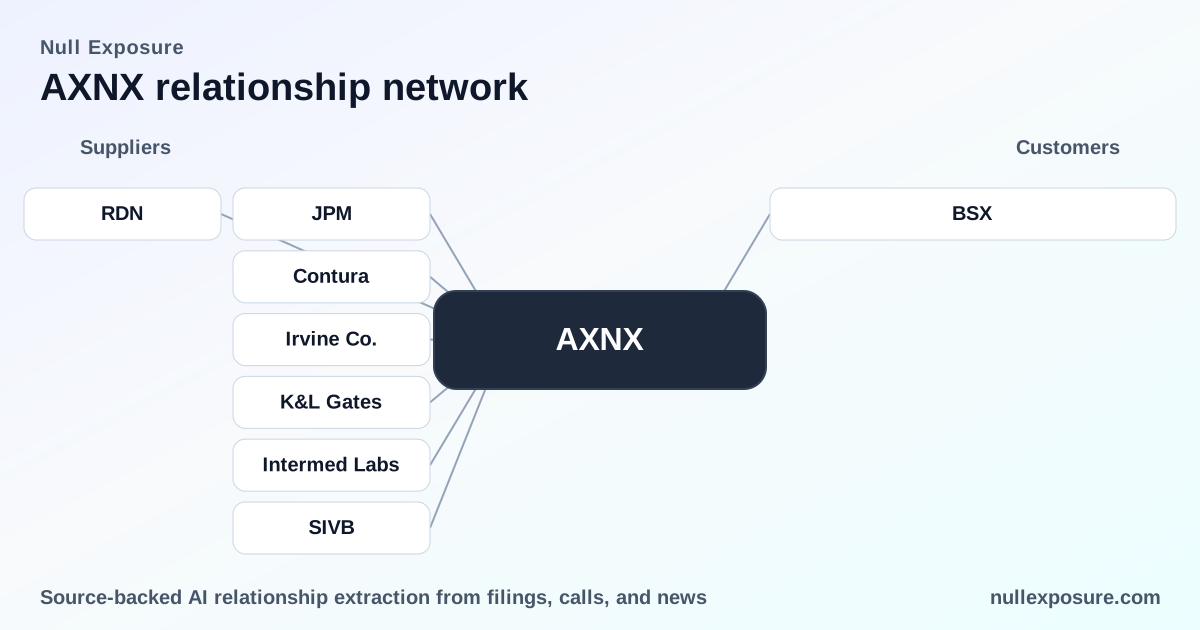
Axonics customer relationships: what investors should know now that AXNX is in BSX hands
Axonics built a focused commercial franchise selling sacral neuromodulation implants and related clinician training, monetizing through device sales to hospitals, health systems and specialty urology practices plus branded Center‑of‑Excellence partnerships that drive adoption and repeat procedural volume. The strategic outcome — a $3.7 billion sale to Boston Scientific — converts a recurring procedure business into an asset integrated into a larger medtech distribution and reimbursement engine, shifting commercial risk to the acquirer while validating the clinical and market value of Axonics’ installed base.
For consolidated coverage and data on corporate relationships and filings, visit the NullExposure homepage: https://nullexposure.com/
Why Boston Scientific bought Axonics and what that means for customer ties
Boston Scientific’s acquisition of Axonics is the single defining customer outcome for AXNX. The purchase prices the company’s installed base, clinician relationships and Centers of Excellence network into Boston Scientific’s broader urology and neuromodulation platform, accelerating scale, reimbursement leverage and cross‑sell opportunities across hospital customers. MassDevice reported the completion of the $3.7 billion deal in May 2026 and Boston Scientific framed the integration as a capability expansion in its public commentary (MassDevice, May 2, 2026; Boston Scientific news release, May 2026).
Strategically, the acquisition reduces standalone execution risk for Axonics’ customer programs while concentrating responsibility with Boston Scientific’s commercial organization and payer relationships — a consolidation that investors should treat as both a value realization event and a governance shift in how those customer relationships will be managed going forward.
Customer roster in plain English — each relationship from the record
-
Boston Scientific (BSX): Boston Scientific completed a $3.7 billion acquisition of Axonics, converting Axonics’ commercial footprint and clinician network into Boston Scientific ownership and control. Sources report the transaction closed and Boston Scientific has publicly discussed integrating Axonics’ capabilities (MassDevice, May 2, 2026; Boston Scientific corporate release, May 2026; Fortune recap of M&A activity, FY2024 reporting).
-
AdventHealth Hendersonville: AdventHealth Hendersonville has been formally designated an Axonics Center of Excellence, signaling a structured training and referral relationship between Axonics and a health system site that supports device adoption and procedural volume (AdventHealth news release, FY2022).
-
Jefferson Regional Urology Associates: Jefferson Regional Urology Associates received an Axonics Center of Excellence designation, indicating Axonics’ strategy of building clinician hubs that drive local market penetration and repeat implants in community urology practices (Stuttgart Daily Leader report, FY2025).
-
University of Alberta: The University of Alberta implanted initial patients with Axonics’ recharge‑free sacral neuromodulation system, marking an early clinical rollout in Canada and demonstrating institutional adoption beyond U.S. markets (Neuronews International coverage, FY2022).
-
Mon Health System: Mon Health System publicized an Axonics Center of Excellence designation for a named urologist, reflecting continued use of Axonics’ clinician recognition program to secure programmatic referrals and a local procedural base (Mon Health System newsroom, FY2024).
Each relationship above is documented in primary or trade press coverage linked to the reporting outlet.
How Axonics’ customer model shapes commercial constraints and operational signals
With no separate constraints file provided, the observable company‑level signals in these customer ties show clear operating characteristics:
-
Contracting posture — direct hospital and practice engagement. Axonics sold through direct clinical designations (Centers of Excellence) and hospital implant programs, which creates bilateral commercial contracts and high touch training obligations rather than low‑touch distributor relationships.
-
Concentration and leverage. The presence of named Centers of Excellence and a relatively narrow product focus implies concentration around procedural customers and top clinician partners, heightening the commercial importance of each institutional win.
-
Clinical criticality. Sacral neuromodulation devices are clinically critical implants for targeted patient populations; hospitals and urology practices require device reliability, clinical support and training, making customer relationships operationally sticky but also dependent on reimbursement and physician preference.
-
Maturity and exit signal. The November 2024 close of the Boston Scientific acquisition and subsequent press coverage show the company had achieved commercial scale sufficient to attract strategic buyers, converting growth‑stage relationships into an acquirable asset for a large medtech player.
These signals are company‑level characteristics derived from the pattern of customer documentation and the corporate exit event; they are not attributed to any single customer unless explicitly stated in source material.
Investment implications and where to watch execution risk
-
Realized value through acquisition. The $3.7 billion sale crystallizes value for shareholders and validates the commercial model of clinician hubs and hospital implant programs. Boston Scientific’s scale reduces execution risk on reimbursement and distribution but creates integration risk to monitor.
-
Customer retention and integration. Monitor Boston Scientific’s post‑close integration metrics: whether existing Centers of Excellence remain active under the BSX commercial playbook, and whether hospital customers see faster adoption or administrative friction from the transition.
-
Reimbursement and adoption cadence. Clinical adoption remains the primary growth lever; investors should watch procedure volume disclosures, payer coding developments and physician training throughput as leading indicators.
For a deeper dive into how these customer relationships were documented and how they feed into valuations, see further analysis at NullExposure: https://nullexposure.com/
Final read: what to file away
- The Boston Scientific acquisition is the dominant relationship outcome — it converts Axonics’ customer franchise into strategic intellectual property and installed base value. (MassDevice, Boston Scientific release, Fortune, FY2024–FY2025 reporting.)
- Center‑of‑Excellence designations are the commercial instrument Axonics used to institutionalize clinician partnerships and drive procedural volume across community hospitals and health systems (AdventHealth, Jefferson Regional, Mon Health System, FY2022–FY2025).
- International clinical adoption is underway — the University of Alberta implants signal cross‑border program expansion and a proof point for wider geographic growth (Neuronews International, FY2022).
Investors evaluating AXNX should treat the customer relationships as validated commercial assets now owned by Boston Scientific, and shift focus to integration, procedure growth data and payer dynamics as the primary levers that determine realized revenue and margin upside.