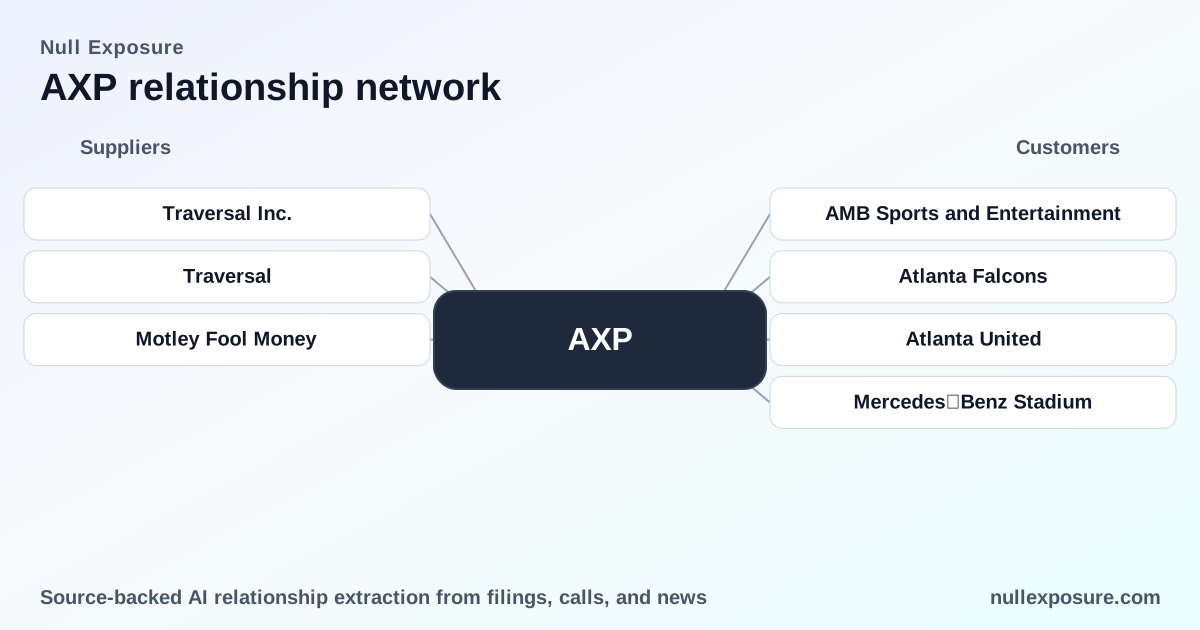
American Express (AXP): how customer relationships convert into durable fee and network economics
American Express monetizes a closed-loop payments ecosystem by issuing cards, operating a payments network and contracting merchants for acceptance and value-added services. Revenue derives from cardholder interest and fees, merchant discount rates, co-brand and network partnerships, and premium travel/lifestyle services—a model that scales with high-value consumer and commercial spend and benefits from long-term co-branding and stadium/league sponsorships that drive engagement and interchange volume.
For a concise gateway to the underlying sourcing behind this note, visit https://nullexposure.com/.
What the relationship map tells investors about AmEx’s operating posture
American Express runs a mixed contracting posture: large merchants and partners typically sign multi‑year deals (three to seven years) while small- and mid‑market merchant relationships are often open‑ended, creating a blend of recurring, contractually defended revenue and higher churn potential at the margins. The company serves a full spectrum of counterparties — individuals, small businesses, mid‑market firms and large enterprises — and its exposure is geographically concentrated in North America but globally distributed through partnerships and sponsorships. These characteristics produce high-margin, service-led revenues with customer concentration in high‑value segments and significant brand-critical tie‑ups.
Key operational signals from filings and corporate commentary:
- Contract maturity: large merchant agreements are typically multi‑year; many smaller merchants have no fixed duration.
- Counterparty mix: revenue drivers include individuals and small-business card members (credit risk concentrated with individuals) as well as large corporate partners.
- Geography: roughly 80% of unused customer credit availability is within the U.S., indicating domestic concentration offset by global partnerships.
- Role: AmEx acts both as a seller (products and services) and as a service provider (issuer, acquirer and network operator).
- Segment focus: the business is services-led (cards, merchant acquiring, network services, travel and lifestyle).
These company-level signals explain why AmEx invests in co-brand relationships, venue collections and league-level sponsorships: they lock in brand equity, drive high-margin spend, and reduce acceptance frictions for target cardholders.
Observed customer relationships and what they mean for revenue and distribution
Below are every customer relationship captured in the source set, each with a concise take and source reference.
- Atlanta Falcons — American Express is a Founding Partner and Official Payments Partner for the Falcons, which drives branded activation and payments integration at team events and related commerce (ATL Utd press release, March 2026: https://www.atlutd.com/news/amb-sports-and-entertainment-announce-long-term-partnership-with-american-express).
- Atlanta United — The company is also named a Founding Partner and Official Payments Partner for Atlanta United, extending stadium and fan engagement programs (ATL Utd press release, March 2026: https://www.atlutd.com/news/amb-sports-and-entertainment-announce-long-term-partnership-with-american-express).
- Mercedes‑Benz Stadium — The venue enters the American Express Venue Collection™, granting AmEx card members exclusive access and experiences and expanding acceptance and premium offerings at the stadium (ATL Utd press release, March 2026: https://www.atlutd.com/news/amb-sports-and-entertainment-announce-long-term-partnership-with-american-express).
- AMB Sports and Entertainment (AMBSE) — AMBSE named AmEx a Founding Partner and Official Payments Partner for its portfolio, formalizing a long-term sponsorship and payment-network relationship that covers teams and venues (ATL Utd press release, March 2026: https://www.atlutd.com/news/amb-sports-and-entertainment-announce-long-term-partnership-with-american-express).
- KOSS — Historical operational oversight: an AmEx investigator identified approximately $14 million in questionable charges on Koss corporate cards tied to an embezzlement case (Milwaukee Journal Sentinel archive, noting the incident; first reported detail archived: https://archive.jsonline.com/business/fired-koss-executive-sachdeva-once-seen-as-model-employee-by-ceo-b99361546z1-277501111.html).
- Synchrony Financial (SYF) — Synchrony expanded its partnership with Lowe’s as issuer of a co‑brand card while American Express continues as the payment network for the MyLowe’s Pro Rewards American Express® Card (PR Newswire, April 2026: https://www.prnewswire.com/news-releases/synchrony-expands-partnership-with-lowes-as-new-issuer-of-co-brand-credit-card-for-home-improvement-professionals-302758954.html).
- Lowe’s (Tikr note) — Management flagged that exits of co‑brands with Amazon and Lowe’s will cause a low‑single‑digit drag on SME spend growth, creating a visible revenue headwind to acceptance-driven spend (Tikr Q1 2026 commentary, May 2026: https://www.tikr.com/blog/american-express-q1-2026-strong-quarter-reinvested-upside-and-50-potential-returns).
- Lowe’s (Hardware Retailing) — Synchrony’s expanded co‑brand with Lowe’s leverages the American Express Network to broaden acceptance beyond Lowe’s stores and access small‑to‑medium pro customers (HardwareRetailing report, May 2026: https://hardwareretailing.com/synchrony-and-lowes-expand-partnership-with-new-mylowes-pro-rewards-american-express-card/).
- Hilton (HLT) — Hilton surveyed U.S. Honors members about launching a debit card with American Express as the co‑brand issuer, signaling product experimentation to capture loyalty spend across payment rails (LoyaltyLobby, April 2026: https://loyaltylobby.com/2026/04/30/hilton-surveying-possible-honors-debit-card-with-american-express-for-us/).
- Synchrony (Hardwareretailing) — Synchrony publicly confirmed it will issue the MyLowe’s Pro Rewards American Express® Card, demonstrating AmEx’s role as the network provider in an issuer‑partner model (HardwareRetailing, May 2026: https://hardwareretailing.com/synchrony-and-lowes-expand-partnership-with-new-mylowes-pro-rewards-american-express-card/).
- Synchrony (SahmCapital) — American Express executives framed the Synchrony/Lowe’s deal as building on a longstanding relationship and expanding AmEx network reach in pro markets (SahmCapital press summary, April 2026: https://www.sahmcapital.com/news/content/synchrony-expands-partnership-with-lowes-as-new-issuer-of-co-brand-credit-card-for-home-improvement-professionals-2026-04-30).
- Amazon — Management noted that the exit of the Amazon co‑brand will be a low‑single‑digit drag on SME spend growth, highlighting sensitivity of SME volumes to co‑brand terminations (Tikr Q1 2026 write-up, May 2026: https://www.tikr.com/blog/american-express-q1-2026-strong-quarter-reinvested-upside-and-50-potential-returns).
- National Football League (NFL) — AmEx signed a multi‑year global partnership making it the NFL’s official payments partner beginning with the 2026 season, a league-level tie that expands global brand reach and event-level acceptance (Benzinga transcript of Q1 2026 earnings call, April 2026: https://www.benzinga.com/insights/news/26/04/51998099/transcript-american-express-q1-2026-earnings-conference-call).
- Toast, Inc. (TOST) — Toast announced a strategic partnership with American Express to enhance dining experiences and expand market reach, reinforcing AmEx’s focus on restaurant and hospitality spend (The Globe and Mail / Toast press note, cited March 2026: https://www.theglobeandmail.com/investing/markets/stocks/TOST/pressreleases/33948177/toast-inc-reports-strong-q2-2025-growth-and-new-partnerships/).
- Mercedes Benz Stadium (Benzinga) — Management noted new multi‑year sports and entertainment agreements that include Mercedes Benz Stadium, reinforcing venue-level partnerships beyond the initial AMBSE announcement (Benzinga earnings transcript, April 2026: https://www.benzinga.com/insights/news/26/04/51998099/transcript-american-express-q1-2026-earnings-conference-call).
- MetLife Stadium — AmEx announced a multi‑year agreement with MetLife Stadium, extending branded venue experiences and payments integration to another large sports/entertainment complex (Benzinga earnings transcript, April 2026: https://www.benzinga.com/insights/news/26/04/51998099/transcript-american-express-q1-2026-earnings-conference-call).
- American Express Global Business Travel (APGB) — An 11‑year trademark/license arrangement will allow GBT to continue using the American Express name post-transaction, preserving co‑branded travel and meetings distribution (Conference‑News.co.uk report on the 2021 transaction terms, referenced March 2026: https://www.conference-news.co.uk/news/amex-global-business-travel-go-public-through-ps4bn-merger/).
- Uber (UBER, Marketbeat) — Consumer reports flagged viral rider complaints about higher charges when paying with AmEx, a reputational and demand risk that can create regulatory and PR exposure for acceptance and network economics (MarketBeat alert, April/May 2026: https://www.marketbeat.com/instant-alerts/filing-vanguard-group-inc-acquires-1670761-shares-of-uber-technologies-inc-uber-2026-04-26/).
- Uber (duplicate alert) — A second market alert echoed the same negative sentiment on AmEx payment frictions in ride‑hailing contexts, underscoring recurring headlines around consumer perception of acceptance costs (MarketBeat filing/alert, April/May 2026: https://www.marketbeat.com/instant-alerts/filing-munich-reinsurance-co-stock-corp-in-munich-buys-61908-shares-of-uber-technologies-inc-uber-2026-04-25/).
- Bread Financial (BFH) — Bread Financial offers branded Bread Cashback American Express products, signaling AmEx’s network participation in direct‑to‑consumer fintech product offerings (MarketScreener summary, May 2026: https://www.marketscreener.com/news/morgan-stanley-upgrades-bread-financial-to-equalweight-from-underweight-adjusts-price-target-to-91-ce7e50dddf8aff23).
- Synchrony (Markets/Hardwareretailing duplicate entry) — Synchrony reiterated it will issue the Lowe’s pro card using the AmEx network, demonstrating repeated market confirmations of the issuer-network partnership (HardwareRetailing / May 2026: https://hardwareretailing.com/synchrony-and-lowes-expand-partnership-with-new-mylowes-pro-rewards-american-express-card/).
- NBA — AmEx renewed its sponsorship with the NBA and several NBA team agreements, maintaining league-level distribution and premium cardholder experiences at events (Benzinga earnings transcript, April 2026: https://www.benzinga.com/insights/news/26/04/51998099/transcript-american-express-q1-2026-earnings-conference-call).
Investment implications: where relationships translate to returns — and risk
- Revenue upside comes from co‑brand and venue agreements that convert marketing spend into incremental high‑ticket and travel/dining spend by premium cardholders. Sponsorships with NFL, NBA and major stadiums are revenue-multipliers because they scale cardholder activation and interchange on big-ticket experiences.
- Distribution risk arises where issuer/issuer‑partner changes (e.g., Synchrony issuing Lowe’s card) or co‑brand exits (Amazon, Lowe’s) reduce SME and acceptance‑sourced spend; management has acknowledged these as low‑single‑digit headwinds to SME spend growth.
- Reputational and regulatory risk is non‑trivial: consumer complaints about merchant surcharges (Uber) can accelerate adverse publicity or regulatory attention that affects acceptance economics.
For a practical view of how these relationships map to revenue levers and credit exposure, see our research hub: https://nullexposure.com/.
Bottom line
American Express combines durable, contract-backed brand partnerships with a network-driven merchant acceptance strategy that prioritizes premium cardholder value and high-margin spend. The relationship set documented here underscores a deliberate tilt toward sports, venue and travel ecosystems to drive stickier, higher‑value transactions, while issuer partnerships and co‑brand churn create measurable near‑term revenue variability. Investors should underwrite AmEx on the twin pillars of premium spend economics and execution on large-scale partnership monetization, while monitoring co‑brand transitions and consumer acceptance headlines as the key operational risks.