AXIS Capital (AXS): Customer Relationships and Strategic Implications for Investors
AXIS Capital is a Bermuda-headquartered global specialty underwriter and reinsurer that monetizes through underwriting premiums, reinsurance commissions and investment income, selling capacity and tailored risk-transfer solutions primarily through broker channels and contractual reinsurance relationships. The company's operating model blends long-duration liability exposures with active retrocession and portfolio-management transactions to manage capital and reserves, while underwriting discipline drives margin performance. For more signals on counterparty footprints and operational constraints, visit https://nullexposure.com/.
How AXIS’s customer posture shapes capital and execution risk
AXIS runs a broker-distributed, specialty insurance and reinsurance business that underwrites niche liability, marine, aviation, energy and financial-risk lines on a global basis. The public record presents several company-level operating signals investors should treat as structural:
- Contracting posture: Certain lines—notably credit and political-risk business—are written on a multi-year basis, producing higher persistency and longer reserve horizons. That increases the importance of actuarial reserve management and investment-duration matching.
- Concentration and counterparty profile: No single cedant or insured accounted for more than 10% of gross premiums written in either segment, signaling diversified counterparty exposure rather than dependency on a small set of large clients.
- Distribution model: AXIS produces business primarily through brokers, so its growth and placement depend on broker relationships and market access rather than direct retail channels.
- Materiality and critical obligations: While individual counterparty exposures are generally immaterial, AXIS is contractually obligated to pay claims for covered loss events, making loss payments the firm's most significant future payment obligation and a critical operational risk.
- Geographic scope: AXIS operates globally (Bermuda, U.S., Europe, Singapore, Canada), exposing the company to cross-border regulatory and treaty-reinsurance dynamics.
- Role set: AXIS functions as a seller of insurance/reinsurance, a service provider for underwriting and claims administration, and as a counterparty in retrocession/reinsurance markets.
These signals combine into a profile of a specialty insurer that leverages underwriting capacity, retrocession transactions and diversified distribution to manage capital efficiency and underwriting risk.
Publicly visible counterparties and transactions
SNXX (two public references)
Yahoo Finance profile pages reference "Fund family AXS" and list trading descriptors such as "AXS / Trading--Leveraged Equity," indicating that SNXX’s public materials identify AXS as a fund family or trading descriptor in their profile text. According to Yahoo Finance profile and quote pages (May 2026), SNXX references AXS in its public profile and quote metadata. (Sources: Yahoo Finance profile and quote pages, May 2026.)
Monarch Point Re
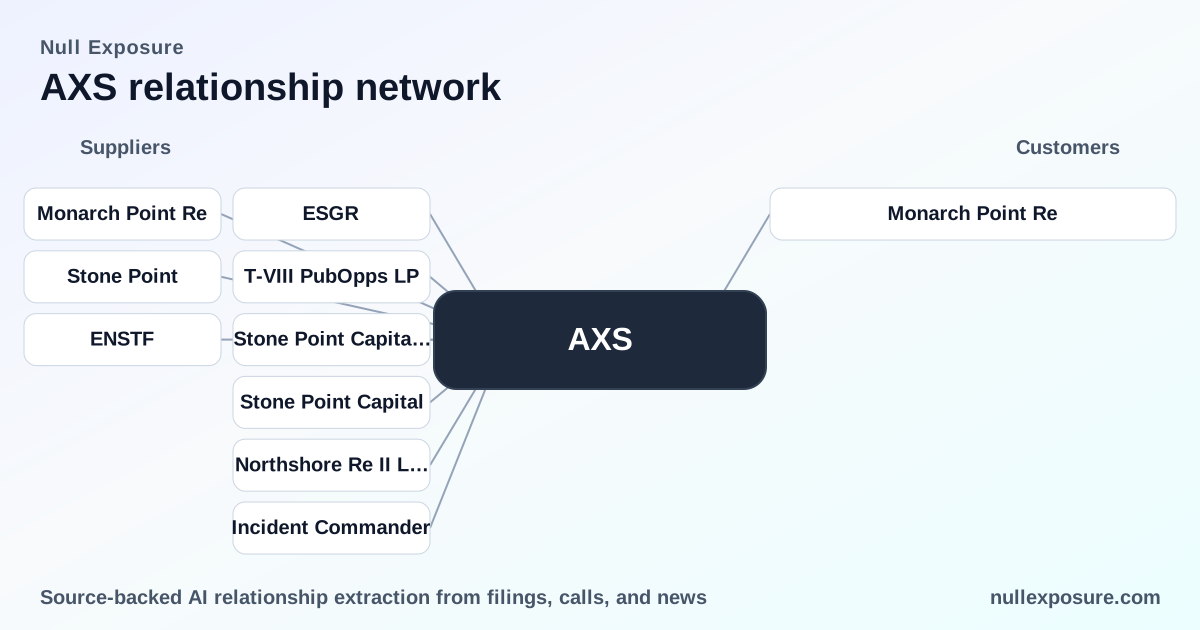
AXIS subsidiaries retrocede a diversified casualty reinsurance portfolio to Monarch Point Re via a quota-share arrangement, placing Monarch Point Re as a collateralized vehicle receiving retrocessioned casualty business from AXIS entities operating in Bermuda. This arrangement was reported in March 2026 by Artemis Bermuda describing Monarch Point Re’s registration and its retrocession relationship with AXIS subsidiaries. (Source: Artemis.bm, March 2026.)
ESGR (Enstar / Lloyd’s Syndicate 2008 loss portfolio transfer)
AXIS retroceded approximately US$2.3 billion of reinsurance segment reserves—primarily casualty portfolios from underwriting years 2021 and prior—totaling US$3.1 billion as of September 30, 2024, as part of a loss portfolio transfer transaction reported in March 2026. The transfer illustrates AXIS’s use of third-party structures to manage reserve volatility and capital consumption. (Source: InsuranceBusiness / transaction coverage, March 2026.)
BTCS
A GlobeNewswire release from May 2022 described BTCS completing technical work to run an Axie Infinity validator node and including it in a planned staking service; BTCS’s public materials reference blockchain infrastructure activities rather than an obvious AXIS commercial relationship. The BTCS mention appears in the relationship results but reflects an unrelated blockchain operations announcement rather than a core insurance counterparty. (Source: GlobeNewswire, May 2022.)
MMYT (MakeMyTrip advisory engagement)
MakeMyTrip’s IPO planning included Axis Capital (the investment bank) among advisers for a proposed share sale; public reporting in May 2026 lists Axis Capital alongside Morgan Stanley and JPMorgan as advisers in the syndicate for a proposed IPO. This reference concerns Axis Capital (investment-banking advisory activity) rather than AXIS Capital Holdings Ltd’s underwriting business. (Source: Inc42 summarizing Bloomberg reporting, May 2026.)
What these relationships tell investors about operational execution
The relationship set and associated public transactions suggest several actionable conclusions:
- Active use of retrocession and portfolio-transfer mechanisms. The Monarch Point Re quota share and the ESGR loss portfolio transfer show AXIS deliberately shifts reserve and underwriting tail risk into collateralized vehicles or third-party structures to optimize capital and reduce reserve volatility. This is a core capital-management lever for the company.
- Diversification across cedants. Company disclosures assert no single cedant exceeds 10% of gross premiums written, which translates to lower single-counterparty concentration risk even as AXIS participates in large retrocession deals.
- Distribution and intermediary dependence. The firm’s broker-driven placement model elevates the strategic importance of intermediary relationships for new business flow and pricing power.
- Potential signal noise in open-source mentions. Some items returned (BTCS, MMYT advisory-role references, SNXX fund-family mentions) reflect either naming overlap or non-core affiliations; investors should treat such mentions as noise unless corroborated by AXIS filings or formal press releases.
Investment implications and risk factors
- Underwriting profit remains the primary earnings driver. AXIS’s profitability depends on sustained underwriting discipline across specialty lines and effective retrocession strategies.
- Claims-payment obligation is the principal execution risk. Even with diversified premium sources, the contractual obligation to pay claims is critical and can be materially impacted by reserve adequacy, macroeconomic stress, or widespread non-payment by intermediaries.
- Capital efficiency benefits from transfers. Portfolio transfers and quota-share retrocessions improve capital flexibility but introduce counterparty and collateral management requirements; these transactions are operationally material.
- Regulatory and geographic complexity. Global operations expose the firm to regulatory regimes and cross-border treaty constraints that affect reinsurance placement and solvency calculations.
Bottom line
AXIS operates a globally distributed specialty insurance and reinsurance business that monetizes through underwriting and investment returns while actively managing reserve and capital risk through retrocession and loss-transfer transactions. Public records show specific retrocession and loss-transfer counterparties (Monarch Point Re, ESGR) and a mix of peripheral public mentions (SNXX, BTCS, MMYT) that underscore both the company’s core reinsurance activity and the need for careful source validation. For further counterparty intelligence and to explore how these relationships influence exposure maps and capital scenarios, visit https://nullexposure.com/.