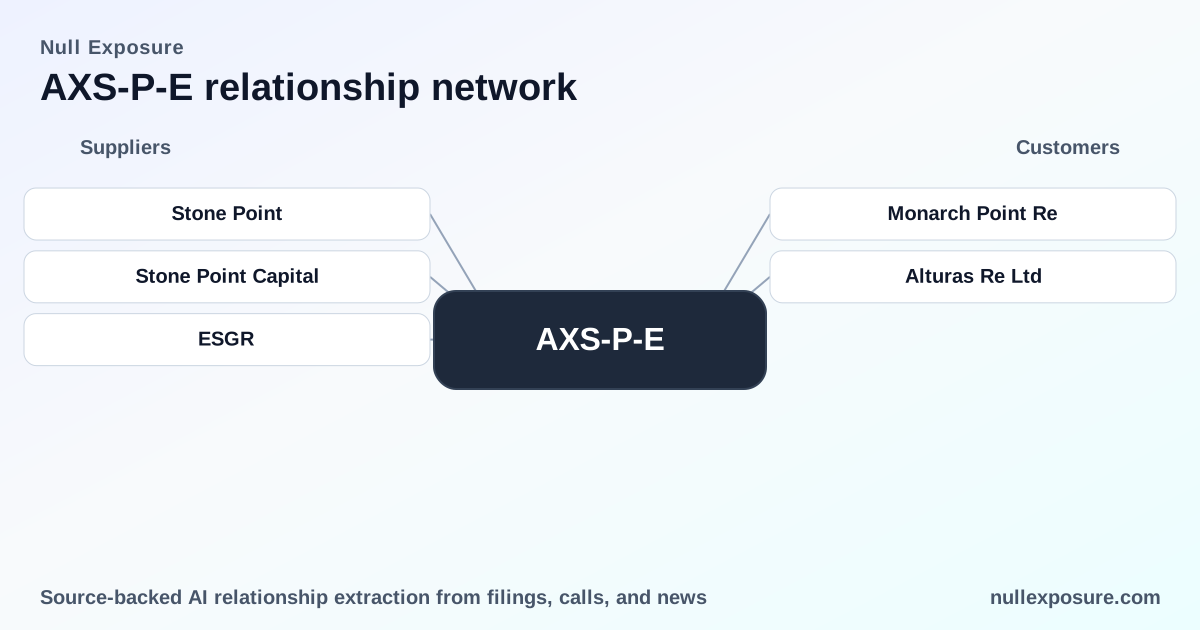
Axis Capital (AXS‑P‑E) — customer relationships that shape capital strategy
Axis Capital’s preferred series represents a claim on a business that systematically uses third‑party capital vehicles and structured transactions to manage underwriting volatility and shore up regulatory capital. The company monetizes through underwriting margins and fee income from insurance‑linked securities (ILS) and sidecar structures, while preserving balance‑sheet capacity via quota shares and portfolio transfers; these relationships are central to Axis’s capital allocation and shareholder actions such as buybacks. For primary research and access to related coverage, visit https://nullexposure.com/.
How Axis uses third‑party capital to run the business
Axis runs a hybrid operating model: it underwrites risks directly and delegates portions of that risk to investor capital through retrocession, sidecars, and portfolio transfers. That contracting posture reduces retained volatility, generates fee income, and creates recurring governance and counterparty management workflows. The tradeoff is increased operational complexity and dependence on capital markets and specialist counterparties to absorb peak losses and provide capital relief when needed.
The relationships that matter to Axis’s capital and underwriting
Below I cover every customer/partner relationship surfaced in the underlying reporting. Each entry is a concise, plain‑English take with the original reporting referenced.
Monarch Point Re — a Bermuda vehicle used to retrocede casualty risk
Monarch Point Re is a Bermuda reinsurer that takes a diversified portfolio of casualty business retroceded by Axis subsidiaries under quota share arrangements; Axis uses the vehicle to place casualty exposures with third‑party capital rather than retaining them on its balance sheet. According to Artemis reporting from March 9, 2026, Axis set up Monarch Point Re as part of its 2026 collateralized insurer initiatives and has been routing casualty retrocession through that vehicle. (Artemis, March 9, 2026)
Monarch Point Re — part of a broader upswing in sidecar and third‑party capital use
Axis reduced catastrophe load in prior years but has re‑increased use of sidecars and third‑party capital to spread a broader range of risks, including casualty, via Monarch; this signals a strategic re‑reliance on external capital to grow or stabilize underwriting capacity. Artemis noted this trend in the same March 2026 coverage on Axis’s ILS and sidecar activity. (Artemis, March 9, 2026)
Alturas Re Ltd — a sidecar conduit for investor‑funded risk transfer
Alturas Re Ltd has historically been a conduit through which Axis ceded both insurance and reinsurance risks to third‑party investors, though recent activity shows only a single reinsurance issuance from the structure in the current review period. Artemis’s March 2026 article documents that Alturas has been used for ceding risk to investors but that issuance frequency has slowed to limited transactions this cycle. (Artemis, March 9, 2026)
Enstar — a portfolio transfer that unlocked capital for buybacks
Axis executed an LPT (loss portfolio transfer) with Enstar that delivered tangible capital relief, enabling the company to conduct share repurchases at a higher pace relative to income than in a normal year. Management highlighted the Enstar LPT transaction as a material capital maneuver during the Axis earnings call coverage transcribed on May 2, 2026. (Investing.com transcript, May 2, 2026)
What these relationships imply for investors
- Capital flexibility is the operating lever. Axis systematically substitutes investor capital for balance‑sheet capital via quota shares, sidecars, and LPTs, thereby smoothing earnings volatility and creating tactical capacity for M&A or buybacks.
- Fee income and capital relief are both monetization channels. Artemis coverage notes that Axis earned meaningful ILS fees in 2025, which collectively with sidecar arrangements provide recurring non‑underwriting revenue and reduced capital strain. (Artemis, March 9, 2026)
- Counterparty and market dependence is elevated. Reliance on external vehicles increases exposure to investor market appetite, collateral requirements, and third‑party governance — operational risks that are distinct from underwriting exposure.
- Activity is cyclical but currently elevated. Recent reporting shows an uptick in third‑party capital use after a prior pullback in catastrophe writing, indicating Axis is actively re‑leveraging market structures to expand or stabilize capacity. (Artemis, March 9, 2026)
Constraints and company‑level signals affecting the business model
With no constraints explicitly attached to a single relationship in the reporting, the following are company‑level operational characteristics driven by the documented relationships:
- Contracting posture: Axis favors quota share and sidecar arrangements to offload risk and access investor capital; these contracts are negotiated to deliver capital relief and fee income while preserving distribution and underwriting control.
- Concentration and counterparty dispersion: Use of multiple vehicles (Monarch, Alturas, LPT partners like Enstar) indicates moderate dispersion of counterparty exposure rather than dependence on a single third party, which reduces single‑point counterparty risk but raises coordination costs.
- Criticality to capital management: Third‑party structures are critical to Axis’s capital strategy, both to generate fee income (ILS) and to create statutory/capital relief that enables shareholder actions such as buybacks.
- Maturity of the approach: Axis’s use of sidecars and portfolio transfers is not experimental — these are established tools in the company’s toolkit — but activity levels are cyclical and responsive to market conditions, as demonstrated by the recent uptick in 2025–2026 activity.
- Operational implications: Repeat transactions require robust governance, collateral management, and investor relations capabilities; failure or market dislocation in third‑party capital markets would pressure Axis’s ability to scale or de‑risk exposures quickly.
Investment takeaways and risks to monitor
- Positive: Axis’s structured capital moves—sidecars, retrocession, and LPTs—create clear capital and earnings advantages, including fee income and the ability to repurchase shares. The Enstar LPT is a concrete example of capital engineering translating to shareholder returns. (Investing.com, May 2, 2026)
- Watchlist: Track investor demand for ILS/sidecar capacity, collateral standards in collateralized reinsurers, and the frequency of issuances from vehicles like Alturas; a pullback in market demand would restrict Axis’s flexibility. Artemis’s reporting highlights both the fee benefits and the variable issuance cadence. (Artemis, March 9, 2026)
- Operational risk: Ongoing governance, model validation, and counterparty credit monitoring are required to sustain this model without increasing aggregate risk to policyholders or preferred holders.
For a concise dashboard and deeper relationship mapping, visit https://nullexposure.com/ — our research collates these structures and the filings that underpin them.
Bottom line
Axis’s use of Monarch Point Re, Alturas Re, and the Enstar LPT shows a deliberate capital‑management architecture: shift volatility off balance sheet, monetize through fees, and maintain capital agility for shareholder returns. Investors in Axis’s preferred series should treat these third‑party arrangements as central to credit and capital assessment — they are not peripheral deals, they are the mechanics of how Axis funds underwriting growth and shareholder distributions.