AXT Inc (AXTI): Customer Relationships Drive an IP-Grade Substrate Franchise
AXT, Inc. designs, manufactures and sells compound semiconductor substrates—primarily indium phosphide, gallium arsenide and germanium wafers—to upstream epitaxial and device manufacturers, monetizing through product sales under short-term purchase orders. Revenue is generated at the point of shipment with no lingering customer acceptance obligations, and the company’s commercial footprint is concentrated offshore, supplying customers that convert substrates into lasers, RF devices and optical components for hyperscalers and telecom vendors. For a deeper view of customer linkages and signals, see https://nullexposure.com/.
Why customer linkages matter for valuation and strategy
AXT’s business is transactional and volume-driven: margins and growth depend on wafer mix, manufacturing throughput in China, and the cadence of demand from high-volume customers in APAC and Western Europe. The company’s revenue recognition practice—single performance obligation on product transfers and contracts that are typically shorter than six months—creates predictable near-term cashflows but exposes AXT to demand cyclicality and rapid shifts in hyperscaler build-outs.
Geography and concentration are central: about 92% of 2024 sales were to customers outside the United States, with China, Taiwan and Germany representing the largest market buckets. That footprint makes AXT sensitive to semiconductor capex cycles in Asia and European device makers, while its role as a seller of foundational substrate material positions it as a critical, though upstream, supplier in customer value chains.
If you’re modeling growth or counterparty exposure, bear in mind the company’s product-centric segment focus—core substrates and related high-purity materials—and the purchase-order sales posture. Learn more about relationship intelligence at https://nullexposure.com/.
Publicly reported customer relationships: what the press highlights
GOOG — Markets.FinancialContent technical note (FY2026)
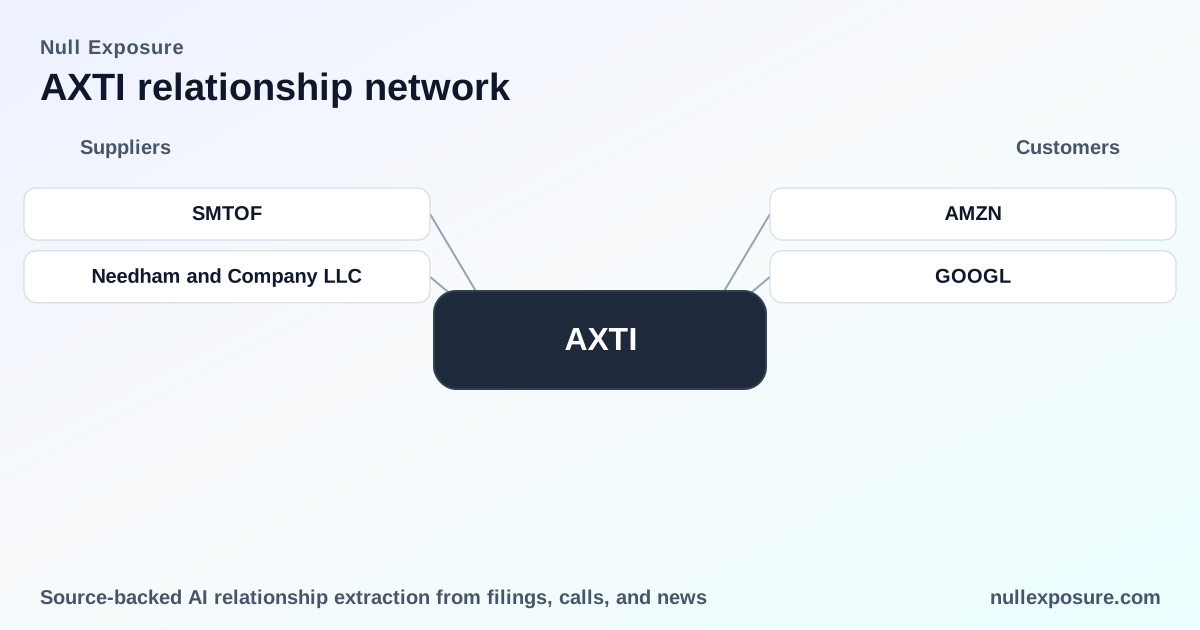
A Markets.FinancialContent piece on March 4, 2026 highlights that AXT’s indium phosphide wafers are essential components for laser chips powering next-generation 800G and 1.6T optical transceivers used by Google and other hyperscalers. This positions AXT as a materials supplier to hyperscaler optical-systems supply chains. (Markets.FinancialContent, March 4, 2026: https://markets.financialcontent.com/stocks/article/marketminute-2026-3-4-axt-inc-axti-stock-technical-analysis-understanding-the-march-4-pullback)
Amazon — StocksToTrade coverage (FY2026)
An analyst note on StocksToTrade dated March 2, 2026 cites strong ties to major tech giants such as Amazon as a driver for anticipated expansion opportunities, signaling that AXT’s product set is on the radar of large cloud and content-distribution customers as they upgrade interconnect speeds. (StocksToTrade, March 2, 2026: https://stockstotrade.com/news/axt-inc-axti-news-2026_03_02/)
GOOGL — StocksToTrade coverage (FY2026)
The same StocksToTrade article references Google explicitly alongside Amazon, noting analyst commentary that links AXT to hyperscaler demand for higher-bandwidth optical components—an endorsement that underlines the strategic relevance of AXT’s indium phosphide substrates to cloud-scale networking upgrades. (StocksToTrade, March 2, 2026: https://stockstotrade.com/news/axt-inc-axti-news-2026_03_02/)
Google — StocksToTrade coverage (FY2026)
StocksToTrade’s March 2, 2026 report repeats the nexus between AXT and major tech customers including Google, reinforcing market narratives that AXT’s substrate portfolio is aligned with hyperscaler optical and laser-chip roadmaps. The repetition across outlets indicates active market attention to these customer ties. (StocksToTrade, March 2, 2026: https://stockstotrade.com/news/axt-inc-axti-news-2026_03_02/)
Operational constraints that shape AXT’s commercial profile
AXT’s public filings and disclosures reveal operational characteristics that inform risk and opportunity assessments:
- Contracting posture — short-term: Management states that the majority of contracts are short-term (usually under six months) and represent a single performance obligation. This creates flexibility but also revenue volatility tied to customer ordering cycles.
- Geographic concentration — APAC/EMEA heavy: In 2024 the geographic revenue table shows China (
$56.1m), Taiwan ($14.1m) and Europe (primarily Germany, ~$13.8m) as material markets, while North America accounted for roughly 8% of revenue in 2024. Company-level signals therefore point to customer demand driven primarily by Asia and Western Europe. - Global manufacturing footprint: AXT manufactures substrates in China and reports that ~92% of sales were to customers outside the U.S. in 2024, creating an operational exposure to China manufacturing continuity and logistics.
- Role in the value chain — seller of core product: The company sells high-performance substrates and certain raw materials; after shipment there are no remaining obligations that preclude revenue recognition, which indicates a commodity-like delivery model rather than long-term engineered service contracts.
- Product focus — core_product: The business is concentrated on substrates (indium phosphide, gallium arsenide, germanium) and ancillary high-purity materials—the firm’s economics hinge on wafer mix, yield, and high-purity material sourcing.
These constraints translate into a predictable-but-volatile cash profile: predictable at shipment, volatile in aggregate because orders come in short cycles and are geographically concentrated.
Investment implications: drivers, risks and the research checklist
- Growth drivers: hyperscaler migration to 800G/1.6T transceivers and the broader optical upgrade cycle create a structural demand pathway for indium phosphide substrates; analyst coverage (target price consensus) reflects upside scenarios tied to that market expansion.
- Margin and valuation context: The company reported negative EPS on trailing metrics and thin operating margins, while valuation multiples implied by enterprise multiples are elevated; investors should reconcile growth expectations against recent profitability and cash flow dynamics.
- Key risks: customer concentration to Asia/Europe, dependency on China manufacturing, short-term contracting, and cyclicality of semiconductor capital spending. A single-year swing in hyperscaler capex can disproportionately affect revenue given the short purchase-order cycle.
- Due diligence items: Confirm direct procurement relationships with hyperscalers versus indirect exposure through tier suppliers; validate wafer supply chain resilience in China; model demand scenarios for optical transceiver ramps and the impact on wafer ASPs and utilization.
If you need granular, relationship-level signals and primary-source tracking for modeling counterparty exposure, NullExposure maintains a curated view of disclosed and media-linked customer mentions—explore further at https://nullexposure.com/.
Bottom line
AXT operates a focused substrate franchise that sells high-purity wafers under short-term purchase orders to a geographically concentrated customer base, and recent press coverage links its indium phosphide products directly to hyperscaler optical upgrades involving Google and Amazon. That positioning creates a compelling growth vector if next-generation optical demand materializes, balanced by tangible concentration and manufacturing-location risks. Investors and operators valuing AXT must weigh the upside of hyperscaler-driven demand against the short-duration contract structure and Asia-centric revenue mix.