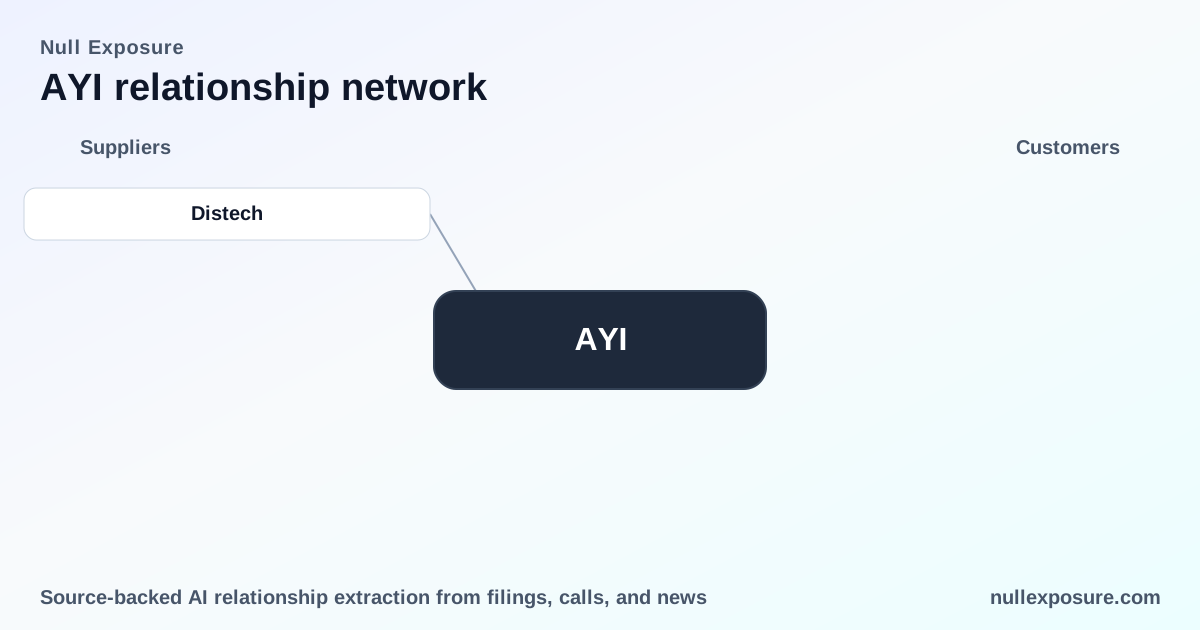
Acuity Brands (AYI): Customer Relationships and What They Reveal About Revenue Quality
Acuity Brands operates as a commercial and institutional lighting and building management platform, monetizing primarily through the sale of luminaires, lighting and building controls, and complementary software and services. Revenue streams combine short-term product sales, recognized at delivery, with longer-duration service-type warranties and software arrangements that bill or recognize over multiple years; distribution runs through a mix of independent agencies, electrical distributors, system integrators and direct enterprise accounts. For investors, the key takeaway is that revenue is anchored in hardware but increasingly supported by higher-margin recurring software and warranty cash-flows, with customer concentration intentionally low and go-to-market breadth that reduces counterparty risk. For more context on AYI’s customer footprints and disclosures, see https://nullexposure.com/.
Recent customer wins that matter to operators and analysts
Acuity’s public customer mentions in the period examined are targeted commercial and institutional deployments rather than large headline OEM partnerships. Two relationships were disclosed in a press release about outdoor LED deployments in Wisconsin.
Appleton Medical Center — targeted outdoor LED parking solution
Appleton Medical Center selected Acuity Brands' outdoor LED lighting for a parking project, aimed at improving energy efficiency and safety in a healthcare campus environment. This purchase reflects straightforward product sales with expected energy- and maintenance-related value propositions. Source: ledinside.com press release, April 2026 (reporting on ThedaCare selection).
ThedaCare health system — multi-campus outdoor lighting retrofit
ThedaCare health system contracted Acuity Brands to address safety, energy and maintenance concerns with outdoor LED lighting across two campuses, signaling multi-site rollouts typical of institutional customers that buy through a combination of direct and distributor channels. Source: ledinside.com press release, April 2026 (ThedaCare announcement).
(For readers who want a succinct platform overview and tracking on customer mentions, visit https://nullexposure.com/.)
What these customer references tell investors about deal size and criticality
The public references are transactional and deployment-focused, not strategic equity partnerships. Both relationships are consistent with Acuity’s core go-to-market: selling lighting hardware and controls into large institutional customers (health systems, campuses) where energy savings and reduced maintenance justify retrofits. These are commercial retrofit projects rather than large multi-year managed services engagements, reinforcing that the near-term revenue profile is product-led while providing avenues for follow-on controls and software sales.
Company-level constraints that shape revenue durability and risk
Acuity’s filings and disclosures establish the framework for how customer relationships convert into reported revenue and cash:
-
Contracting posture — mixed, product-led with embedded long-duration obligations. The company states that “substantially all” revenue historically comes from short-term contracts for tangible goods such as luminaires and lighting controls, which means cash realization is front-loaded on delivery. At the same time, the company discloses non‑current deferred revenues tied to long-term service-type warranties recognized ratably over five to ten years, creating a modest, predictable revenue tail from warranty services. Source: company filings through August 31, 2025.
-
Recurring software revenue is present and growing. Filings explicitly list software licenses, data usage fees and SaaS arrangements as part of software sales, indicating an expanding higher-margin recurring cohort beneath the hardware base. Source: company filing excerpts, FY2025.
-
Go-to-market breadth and counterparty type lower concentration risk. Sales are routed through independent sales agencies, internal reps, electrical distributors, consumer retailers, direct enterprise accounts and OEM channels; AIS business lines sell primarily through system integrators. This multi-channel approach distributes risk across many counterparties and verticals. Source: company filings, FY2025.
-
Geographic footprint is North America-first with selected international exposure (including EMEA). Customer verticals and AIS channel references show meaningful activity in North America and Europe, consistent with a diversified geographic profile rather than single-market dependence. Source: FY2025 disclosures.
-
Customer concentration is low and immaterial to overall receivables. Filings state that no single customer accounted for more than 10% of net sales or receivables in recent fiscal years, a direct statement of immaterial concentration. This is a material corporate-level signal for credit and revenue risk assessment. Source: consolidated financial statements, August 31, 2025.
-
Distribution and reseller orientation. Repeated disclosure that lighting solutions are sold primarily through distributors, independent agencies and system integrators underscores that many customer relationships are indirect, which reduces single-buyer negotiating leverage but increases dependence on channel economics. Source: company filings, FY2025.
How these structural signals translate into investment implications
-
Revenue durability: The company’s mix — short-term product sales plus multi-year warranty recognition and growing software — produces revenue that is predictable at the macro level while still subject to product-cycle and project-timing volatility at the micro level. Expect quarter-to-quarter swings tied to construction and retrofit timing; expect smoother multi-year recognition from warranty and subscription lines.
-
Risk profile: Low single-customer concentration and broad channel distribution reduce counterparty concentration risk; channel dependence introduces execution risk tied to distributor inventory and project pipelines. Geographic exposure is diversified across North America and Europe, limiting single-market shock.
-
Upside levers: Scaling software, analytics and control platform adoption across installed base boosts recurring margin and customer “stickiness.” The recent healthcare retrofit references demonstrate an installed-base pathway for upsell of controls and services.
-
Near-term cadence: Institutional retrofit projects (like ThedaCare) are highly observable, project-based revenue events; they are important for top-line growth but are not, in isolation, transformative long-term contracts.
Actionable takeaways for portfolio managers and operators
- Focus on recurring revenue growth and margin expansion in software/controls when modeling AYI’s forward earnings; hardware sales deliver volume but lower margin stability.
- Stress-test distributor channel dynamics and working capital assumptions because indirect sales dominate go-to-market and can amplify or dampen revenue recognition.
- Monitor warranty deferred revenue and the pace of SaaS adoption as early indicators of revenue smoothing and recurring cash-flow build.
Bottom line
Acuity Brands runs a hardware-first commercial model with credible, company-acknowledged paths to increase recurring revenue through warranties and software. Recent customer mentions such as Appleton Medical Center and ThedaCare are representative product-deployment wins that validate demand in institutional verticals and provide natural avenues for upsell. For detailed monitoring of customer activity and press-level relationship signals, visit https://nullexposure.com/.
For bespoke research or to track relationship-level exposures across a portfolio, explore additional resources at https://nullexposure.com/.