Aytu BioScience: commercial partners, concentration risk, and where revenue comes from
Aytu BioScience operates as a specialty pharmaceutical commercializer that monetizes through prescription product sales to wholesale distributors and pharmacies in the United States while expanding reach via exclusive international licensing and distribution agreements. Revenue flows primarily from product sales into U.S. wholesale channels and from licensing/collaboration receipts when Aytu grants commercialization rights abroad or to other manufacturers.
If you want a concise marketplace map targeting commercial counterparties and concentration signals, see https://nullexposure.com/ for expanded coverage and analytics.
What matters most to investors: concentrated U.S. sales and targeted international rollouts
- Concentration is the dominant corporate characteristic. Aytu discloses four customers accounted for roughly 85% of gross revenue and 89% of gross accounts receivable in the latest fiscal year, which makes single-counterparty disruption a material business risk.
- Primary monetization channel is distributor sales in the U.S., with product shipments recorded as net product sales to a limited set of wholesale distributors and pharmacies.
- International expansion is executed via exclusive collaboration/distribution agreements, which transfers commercialization execution and market risk to local partners while generating license or distribution revenue for Aytu.
- Patent/licensing arrangements with large generic manufacturers introduce scheduled competition dates, indicating a matured IP posture for certain products.
These points shape the contracting posture: Aytu is a seller/licensor with concentrated wholesale channels at home and selective third‑party partners abroad.
Customer and partner relationships (what the public record shows)
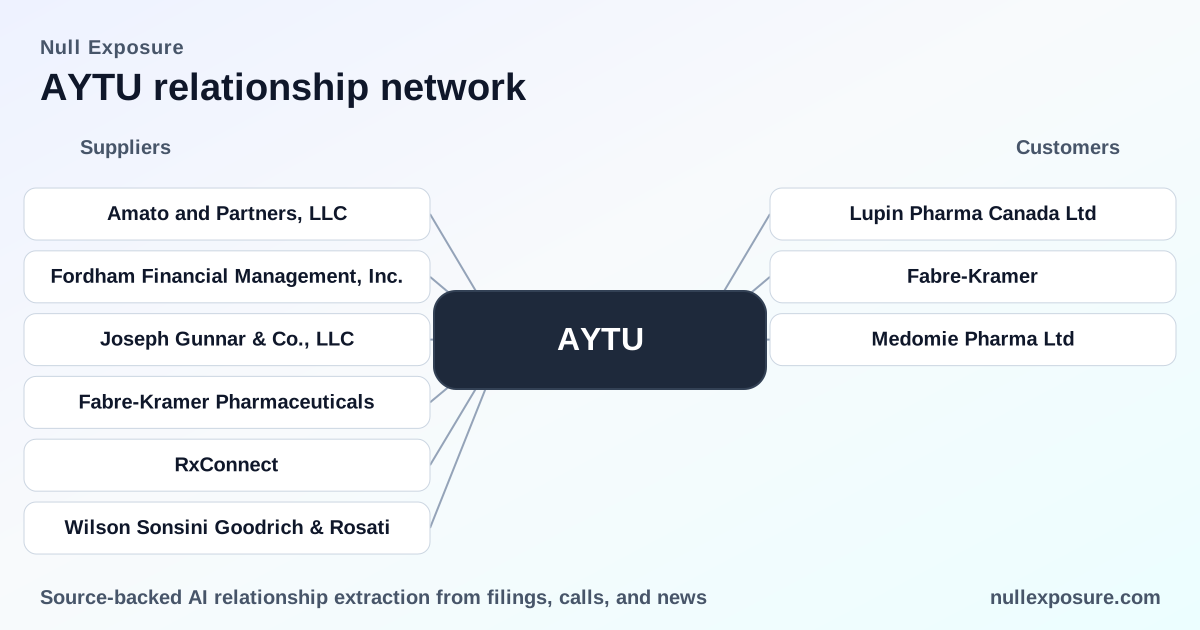
Aytu’s public disclosures and press reports identify a small set of named commercial partners. Below are concise, investor-oriented summaries of each relationship uncovered in the record.
Lupin Pharma Canada Ltd
Aytu entered an exclusive collaboration, distribution and supply agreement with Lupin Pharma Canada for its ADHD product lines (Adzenys XR‑ODT and Cotempla XR‑ODT) in Canada, marking a formal push to commercialize those brands outside the U.S. in FY2024–FY2025 disclosures. According to a firm notice published October 1, 2024 and reiterated in Aytu’s FY2025 filings, Lupin will be the exclusive Canadian commercialization partner for those products (see the Wilson Sonsini release and subsequent SEC‑reporting coverage).
Source: Wilson Sonsini announcement (Oct 1, 2024) and Aytu FY2025 SEC disclosures reported on TradingView.
Medomie Pharma Ltd
Aytu agreed to an exclusive collaboration with Medomie Pharma for commercialization of certain ADHD products in Israel and the Palestinian Authority, establishing a regional commercialization pact in FY2025. The arrangement was disclosed in Aytu’s FY2025 filings and reported in related press coverage.
Source: Aytu FY2025 SEC disclosures reported on TradingView.
Fabre‑Kramer
Fabre‑Kramer holds an exclusive U.S. commercialization agreement for EXXUA s, according to Aytu’s FY2025 disclosures, positioning Fabre‑Kramer as a U.S. commercialization partner for that specific product line. This is part of Aytu’s strategy to partner for commercialization rather than execute all launches internally.
Source: Aytu FY2025 SEC disclosures reported on TradingView.
How these relationships fit Aytu’s operating model and risk profile
Several constraints from Aytu’s disclosures define how investors should read the partnership map:
- Geography and channel focus are U.S.‑centric. The company states its prescription products are sold primarily in the United States through multiple channels—principally wholesale distributors and pharmacies—so domestic distributor performance drives near‑term revenue. This is a company‑level signal tied to sales mix and operating rhythm.
- Customer concentration is critical. The company reports that four customers represented more than 10% of gross revenue each and together accounted for 85% of gross revenue and 89% of gross accounts receivable as of June 30, 2025. That concentration elevates counterparty credit and negotiation risk across revenue, collections, and pricing.
- Role posture: seller and distributor‑facing. Net product sales are recorded as sales to wholesale distributors and pharmacies; Aytu’s contracting posture in the U.S. is primarily as seller to distributors rather than direct retail or physician sales.
- Licensor activity and IP maturity are visible in historical agreements. Aytu disclosed non‑exclusive patent licenses historically granted to Actavis Laboratories FL and Teva Pharmaceuticals USA that allow generic manufacture under ANDAs with trigger dates in 2025 and 2026, respectively—an explicit company signal that some product lines face scheduled generic entry and that licensing has been a tool to monetize IP and manage market transitions.
Together these signals explain why Aytu balances concentrated domestic sales with selective international licensing: distribution partners reduce Aytu’s direct market risk abroad while the home market remains reliant on a small set of wholesale customers.
Investment implications and what to watch next
- Revenue volatility is highly likely until customer concentration is diversified. With four customers driving most revenue and receivables, any dispute, inventory order change, or distributor destocking will have outsized P&L and cash‑flow impact.
- International partnerships provide risk transfer and upside, but they do not eliminate counterparty risk—partner commercial execution, regulatory approvals, and supply reliability determine whether these deals convert into sustained revenue.
- IP timelines matter. The company’s prior licensing to large generics with ANDA effective dates signals potential revenue erosion windows for affected branded products; investors should track patent disputes, settlement terms, and launch dates tied to those agreements.
- Macro read: Aytu reported $62.64M revenue TTM and gross profit of $41.87M, with negative EPS of -3.35 and an analyst target price of $9.33 per share in the public snapshot—metrics that put the company in the early commercial, growth‑with‑risk stage rather than a stable cash generator.
If you track corporate counterparties and concentration across healthcare portfolios, detailed mapping and alerts for partner announcements are available at https://nullexposure.com/.
Bottom line
Aytu’s commercial model is straightforward: sell into concentrated U.S. distributor channels while licensing and partnering internationally to expand reach without building full foreign go‑to‑market infrastructure. That model accelerates scale but preserves meaningful counterparty and IP‑timing risk. Investors should prioritize monitoring distributor performance, receivables by counterparty, and the execution of international partners such as Lupin, Medomie, and Fabre‑Kramer against the company’s fiscal disclosures.