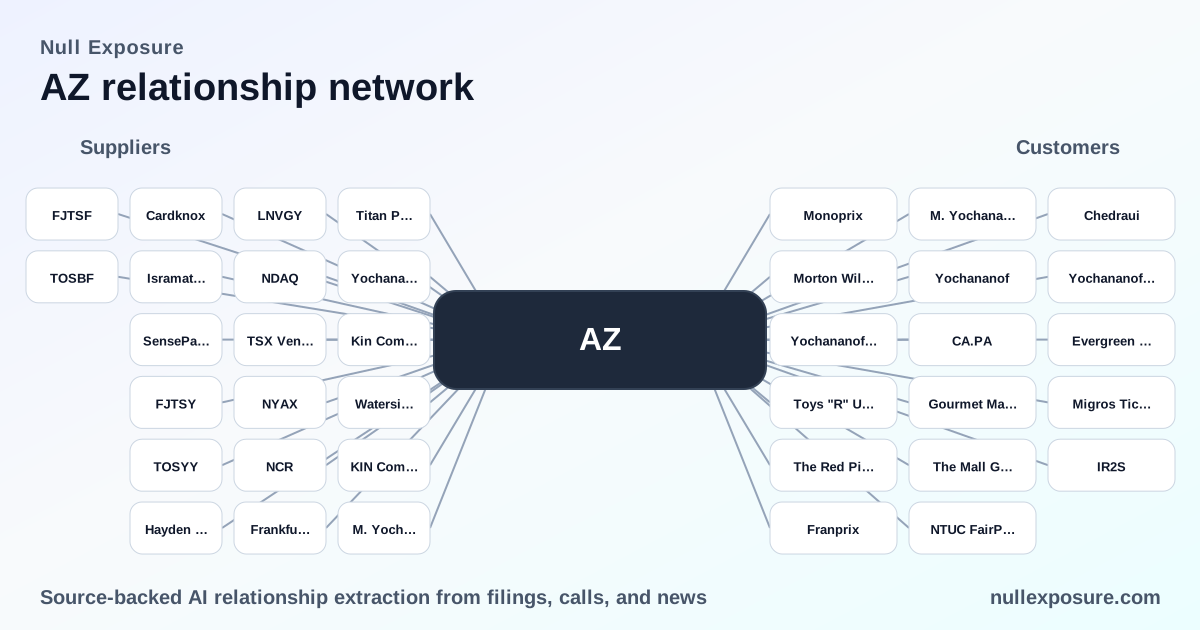
A2Z Smart Technologies (AZ): Customer Map and What It Means for Investors
A2Z Smart Technologies builds and monetizes a hybrid hardware‑plus‑software platform—its Cust2Mate smart shopping carts—selling devices, installation and recurring service contracts, and retail‑media advertising access on carts as a recurring revenue stream. The company leverages long‑standing government service contracts for steady work while pursuing rapid commercial scale through large purchase orders and deployment partnerships with supermarket and specialty retail chains. For investors, the core thesis is straightforward: A2Z is a small but fast‑scaling smart‑retail roll‑out with outsized revenue dependence on a handful of large purchase orders and growing retail‑media monetization potential. Learn more about this coverage at https://nullexposure.com/.
How A2Z operates and where the economics come from
A2Z sells hardware (smart carts), integrates to store POS and networks, then layers software services and advertising inventory that transform carts into a retail‑media channel. The company reports Revenue TTM of $7.9M and negative EBITDA, indicating current deployments are early in monetization even as larger purchase orders accelerate recognized backlog. A2Z’s business model combines:
- Up‑front capital sales (purchase orders for carts);
- Recurring service and maintenance revenue (including long‑running contracts with Israeli defense customers); and
- Advertising and data‑driven retail media revenue as deployments scale.
This operating posture implies a mix of pilot‑to‑enterprise sales cycles, customer concentration risk tied to large POs (several million‑dollar orders visible in filings and press releases), and operational criticality for customers once carts integrate to store systems. Institutional ownership (about 40%) and insider stakes (~18%) point to engaged ownership while company fundamentals—negative EPS and thin gross profit today—signal an execution phase focused on scale rather than current profitability.
Customer relationships and evidence from filings and press coverage
Below is a plain‑English summary of every customer relationship cited in the collected results, with source references.
Yochananof / M. Yochananof & Sons (1988) Ltd.
A2Z received a major purchase order and initiated production and deliveries for Yochananof, described in press releases as a multi‑million dollar strategic supermarket partner driving the company’s first large‑scale deployments. According to company announcements and financial press coverage in FY2025–FY2026, A2Z recorded a $55 million PO tied to Yochananof and followed with production and deliveries (Markets FinancialContent; InvestingNews, FY2025).
Super Sapir
A2Z secured a reported $30 million contract to supply 3,000 smart carts to the Israeli supermarket chain Super Sapir, representing a material commercial win and channel expansion in Israel (TipRanks, FY2025).
Toys "R" Us Israel
A2Z signed an advertising and equipment agreement with Toys "R" Us Israel as part of a combined order that included toy retail deployment and retail‑media initiatives, reported alongside related orders in FY2025–FY2026 (Yahoo Finance; Investing.com, FY2025–FY2026).
The Red Pirate
The company announced a deal with toy retailer The Red Pirate as part of the Toys "R" Us Israel transaction—a $15 million combined order for 2,000 carts that positioned A2Z into toy retail advertising and in‑store media (Investing.com; Yahoo Finance, FY2026/FY2025).
Morton Williams / Morton Williams Supermarkets
A2Z ran pilots and follow‑on deployments with the New York‑area upscale chain Morton Williams, cited as an early U.S. pilot customer for Cust2Mate smart carts and later follow‑up orders (JNS.org; Markets FinancialContent, FY2021–FY2024).
Evergreen / Evergreen Kosher Market
A2Z deployed Cust2Mate carts at Evergreen Kosher Market locations in Monsey and Lakewood, New Jersey, marking targeted roll‑outs into neighborhood specialty grocers in FY2021–FY2022 (JNS.org; StockTitan reporting, FY2026).
Monoprix
Monoprix appeared on deployment roadmaps alongside Yochananof and Morton Williams in announcements about the company’s rollout schedule, indicating multi‑market pilot intent across Israel and international partners (Markets FinancialContent, FY2024).
Franprix
A2Z deployed Cust2Mate 3.0 smart carts at Franprix in Paris and later received follow‑up orders to expand to additional Paris stores; this demonstrates early traction in the French urban grocery market (RetailTech Innovation Hub; related 2024–2025 press, FY2024).
Carrefour / CA.PA
A2Z’s Cust2Mate was selected as a supplier for Carrefour’s Connected Cart project in France, reflecting selection by a major European retail group under the CA.PA umbrella (RetailTech Innovation Hub, FY2023).
HaStok Concept / HaStock
A2Z announced a partnership to deploy smart carts across HaStok Concept’s 40 Israel locations (reported under both “HaStok” and “HaStock”), a roll‑out demonstrating expansion into home‑goods and non‑food retail formats (RetailTech Innovation Hub; MarketBeat, FY2023–FY2026).
Gourmet Market
A pilot integration with Gourmet Market included first‑time POS integration with Fujitsu in Thailand, showing A2Z’s international pilot footprint beyond Europe and Israel (AccessWire, FY2022).
The Mall Group
A2Z launched a pilot program with The Mall Group in Thailand, illustrating the company’s strategy of mall and retail operator pilots for regional expansion (AccessWire; RetailTech Innovation Hub, FY2022–FY2023).
NTUC FairPrice Co‑Operative
A2Z executed a pilot program with NTUC FairPrice—the largest supermarket chain in Singapore—giving the company access to a dense Southeast Asian market testbed (AccessWire, FY2022).
Chedraui
A2Z launched a pilot with Chedraui, Mexico’s third‑largest retailer, which operates stores regionally and in U.S. Hispanic markets under banners like El Super, signaling North American and Latin American retail channel tests (AccessWire, FY2022).
Migros Ticaret A.Ş.
A2Z reported collaborations with Migros Ticaret in Türkiye, indicating engagement with leading Turkish supermarket groups as part of its international footprint (StockTitan reporting, FY2026).
IR2S
A reported framework agreement tied to IR2S outlined deployment plans (up to 30,000 carts through 2026) across French retail partners, suggesting A2Z’s use of local systems integrators to scale in national markets (RetailTech Innovation Hub, FY2024).
Israel Ministry of Defense / Israeli Defense Forces (IDF)
A2Z has been a contractor to Israel’s Ministry of Defense and IDF for decades, with reported multi‑year service contracts and a history of recurring government maintenance business, supplying a steady service revenue base distinct from retail activities (AccessWire; InvestingNews, FY2020–FY2026).
What these relationships imply for investors
- Revenue concentration and step‑function growth: Large purchase orders (e.g., reported $55M Yochananof PO and $30M Super Sapir order) create material step increases in backlog and revenue recognition when delivered, but A2Z’s trailing revenue ($7.9M TTM) shows current scale is small relative to headline POs.
- Mixed maturity across verticals: Government contracts provide a mature, service‑oriented base while retail deployments are early‑stage commercial scale with higher growth potential via advertising monetization.
- Execution and integration risk: Deployments require POS integration and store‑level roll‑out capabilities; partnerships with systems integrators (e.g., IR2S, Carrefour projects) and local pilots reduce go‑to‑market friction but place execution burden on operations.
- Profitability runway: The company is investing in scale—negative EBITDA and low gross profit today—so valuation and investor returns depend on converting POs into recurring service and advertising revenue at scale.
For a concise investor briefing and further relationship analytics, visit https://nullexposure.com/.
Bottom line: investment posture
A2Z is a growth story that sits at the intersection of hardware sales, software services and retail media. Its commercial proof points (large POs and multi‑market pilots) validate the go‑to‑market, but current financials reflect early monetization and meaningful concentration risk. Investors should weigh the size and deliverability of announced purchase orders against the company’s execution capabilities and near‑term margin profile.