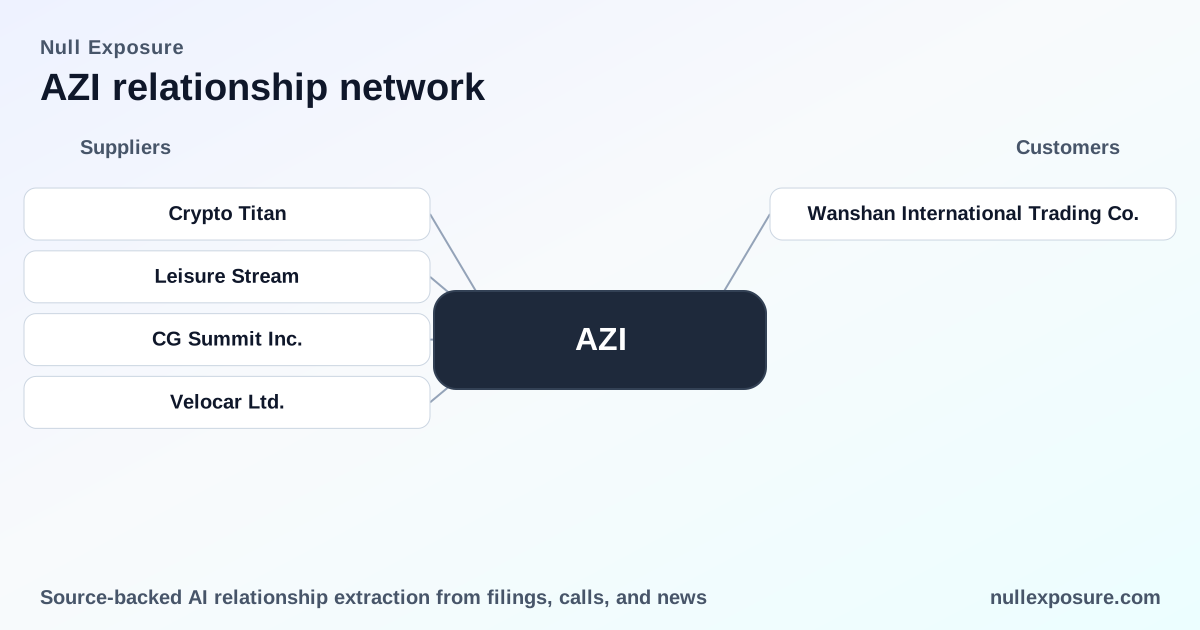
Autozi (AZI) — Customer relationships and what the Wanshan tie-up means for investors
Autozi generates revenue by selling automotive aftermarket parts and related services through both online and offline channels in China, and it is now explicitly pursuing international scale by packaging its parts business together with an SPV portfolio for overseas distribution. Management monetizes through product sales and SPV-enabled channel partnerships; the recent Wanshan arrangement is an acceleration of that distributor-led growth strategy. For investors, the central question is whether a capital-light channel push can overcome Autozi’s strained economics and tiny market capitalization. Learn more about the platform and coverage at https://nullexposure.com/.
Big-picture take: a distribution-first international growth push
Autozi’s core business is retail and wholesale of aftermarket auto parts; the company reports revenue of roughly $122.8 million TTM with gross profit of $2.15 million but remains loss-making (EBITDA at -$17.38 million, latest quarter to 2025-12-31). The announced partnership with Wanshan International Trading is a revenue-scaling, go-to-market move that outsources global distribution to a partner with an established sales network, while Autozi supplies inventory and SPV-structured exposures. According to a March 2026 news report, the partners set a shared target of USD 1 billion in cumulative overseas sales within three years, combining Autozi’s passenger-vehicle aftermarket parts and SPV portfolio with Wanshan’s global sales network.
Key takeaway: Autozi is pivoting to partner-led international expansion to amplify reach without a proportionate increase in fixed costs — a classic capital-light scaling attempt — but that ambition sits against weak profitability and a very small market cap.
The Wanshan partnership in plain English
Wanshan International Trading Co. will act as the global sales network for Autozi’s passenger-vehicle aftermarket parts and related SPV portfolio, with a joint target of USD 1 billion in cumulative overseas sales over three years. The plan leverages Wanshan’s distribution footprint to accelerate Autozi’s cross-border revenue recognition. This arrangement was reported on March 9, 2026 by StockTitan. (Source: StockTitan news, March 9, 2026 — https://www.stocktitan.net/news/AZI/due-to-strong-demand-autozi-internet-technology-global-ltd-announced-uc170spkkakv.html)
What this relationship reveals about Autozi’s operating model
Absent any disclosed, formal constraints tied to customers in the public relationship dataset, company-level signals shape interpretation:
- Contracting posture: Autozi is operating as a supplier and portfolio sponsor rather than a vertically integrated distributor; it is contracting partners to access markets overseas, which reduces direct selling expense but increases dependency on partner performance. The Wanshan deal reflects a supplier-to-distributor posture.
- Concentration and criticality: With institutional ownership at ~0.04% and insiders holding about 1.28%, Autozi’s shareholder base is extremely thin and trading liquidity is limited; operationally, large revenue swings tied to a single major partner would be highly material.
- Maturity: Financial metrics (negative EBITDA, steep losses, and a low gross profit margin) indicate the company is in a scaling and restructuring phase rather than a mature margin-generating enterprise. The SPV approach signals experimentation with product/market packaging to unlock overseas channels.
- Execution dependency: The viability of the $1 billion cumulative target is execution-dependent: inventory sourcing, channel integration, regulatory compliance in target markets, and partner sales effectiveness are all immediate gating items.
Financial and structural constraints that matter to investors
No relationship-level contractual constraints were provided in the available relationship feed; this absence itself is a company-level signal: there are no publicly disclosed customer-side contractual commitments in the relationship dataset that would lock in revenues or cap downside from partner underperformance. Against that backdrop, the following structural facts shape risk and upside:
- Scale mismatch: Market capitalization near $6.25 million contrasts sharply with a $1 billion three-year sales ambition, illustrating the leverage of successful execution but also the enormity of execution risk.
- Profitability pressure: Negative EBITDA and deeply negative EPS underline that top-line growth without improved margins will not translate into shareholder value.
- Liquidity and governance: Low institutional ownership and low float increase share volatility and limit access to patient capital through public markets.
Relationship-by-relationship breakdown (complete)
- Wanshan International Trading Co.: Autozi and Wanshan set a shared target of USD 1 billion in cumulative overseas sales within three years, combining Autozi’s passenger-vehicle aftermarket parts and SPV portfolio with Wanshan’s global sales network; the announcement was reported in March 2026. (Source: StockTitan news, March 9, 2026 — https://www.stocktitan.net/news/AZI/due-to-strong-demand-autozi-internet-technology-global-ltd-announced-uc170spkkakv.html)
This list reflects every customer relationship disclosed in the supplied results.
Risk checklist for investors
- Execution risk: Delivering on the $1 billion target requires rapid, reliable channel rollout and inventory management; any disruption will disproportionately hit a small company.
- Financial runway: Continued negative EBITDA demands capital or profitable scale; failure to improve margins will dilute shareholder value or force equity raises.
- Concentration risk: A single large partner for international push increases operational concentration and counterparty risk.
- Liquidity risk: Tiny market capitalization and low institutional interest elevate trading volatility and raise the cost of raising public capital.
Actionable investor monitoring and next steps
Investors should monitor:
- Formal partnership agreements or revenue-share schedules that provide visibility into near-term contracted revenues.
- Quarterly international sales disclosures and geography breakdowns to validate the pace toward the $1 billion cumulative target.
- Gross margin trends and inventory turnover to ensure scaling does not further compress already thin margins.
For updated relationship intelligence, coverage, and downstream analysis, visit https://nullexposure.com/.
Bold conclusion: Wanshan’s global distribution capability is the single most consequential customer relationship disclosed for Autozi; successful execution could be transformational, but it will need to overcome severe profitability, liquidity, and execution constraints to deliver investor value.