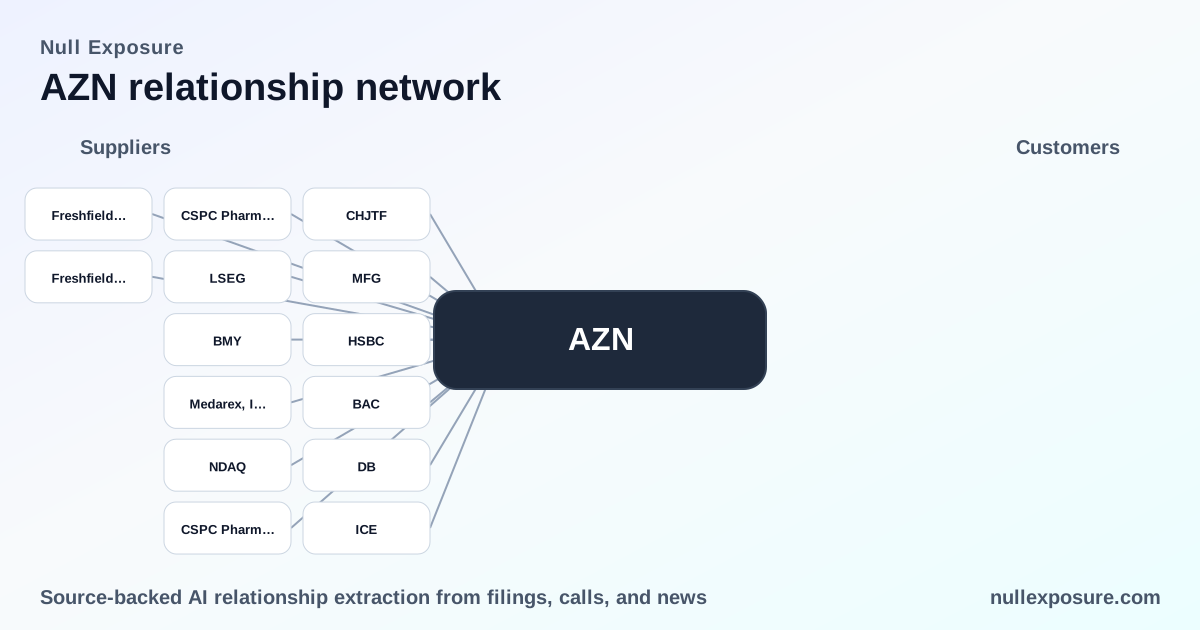
AstraZeneca (AZN): Partner ledger and what it means for investors
AstraZeneca discovers, develops, manufactures and markets prescription drugs across oncology, respiratory, cardiovascular and other therapeutic areas, monetizing through a mix of direct product sales of marketed medicines, milestone and royalty income from out‑licenses, and strategic collaborations that de‑risk early assets. For investors, AstraZeneca’s balance of proprietary commercial franchises and broad licensing activity creates a dual revenue engine: stable cash flows from marketed products and optionality from partnered or out‑licensed early programs.
For a concise partner map and deeper relationship analytics, visit https://nullexposure.com/.
Why partnerships matter for AZN’s model — a quick read for investors
AstraZeneca runs a two‑track operating model: scale commercialization for late‑stage and approved drugs, and selective externalization of preclinical/early clinical assets through licensing or carve‑outs. That posture preserves capital and pipeline optionality while generating near‑term cash via upfronts and future royalties. The partner list below reinforces three structural points: (1) diversified counterparty base across small biotechs, academic sponsors and regional developers; (2) recurring use of licensing and asset transfers as portfolio management; and (3) retention of commercial rights where AstraZeneca believes in global scale value.
Key investor takeaway: partnerships are an active lever in AZN’s capital allocation — they reduce internal development burden and create non‑dilutive cash events, while preserving upside through milestone/royalty structures.
The partner roster — relationship-by-relationship readout
Below are every customer/partner relationship seen in the collected results, each with a plain‑English summary and the original reporting cited.
LSTA
AstraZeneca is collaborating on an Australian clinical trial that combines a peptide candidate (certepetide) with the checkpoint inhibitor durvalumab and standard chemotherapy arms. This arrangement was disclosed in LSTA’s 2025 Q3 earnings call discussing the trial design and funding sponsor WARPNINE. (LSTA earnings call, 2025 Q3)
CGEN
CGEN extended its cash runway into 2029 through a non‑dilutive transaction with AstraZeneca tied to the asset rilvegostomig, demonstrating AZN’s use of structured cash deals to fund smaller partners while retaining asset exposure. (CGEN earnings call, 2025 Q4)
IPHA (Innate Pharma)
Innate paid $50 million upfront for U.S./EU rights to AstraZeneca’s Lumoxiti in a historical multipart immuno‑oncology arrangement, and later executed termination/transition terms that included splitting manufacturing costs and a $6.2 million payment schedule. These events show early upfront payments and shared manufacturing obligations between AZN and specialty partners. (FierceBiotech, FY2018; Innate Pharma/GlobeNewswire, FY2021)
OVID
Ovid Therapeutics acquired global rights to a library of AstraZeneca molecules targeting KCC2 for epilepsy, including lead candidate OV350, under an exclusive licence announced in 2022 — an example of AZN out‑licensing early small‑molecule programs. (MedCityNews/GlobeNewswire, FY2022)
CDT (Conduit Pharmaceuticals)
Conduit has licensed multiple AstraZeneca assets (including AZD1656, AZD5658 and AZD5904), agreed to issue stock to AstraZeneca and to share future sublicense revenues while receiving AZ‑provided preclinical/clinical data and drug supply. Conduit’s filings and press releases make AZN a strategic originator of validated, out‑licensed assets. (Pharmaceutical‑Technology, FY2024; Conduit SEC/press coverage, FY2025–FY2026)
HCM (HUTCHMED)
Savolitinib is being developed jointly by AstraZeneca and HUTCHMED and is commercialized by AstraZeneca, illustrating AZN’s co‑development model in regional collaborations where it often retains commercialization responsibility. (Research‑Tree/Reuters, FY2026)
INSM (Insmed)
Insmed’s disclosures reference license agreements with AstraZeneca AB that impose obligations and restrictions on marketed products and candidates, highlighting how licensing covenants can be a material operational factor for counterparties. (Insmed press release/PR Newswire, FY2026)
ADCT (ADC Therapeutics)
ADCT’s SEC filing notes that PBD technology used in some ADCs was developed by MedImmune and licensed on a target‑exclusive basis — MedImmune being the former AZ biologics arm — showing legacy tech transfers from AstraZeneca units to third parties under license. (ADCT SEC filing summary, FY2026)
KNSA (Kiniksa)
Kiniksa exercised its contractual right to terminate an exclusive license for mavrilimumab with MedImmune, demonstrating that counterparties sometimes exit MedImmune/AZ legacy agreements as strategic priorities change. (Kiniksa press release/GlobeNewswire, FY2025)
PIRS (Pieris Pharmaceuticals)
AstraZeneca communicated the discontinuation and cessation of dosing in ongoing clinical studies of elarekibep (an inhaled IL‑4Rα program), a decision Pieris announced publicly and that directly halted a partner program. This shows AZN’s role in go/no‑go clinical decisions for partnered indications. (Pieris/PRESS coverage on Yahoo Finance and AccessNewswire, FY2023)
LNTH (Lantheus)
Lantheus reported a payment to AstraZeneca to reduce future royalty obligations tied to NAV‑4694, and related milestone adjustments — illustrating AZN’s role as a counterparty in royalty and obligation restructuring. (Zacks/SCR earnings flash, FY2026)
ARTL (Artelo Biosciences)
ART27.13 — now in Artelo’s pipeline for glaucoma — was originally developed at AstraZeneca and evaluated in multiple clinical studies, providing Artelo an asset with AstraZeneca pedigree and safety data. (Business Insider/Yahoo Finance coverage, FY2026)
RDHL (RedHill)
RedHill’s promotional materials note that Movantik is a registered trademark of the AstraZeneca group, underscoring AZN’s IP ownership and brand control even when third parties handle promotion or distribution. (EurekAlert, FY2022)
KAPA (Kairos / Kairos Pharma)
Kairos planned a Phase 1 trial combining ENV105 with Tagrisso (AstraZeneca’s EGFR inhibitor), indicating AZN products are used as standard‑of‑care backbones in partner‑run combination studies. (PR Newswire, FY2022)
Operational signals investors should extract
Across these relationships, several company‑level characteristics stand out as strategic signals rather than one‑off facts:
- Contracting posture: AstraZeneca operates as both a licensor and commercial partner, favouring non‑dilutive upfronts, milestone structures and selective retention of commercial rights for global markets. This is a deliberate outsourcing of early risk and scaling of late‑stage value.
- Concentration: Partner counterparties are numerous and small to mid‑cap; no single counterparty dominates the portfolio, reducing bilateral concentration risk while increasing aggregate counterparty management complexity.
- Criticality of relationships: Many partnerships relate to either clinical development inputs or royalty/branding arrangements; these are mission‑critical for counterparties (e.g., manufacturing splits, commercialization rights) and represent structurally important levers for AZN.
- Maturity mix: The pipeline of relationships spans early preclinical licences through marketed product trademarks and co‑commercialization, giving AZN immediate revenue from sales plus long‑term optionality through out‑licenses.
Investment implications and risk checklist
- Upside: Licensing and asset sales generate non‑dilutive cash and de‑risk early pipeline exposure while preserving upside through royalties and milestone participation.
- Risk: Partner dependency for certain franchises, termination/clinical discontinuation decisions (as with Pieris), and contractual obligations that can surface as cash or manufacturing liabilities for partners.
- Operational complexity: Managing dozens of bilateral agreements increases legal, supply‑chain and compliance overhead; however, AstraZeneca’s scale and IP breadth make it a preferred counterparty for smaller biotechs.
For a deeper map of AZN’s counterparty interactions and event‑driven signals, see the full platform at https://nullexposure.com/.
Bold final takeaway: AstraZeneca uses partnerships strategically to monetize early assets, smooth R&D volatility, and maintain global commercialization control — a structure that supports steady cash flow today while preserving asymmetric upside from pipeline de‑risking.