Azenta (AZTA): Sample management as a recurring services business with bespoke hardware revenue
Azenta monetizes through a hybrid model: selling advanced laboratory hardware (automated stores, cryogenic systems, instruments, consumables) while building recurring, higher-margin revenue from sample repository and genomic services. The company’s commercial posture blends long-term, project-based contracts for customized automation with broad, geographically diversified service relationships across pharma, academia and government. For investors, the key read is how durable service revenue and contract backlog offset cyclical hardware sales and portfolio pruning. Learn more at https://nullexposure.com/.
How Azenta sells value — operating model and constraints that shape revenue
Azenta operates where capital equipment and managed services converge, and several company-level signals define that position:
- Long-term contracting posture. Azenta recognizes revenue over time for heavily customized automation projects and reports remaining performance obligations that extend beyond one year (for example, as of September 30, 2025 Azenta disclosed remaining performance obligations totaling about $66.9 million with roughly $21.7 million greater than one year). This drives backlog visibility and multi-year cash flow from systems projects.
- Service-first commercial role. The business mixes product sales with substantial services: Multiomics and repository offerings operate as service lines that deliver recurring fee streams and increase customer stickiness.
- Global footprint and geographies of scale. The company reports sales in approximately 95 countries with material exposure to the United States, the UK, and China, supporting diversified demand across NA, EMEA and APAC.
- Low customer concentration but high client criticality. No single customer represented more than 10% of revenue in recent years, reducing single-counterparty risk, while the nature of sample management and genomic services gives Azenta a mission‑critical relationship with many clients.
- Segment mix with different margin and capital profiles. Hardware (core products) drives one‑time sales and capital needs; services (sample repositories, sequencing and synthesis) generate mix-shift and recurring margins.
These constraints imply Azenta’s revenue is less volatile than pure instrument vendors because contracted projects and managed services provide revenue smoothing, but the company remains exposed to capital spending cycles and to execution risk on long-term projects.
Customers and partners to watch
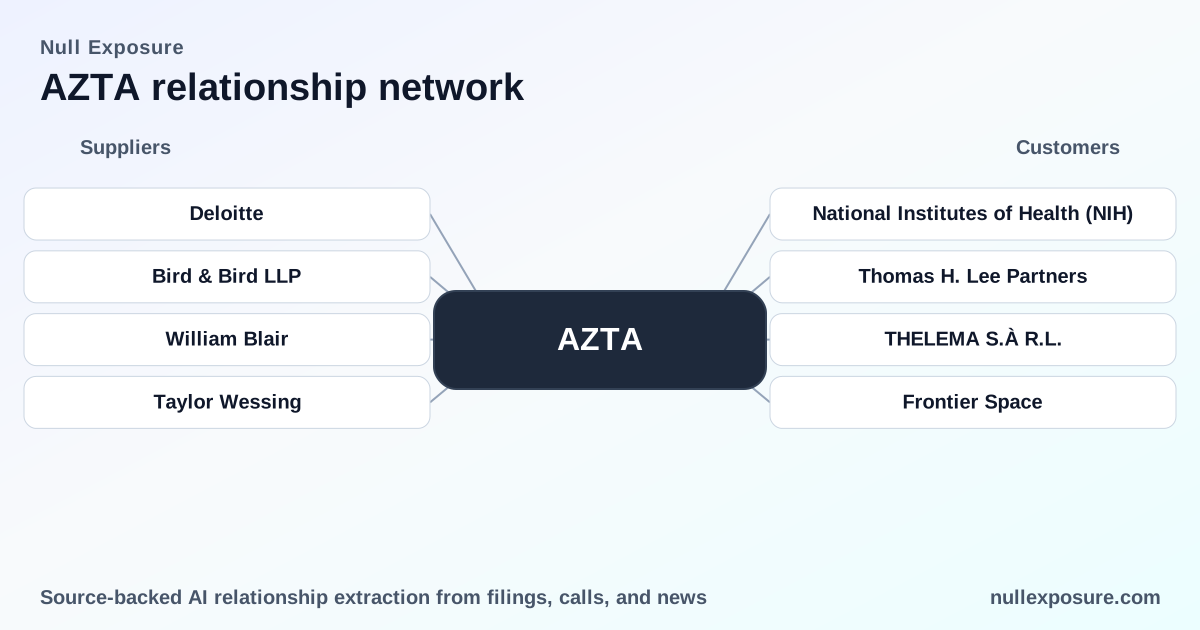
Below I cover every relationship referenced in the public results set, one by one, with a concise plain-English summary and source reference.
National Institutes of Health (NIH)
Azenta counts government and academic institutions among its customers, including the NIH as part of a highly diversified client base that spans top pharma, biotechs and research organizations. This underscores Azenta’s role in public-sector life‑science infrastructure (FinancialContent, Feb 5, 2026 — https://markets.financialcontent.com/stocks/article/finterra-2026-2-5-cold-chain-high-stakes-a-deep-dive-into-azentas-azta-life-sciences-transformation).
Thomas H. Lee Partners
Thomas H. Lee Partners acquired Azenta’s former semiconductor automation business for $3.0 billion in cash, a transaction that preceded Azenta’s rebranding to focus on life‑sciences sample management and services; this is a historical divestiture that materially reshaped the company’s strategic focus (FinancialContent, Feb 5, 2026 — https://markets.financialcontent.com/stocks/article/finterra-2026-2-5-cold-chain-high-stakes-a-deep-dive-into-azentas-azta-life-sciences-transformation).
THELEMA S.À R.L. (Thelema)
Azenta entered a definitive agreement to sell its B Medical Systems business to THELEMA S.À R.L. for US$63 million—an announced portfolio divestiture intended to streamline Azenta’s focus on sample management and multiomics (Azenta press coverage and investing.com, Dec 29, 2025 / reporting in 2026 — https://www.investing.com/news/company-news/azenta-to-sell-b-medical-systems-business-for-63-million-93CH-4423985 and https://www.theglobeandmail.com/investing/markets/stocks/AZTA-Q/pressreleases/36827816/azenta-divests-b-medical-systems-to-streamline-portfolio/).
Subsequent reporting indicated the buyer failed to secure required financing and the planned March 31, 2026 closing did not occur, introducing execution risk in the divestiture process (TradingView reporting, May 2, 2026 — https://www.tradingview.com/news/tradingview:7eda3638a5bcd:0-azenta-sale-of-b-medical-systems-delayed-as-buyer-fails-to-secure-financing/).
Frontier Space
Azenta announced a strategic partnership with Frontier Space to pilot sample management technologies in space-based life‑science experiments, extending Azenta’s serviceable addressable market into commercial space research and novel R&D platforms (company announcement covered by StockTitan and SahmCapital, Feb–Mar 2026 — https://www.stocktitan.net/news/AZTA/azenta-life-sciences-and-frontier-space-announce-strategic-h86e9qbt9cte.html and https://www.sahmcapital.com/news/content/azentas-space-trials-put-sample-tools-and-valuation-in-new-focus-2026-02-12).
What these relationships imply for investors
- Diversified, mission-critical customer mix reduces concentration risk. With ~14,000 customers globally and no customer >10% of revenue, Azenta’s revenue base is diversified; that lowers counterparty concentration but increases operational complexity across geographies.
- Portfolio pruning is both strategic and a liquidity lever. The sale of non-core assets like B Medical Systems for $63 million is consistent with a management focus on core sample management and multiomics, but the buyer financing delay highlights transaction execution risk that can temporarily affect cash flow and strategic timing.
- Backlog and long-term contracts smooth revenue but require execution. Remaining performance obligations and over‑time revenue recognition for customized automation projects mean future revenue is visible—but delivery and margin realization are execution-dependent.
- New adjacencies can expand growth optionality. The Frontier Space partnership is a differentiated proof point that Azenta is monetizing its sample‑management expertise into specialized R&D platforms, which could command premium pricing if scaled.
If you want a structured assessment of Azenta’s partner exposures and how they drive revenue mix and margin sensitivity, see more analysis at https://nullexposure.com/.
Bottom line
Azenta’s business is defined by a hybrid seller/service-provider model, global scale, and long-term contracts that create recurring, defensive revenue while still being exposed to hardware cycles and divestiture execution risk. Watch the outcomes of the B Medical Systems sale and the commercialization path for Frontier Space trials as near-term catalysts that will materially affect the company’s cash flow profile and strategic focus.