Azitra Inc (AZTR): Partnership- and financing-driven valuation in a pre‑clinical dermatology play
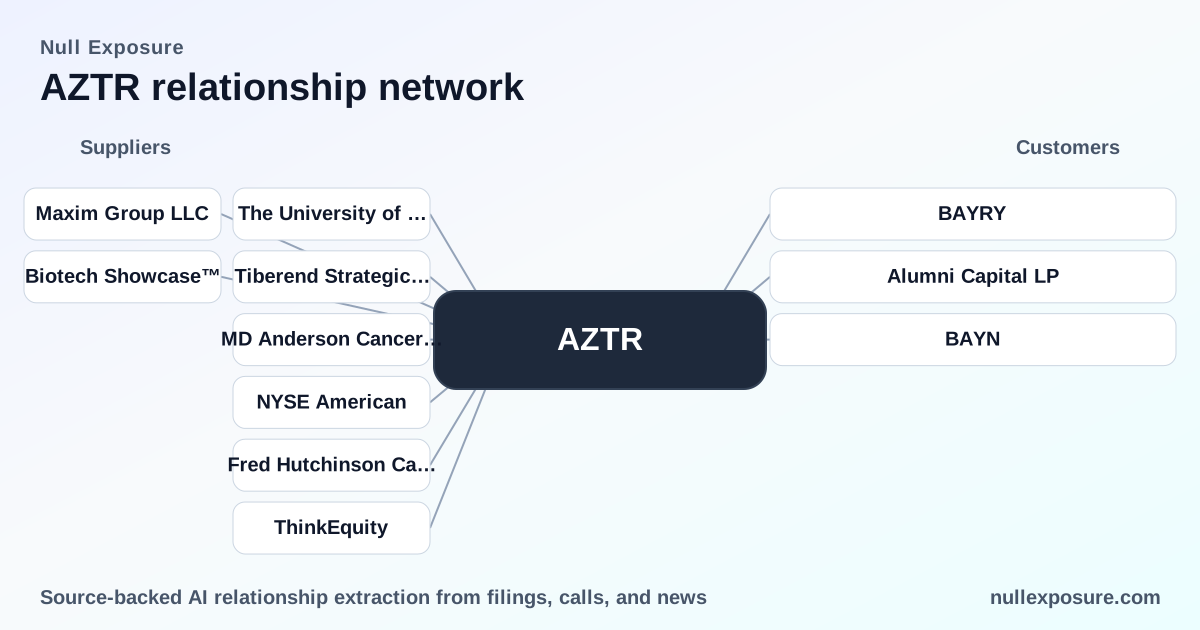
Azitra is a pre‑clinical biopharma developing engineered proteins and live biotherapeutic products for precision dermatology. The company generates value through joint development agreements, licensing and milestone economics, and through equity financings rather than product sales today. With zero reported revenue, negative EBITDA and a market capitalization near $4.1M, investor returns will be driven by clinical progress, selective corporate partnerships, and near‑term capital raises.
For an interactive view of these relationships and structured signals visit https://nullexposure.com/ for the full profile.
Why partnerships and financings are the business model
Azitra’s operating model is the archetype of an early‑stage specialty biotech: science‑heavy, revenue‑light, and financing‑dependent. The firm pursues external development agreements to validate programs and capture non‑dilutive or mildly dilutive value through milestones and shared development. Simultaneously, equity transactions play a central role in keeping operations funded given current zero revenue and sustained R&D losses.
Key operating characteristics that define risk and upside:
- Contracting posture: Collaborations (joint development agreements) rather than commercial distribution; contracts are tools for R&D de‑risking and candidate externalization.
- Concentration: Very few material commercial partners referenced publicly; this concentrates strategic exposure to each counterparty.
- Criticality: Partnerships are strategic validation points rather than immediate revenue streams; they are critical for program progression but not for near‑term cash generation.
- Maturity: Pre‑clinical; the company is not yet in commercial operations, so valuation depends on clinical milestones and capital markets access.
Financial snapshot that frames partner impact
Azitra reports zero trailing revenue and a negative EBITDA of approximately $10.8M, with shares outstanding ~16.2M and institutional ownership under 2%. The balance of value rests on partnerships and financing capacity rather than recurring cash flows. Equity dilution and access to capital are the dominant financing risks for current investors.
Customer and capital relationships you must evaluate
Below I cover every relationship item found in public reporting and press mentions. Each entry is summarized in plain English with the cited source.
Bayer — FY2026 (Zacks, March 9, 2026)
Azitra recorded no revenue in FY2026 compared with a prior small amount linked to a Bayer joint development agreement, indicating the Bayer JDA has not produced material near‑term receipts. According to a Zacks report (March 9, 2026), no FY2026 revenues were recognized versus $8,000 previously tied to Bayer.
Bayer — FY2026 duplicate mention (Zacks, March 9, 2026)
The same Zacks item reiterates that Bayer’s contribution to revenue is immaterial in FY2026, underscoring that the JDA functions as an R&D collaboration rather than a revenue source. Zacks coverage on March 9, 2026, cites the absence of FY2026 revenue from the Bayer agreement.
Alumni Capital LP — FY2026 (StockTitan, March 9, 2026)
Azitra entered a Securities Purchase Agreement with Alumni Capital LP (dated November 24, 2025) that contemplates issuance of equity and warrants representing potentially more than 19.99% of outstanding common shares, a vote the company sought shareholder approval for at a special meeting. The StockTitan notice (March 9, 2026) described Proposal One to comply with NYSE American listing rules.
Alumni Capital LP — FY2026 reconvened meeting (The Globe and Mail, May 2, 2026)
A company press release carried by The Globe and Mail (May 2, 2026) confirmed a reconvened virtual meeting to vote on the same transaction and noted the vote’s importance to Azitra’s financing plans and capital structure, signaling substantial near‑term dilution risk tied to Alumni Capital financing.
Bayer Consumer Care AG — FY2024 (Zacks, 2024 article referenced March 2026)
Azitra previously announced a Joint Development Agreement with Bayer Consumer Care AG for consumer health candidates, positioning Bayer as a strategic development partner rather than a payer of meaningful product revenues to date. A Zacks article that reviewed Azitra’s Netherton Syndrome work (published and referenced in March 2026) highlights that JDA.
Bayer Consumer Care AG — FY2024 duplicate mention (same Zacks article)
The duplicate reference to the FY2024 Zacks coverage reiterates the JDA with Bayer Consumer Care AG, confirming that the relationship is framed as a development collaboration focused on consumer health candidates rather than a current commercial supplier/customer dynamic.
What these relationships imply for valuation and risk
- Partnerships are validation, not cashflow. Multiple mentions of Bayer as a JDA partner indicate program validation and potential downstream economics, but the agreements have not translated into meaningful revenue. That keeps valuation dependent on future milestones and regulatory progress rather than present receipts.
- Financing controls the near term. The Alumni Capital securities purchase agreement—if approved and executed as described—creates material dilution and potential governance shifts because it contemplates issuance exceeding 19.99% of common stock. The shareholder votes reported in March–May 2026 frame the transaction as essential to liquidity and runway.
- Concentration risk is real. Public disclosures show a small number of named counterparties and minimal institutional ownership, which concentrates strategic execution risk and places extra weight on a handful of financing and development decisions.
- Early‑stage maturity requires investor discipline. With zero revenue and sustained operating losses, the investment thesis is binary: successful program advancement and favorable partnership economics create upside; failure to secure financing or advance trials destroys value.
Key takeaways for investors and operators
- Azitra is a development‑stage company monetizing through partnerships and equity financing rather than product sales.
- Bayer’s role is strategic validation via a JDA, not a material revenue source to date.
- The Alumni Capital transaction is the principal near‑term financing event and creates significant dilution risk if approved.
- Investors should prioritize follow‑on financing terms, shareholder vote outcomes, and any milestone schedules in partnership agreements.
For a consolidated relationship map and ongoing updates, visit https://nullexposure.com/ to inspect the citations and dynamic flags that matter to underwriting and portfolio monitoring.
Conclusion: Azitra’s valuation is driven by clinical and partner milestones plus its ability to execute capital raises. Monitor shareholder approvals and any milestone triggers with partners closely—those events will determine whether the company converts validation into value or dilutes existing holders without commensurate upside.