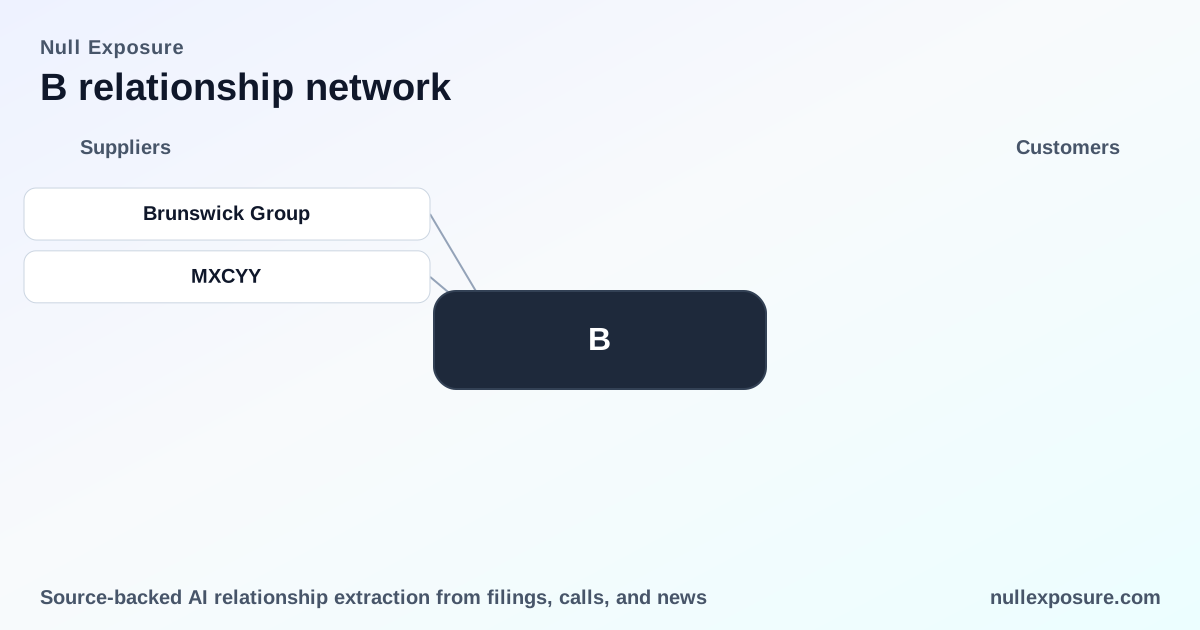
Barrick Mining (B) — Customer relationships that move the balance sheet
Barrick Mining operates as a global gold producer that monetizes through a combination of mine production, concentrate and dore sales, and strategic asset disposals that redeploy capital to higher-return projects. The company’s profitability profile is driven by large-scale operations and disciplined capital allocation: strong margins and robust EBITDA convert commodity receipts into free cash flow, while occasional divestitures reshape the production footprint. For investors evaluating Barrick’s customer and counterparty dynamics, the recent transactional activity in 2026 highlights a deliberate pattern of asset sales and services provision that affects near-term cash, long-term reserve mix, and operating concentration. Explore the company profile and relationship signals at https://nullexposure.com/.
A concise financial snapshot for context
Barrick is a large-cap gold miner with a Market Capitalization around $64.4 billion and trailing EBITDA of $9.9 billion, delivering strong operating margins (approx. 52.6%) and a healthy profit margin of 29.4% on TTM revenue of $16.956 billion. Valuation metrics sit at a trailing P/E of 13.27 and forward P/E around 10.07, reflecting investor expectations of continued cash generation. The company pays a modest dividend (per-share cash distribution listed at $0.50) and carries a mix of institutional ownership (about 66.8%), underlining mainstream investor confidence.
These numbers set the baseline: operational scale and cash conversion provide Barrick flexibility to sell non-core assets without pressuring liquidity, while margin strength supports continued investment in core mines.
What the reported customer relationships reveal about strategic priorities
The 2026 relationship items in the public record are concentrated on asset transfers and service provision. Each of the four relationships below is material for understanding how Barrick executes portfolio optimization and where revenue flows can shift.
Atlantic Group S.A. — Tongon Gold Mine transfer
Atlantic Group S.A. completed the acquisition of the Tongon Gold Mine and certain exploration properties from Barrick in FY2026, representing a direct divestiture of an operating asset and adjacent mineral rights. According to a Simply Wall Street note dated May 2, 2026, this transaction reflects Barrick’s active rebalancing of its asset base toward prioritized operations. (Source: SimplyWall.St news summary, May 2, 2026.)
Carcetti Capital Corp. — Hemlo Gold Mine sale (C$1.1bn)
Carcetti Capital Corp. agreed to acquire the Hemlo Gold Mine from Barrick for $1.1 billion in FY2026, a cash-generative disposition of an established North American asset that reduces Barrick’s near-term operating footprint in exchange for substantial proceeds. This was reported in transaction coverage noted May 2, 2026. (Source: SimplyWall.St news summary, May 2, 2026.)
NG — Management, administrative and contracted services
In its FY2025 filings, NG discloses that it received management, administrative services and third-party contracted services from Barrick, with amounts recorded at $182 for 2025, $452 for 2024 and $332 for 2023 for the periods reported; these line items demonstrate that Barrick operates as a services provider to affiliates or related entities in addition to mine operators. This detail is present in NG’s FY2025 filing (filed November 30, 2025). (Source: NG FY2025 10‑K, Nov 30, 2025.)
Chakana — La Joya Project purchase from Minera Barrick Peru
Chakana completed a full acquisition of the La Joya Project from Minera Barrick Peru S.A., transferring project ownership and associated exploration upside out of Barrick’s portfolio in FY2026. The transaction was captured in coverage of Apr 27, 2026 news reporting and underscores a theme of selling non-core exploration-stage holdings. (Source: Finviz / TMX Newsfile coverage, Apr 27, 2026.)
How these relationships translate to operational and portfolio constraints
No explicit contractual constraint excerpts were provided in the relationship feed; however, the pattern of asset sales and intercompany service provision conveys clear company-level signals about Barrick’s operating model:
- Contracting posture — active seller and service provider. Barrick is executing disposals of operating mines and exploration projects while continuing to provide management and administrative services to related parties, showing a posture of strategic portfolio pruning combined with internal service centralization.
- Concentration — geographic and counterparty diversification. Multiple buyers across regions (Atlantic Group, Carcetti, Chakana) reduce single-counterparty concentration risk for divestiture proceeds, while asset exits concentrate Barrick’s remaining production into fewer, likely higher-margin operations.
- Criticality — divestitures indicate non-core status. Assets transferred in 2026 are positioned as non-core to Barrick’s prioritized production profile; transfers of operating mines and projects indicate these holdings were not critical to core production plans.
- Maturity — mix of mature and development-stage assets. The transactions include both established operations (Hemlo, Tongon) and exploration/project-stage assets (La Joya), signaling that Barrick is monetizing across the maturity curve to optimize capital deployment.
These company-level characteristics have direct investor implications: asset sales increase near-term cash and reduce operational complexity, but they also lower headline production and can shift long-term reserve composition.
Risk profile and what investors should monitor
- Revenue and production volatility: Asset sales lower operating scale; monitor Barrick’s guidance for production and cost metrics post-divestiture.
- Redeployment execution risk: The value of proceeds depends on disciplined reinvestment; watch capital allocation announcements and acquisition targets.
- Service-revenue dependency: Internal service arrangements (as with NG) introduce receivable and concentration exposures that require transparency in intercompany terms.
Bottom line and recommended investor actions
- Key takeaway: Barrick is monetizing non-core assets while retaining a service-provider role within its corporate ecosystem; this strengthens near-term liquidity and focuses the operational portfolio.
- Trading implication: The company’s strong margins and EBITDA provide a buffer for strategic exits, making shares a candidate for investors who value cash-generation and active portfolio management.
For a fuller review of Barrick’s counterparties and to track subsequent filings and media coverage, review the company profile at https://nullexposure.com/. If you are modeling production and cash-flow sensitivity to divestitures, the transaction cadence in FY2026 should be incorporated into short- and medium-term scenarios.
Bold positions in the portfolio require ongoing monitoring of production guidance, use-of-proceeds statements, and any subsequent service agreements that can shift cash flow between related entities.