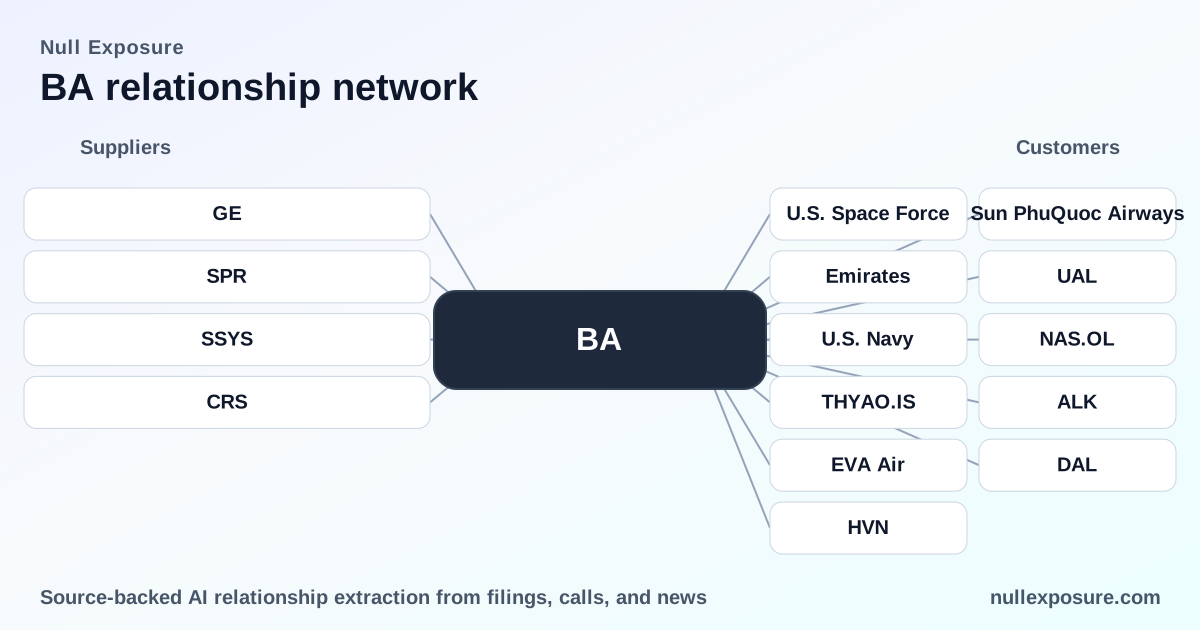
Boeing's customer footprint: orders, defense awards, and the aftermarket that drives revenue
Boeing operates as a vertically integrated aerospace prime: it designs, manufactures and sells commercial aircraft and defense systems, and it monetizes through airframe deliveries, long‑term government contracts, aftermarket parts & services, and leasing/product‑support agreements. With trailing revenue around $92.18 billion and a material defense exposure, Boeing’s cashflow profile blends spot delivery receipts with multi‑year, contract‑driven revenue streams that support sustained services and parts income.
If you want a one‑page signal feed of Boeing customer exposures for underwriting, M&A diligence, or portfolio risk, start here: visit https://nullexposure.com/ for the full platform overview.
Why this customer map matters to investors
Boeing’s business mixes long‑term fixed‑price and over‑time government contracts with point‑in‑time commercial aircraft deliveries. The constraints dataset confirms a dual contracting posture: defense work is concentrated, long‑dated and government‑dependent, while commercial sales are global and volatile but produce high‑margin aftermarket streams. Geography is diversified—roughly half of commercial demand sits offshore—but the U.S. government remains a large, high‑criticality customer for Boeing’s defense segments. For investors, that translates into earnings volatility from delivery timing and quality control, counterbalanced by predictable defense program cashflows and recurring services revenue.
For deeper signals and ongoing monitoring, explore the NullExposure platform at https://nullexposure.com/.
Customer inventory — each relationship, distilled for investors
Below is a concise, source‑anchored catalogue of every counterparty referenced in the collected results. Each entry is one or two sentences with the originating context.
-
U.S. Space Force — The Space Force awarded Boeing a $2.8 billion contract for the Evolved Strategic Satcom program, strengthening Boeing’s space‑systems backlog. (Boeing earnings call, 2025 Q3; first seen 2026‑03‑08.)
-
U.S. Navy — The Navy awarded Boeing multiple contracts including an $805M MQ‑25A engineering and development program and contracts exceeding $400M for F‑18 repairs, underscoring Boeing’s deep naval sustainment role. (Boeing press release & earnings calls, FY2026 / 2025 Q3; first seen 2026‑03‑08 / 2026‑05‑02.)
-
Emirates — Boeing recorded 65 777‑9 airplane orders for Emirates in BCA booking activity, reflecting continued widebody demand in long‑haul carriers. (Boeing earnings call, 2025 Q4; first seen 2026‑03‑07.)
-
Copa Airlines (CPA) — Copa agreed to buy 40 737 MAX jets with options for 20 more, and reported recent 737 MAX deliveries; those orders extend Boeing’s narrowbody visibility in Latin America. (Boeing press release & Copa filings, FY2026 / FY2025; first seen 2026‑05‑02 / 2026‑03‑09.)
-
Biman Bangladesh Airlines — Biman placed its largest‑ever order for 14 Boeing jets (787 and 737 MAX) to modernize its fleet. (Boeing press release via PR Newswire, April 30, 2026; first seen 2026‑05‑02.)
-
Aeroméxico (AERO) — Aeroméxico remains a major Boeing operator and has restructured large Boeing purchase agreements historically, maintaining 787/737 in its fleet and order pipeline. (Multiple press items and filings, FY2021–FY2026; first seen 2026‑03‑09.)
-
Turkish Airlines (THYAO.IS) — Boeing booked 50 787s for Turkish Airlines in quarter bookings, signaling strong widebody demand from the carrier. (Boeing earnings call, 2025 Q3; first seen 2026‑03‑08.)
-
EVA Air — Boeing announced an agreement with EVA Air for digital diagnostic tools and advanced analytics to improve maintenance efficiency and ops performance. (Boeing earnings call, 2025 Q3; first seen 2026‑03‑08.)
-
Ryanair (RYAAY) — Ryanair received deliveries of new 737‑8200s and expects early MAX‑10 deliveries; Boeing remains Ryanair’s core supplier for its single‑fleet strategy. (Press coverage and earnings commentary, FY2026; first seen 2026‑03‑10.)
-
Alaska Airlines / Alaska Air Group (ALK) — Alaska placed the largest order in its history: 105 737‑10s and five 787s (with additional options), materially expanding Boeing’s near‑term order book. (Boeing press release & multiple news outlets, Jan 2026 / FY2026; first seen 2026‑03‑09 / 2026‑03‑07.)
-
Delta Air Lines (DAL) — Delta booked 30 787‑10 Dreamliners as part of a mixed widebody refresh that includes Boeing units among other OEMs. (Boeing results reporting, FY2026; first seen 2026‑05‑02.)
-
Singapore Airlines Group (SIA) — Boeing secured the largest Landing Gear Exchange Program with Singapore Airlines Group, highlighting high‑value aftermarket contracts. (Boeing results reporting, FY2026; first seen 2026‑05‑02.)
-
Air India — Boeing booked orders that include 20 737‑8 for Air India in recent segment bookings. (Boeing results reporting, FY2026; first seen 2026‑05‑02.)
-
Aviation Capital Group — Boeing recorded orders for multiple 737 models (including 737‑10/8) for this lessor, reflecting continued demand from leasing houses. (Boeing Q1 reporting, FY2026; first seen 2026‑05‑02.)
-
Allegiant Travel / Allegiant Air (ALGT) — Allegiant disclosed supplemental purchase agreements and cited reliance on Boeing deliveries, illustrating OEM timing risk for its fleet modernization. (SEC filings and press coverage, FY2026; first seen 2026‑05‑02 / 2026‑03‑09.)
-
Sun Country / SNCY — Sun Country operates an all‑Boeing 737 fleet; its merger with Allegiant expands combined Boeing exposure. (Press coverage, FY2026; first seen 2026‑03‑10 / 2026‑05‑03.)
-
AerSale (ASLE) — AerSale developed a mixed‑reality program for 737NG pilots under license with Boeing, indicating technical/data sharing in aftermarket certification. (Industry press, FY2024; first seen 2026‑03‑09.)
-
Vietnam Airlines (HVN) — Vietnam Airlines finalized an order for 50 737 MAX aircraft, scaling Boeing’s presence in Southeast Asia. (Press coverage and industry reports, FY2026; first seen 2026‑03‑09.)
-
Sun PhuQuoc Airways — Boeing and the new Vietnam carrier announced an order for up to 40 787 Dreamliners to form its widebody backbone. (Industry press, FY2026; first seen 2026‑03‑09.)
-
Air Lease Corporation (AL) — Air Lease historically transacted large orders with Boeing (e.g., 777‑300ER and 737 MAX sales), representing lessor demand that feeds Boeing deliveries. (Boeing press release archive, FY2014; first seen 2026‑03‑09.)
-
BOEU (Direxion Daily BA Bull 2X Shares) — Financial coverage referenced BOEU as a leveraged product tracking BA equity performance; this is a market instrument, not a Boeing customer. (Market commentary, FY2025; first seen 2026‑03‑09.)
-
United Airlines (UAL) — United continues to take deliveries of 787‑9s and is affected by MAX‑10 certification and delivery timing that influence fleet planning. (Carrier filings and commentary, FY2026; first seen 2026‑03‑09 / 2026‑05‑04.)
-
American Airlines (AAL) — American is one of Boeing’s largest airline customers with long‑standing purchase agreements and equipment trust financings that include Boeing frames. (Press reporting and filings, FY2026 / FY2025 10‑K; first seen 2026‑03‑09 / 2026‑03‑08.)
-
Southwest Airlines (LUV) — Southwest operates a single‑type Boeing 737 fleet (803 aircraft reported) and consistently flags Boeing delivery timing as a capacity lever. (Company reports and market press, FY2025–FY2026; first seen 2026‑02‑14 / 2026‑03‑10.)
-
Aviation lessors & financiers (FTAIN, Aviation Capital Group, others) — Multiple finance firms reported portfolios concentrated in modern Boeing aircraft, supporting sustained lease/secondary market demand. (MarketBeat and filings, FY2026; first seen 2026‑03‑09.)
-
Norwegian group / NAS.OL — Boeing booked 30 737‑8 for the Norwegian group during quarter bookings, showing exposure across European short‑haul operators. (Boeing earnings call, 2025 Q3; first seen 2026‑03‑08.)
-
BARK and other niche/new entrants — Miscellaneous press references show speculative or boutique operators evaluating Boeing frames, indicating Boeing’s addressable new‑entrant market. (Consumer press and industry outlets, FY2024–FY2026; first seen 2026‑05‑02.)
-
Miscellaneous airlines and fleet operators (many entries: Copa Holdings, Aeroméxico, Vietnam carriers, AerSale partners) — Collectively these citations confirm Boeing’s global commercial footprint across Latin America, Europe, Asia and the Middle East with both firm deliveries and long‑dated backlog. (Multiple press releases, earnings calls and filings, FY2024–FY2026; first seen 2026‑03‑09 through 2026‑05‑04.)
Operational constraints that shape customer risk and revenue
-
Contracting posture: Commercial airframe revenue is recognized at delivery (spot), while many defense contracts are long‑term and recognized over time; Boeing runs a hybrid model that blends near‑term cash from deliveries with multi‑year program cashflows. (Company disclosures in constraints: contract_type spot & long_term.)
-
Counterparty concentration and criticality: The U.S. government represents a large, critical customer (roughly a third of consolidated revenues in recent years), increasing program stability but concentrating political/regulatory risk. (Constraints: counterparty_type government.)
-
Geographic diversification with concentrated commercial backlog: BCA backlog is predominantly non‑U.S., providing global demand diversification but exposing Boeing to international delivery timing and certification regimes. (Constraints: geography_region global / apac / emea.)
-
Services and aftermarket maturity: Boeing’s services segment is a recurring revenue engine (parts, maintenance, exchange programs), which increases revenue stickiness but ties future margins to fleet health and safety certification cycles. (Constraints: segment services / core_product.)
Investment takeaways
- Boeing’s revenue mix is resilient because government programs provide multi‑year cashflow while commercial orders and aftermarket services generate high‑value follow‑on revenue.
- Delivery timing, certification and quality control are the principal execution risks that ripple across airline customers and lessors.
- For programmatic monitoring of customer order flows, contract awards and aftermarket deals, NullExposure provides ongoing tracking and alerts — see https://nullexposure.com/ for subscription options.