Alibaba (BABA) Customer Relationships: who pays for Qwen, Amap and Alibaba Cloud
Alibaba Group operates a diversified two-sided commerce and enterprise-services platform that monetizes through marketplace fees and advertising, cloud and AI subscriptions, enterprise software, and value-added logistics and payments. For investors, the mix of consumer-facing marketplaces and enterprise cloud/AI contracts creates a revenue profile that benefits from both transaction volume and high-margin, recurring technology services. Explore an evidence-based walk through of customer ties below — for sourcing and deeper signals visit https://nullexposure.com/.
What matters to investors: four quick takeaways
- Cloud and AI are increasingly mission-critical: multiple enterprise and government customers are deploying Alibaba Cloud and Qwen models in production use cases, driving recurring revenue and higher customer stickiness.
- E-commerce volume remains a structural base: relations with brands and merchants sustain marketplace monetization through fees and ad spend.
- Cross-industry partnerships extend monetization beyond pure retail (automotive mapping, travel booking, sports events tech), indicating product diversification and higher revenue optionality.
- No explicit contractual constraints were found in the available signals, so diligence should prioritize concentration and counterparty credit exposures visible in filings and calls.
Customer relationships cited in press and filings (FY2024–FY2026)
Xpeng (XPEV)
Xpeng will deploy its Robotaxi service using Alibaba’s Amap mapping platform in 2026, illustrating Alibaba’s role as the location-data and mobility stack supplier for autonomous services. (Sources: Yahoo Finance / Benzinga reporting on 2026-03-10 — https://finance.yahoo.com/news/tesla-rival-xpeng-hires-morgan-230211852.html; https://www.benzinga.com/markets/tech/26/01/49835904/tesla-rival-xpeng-hired-banks-to-facilitate-flying-car-units-hong-kong-ipo-report)
iQIYI (IQ) — TradingView mention
iQIYI’s Nadou platform incorporates AI models from Alibaba among other vendors, indicating Alibaba’s Qwen or model licensing is being used in media production and creative workflows. (Source: TradingView/GuruFocus coverage, FY2026 — https://www.tradingview.com/news/gurufocus:3a824e9f5094b:0-iqiyi-unveils-ai-overhaul-as-revenue-seen-falling-13/)
iQIYI (IQ) — Economic Times / EnterpriseAI
iQIYI’s Nadou Pro suite will rely on models from Alibaba, ByteDance and Kuaishou for its AI-backed production tools, signaling multi-vendor AI adoption where Alibaba is a named supplier. (Source: Economic Times EnterpriseAI, FY2026 — https://enterpriseai.economictimes.indiatimes.com/news/industry/iqiyi-embraces-ai-aims-for-majority-ai-generated-content-in-five-years/130410560)
China Eastern Airlines (China Eastern / 600115.SHH)
Alibaba’s Qwen-powered app secured a commercial tie-up for natural-language flight booking with China Eastern Airlines, demonstrating a direct consumer-facing AI use case that can drive platform engagement and data capture. (Source: SimplyWallSt summary and Yahoo Finance coverage, FY2026 — https://simplywall.st/stocks/us/retail/nyse-baba/alibaba-group-holding/news/what-alibaba-group-holding-babas-qwen-ai-real-world-rollout/amp; https://finance.yahoo.com/markets/stocks/articles/alibaba-group-holding-nyse-baba-220428832.html)
NAMI (NAMI)
A product launch for AI-powered smart learning glasses was distributed through Alibaba platforms (Tmall/JD), showing Alibaba’s marketplace is used as a primary go-to-market channel for hardware brands. (Source: Investing.com, FY2026 — https://in.investing.com/news/company-news/jinxin-technology-launches-aipowered-smart-learning-glasses-in-china-93CH-5169174)
Industrial and Commercial Bank of China (ICBC)
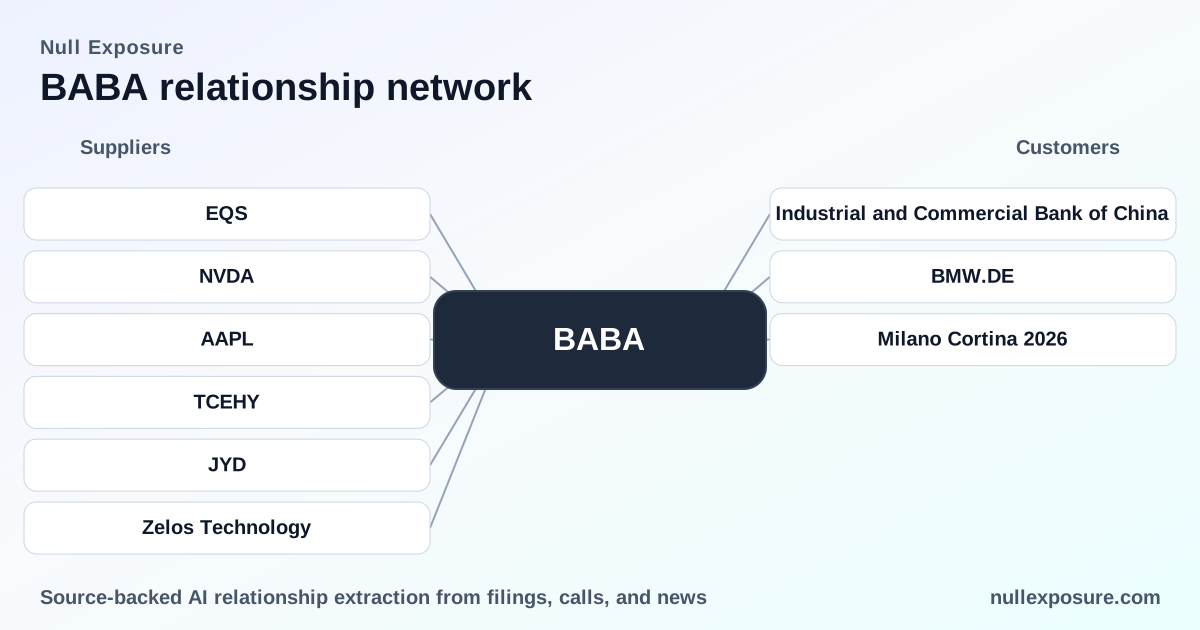
ICBC selected Alibaba Cloud’s PolarDB as its enterprise-wide transactional distributed database, signaling large-scale, mission-critical database deployments in the financial sector and the stickiness of Alibaba’s cloud stack. (Source: Alibaba Q4 earnings call transcript, 2025Q4 — baba-2025q4-earnings-call)
LOBO (LOBO)
LOBO EV is a verified “golden plus” supplier on Alibaba.com and uses Alibaba’s platform as part of its marketing and distribution strategy, underlining Alibaba’s role in global supplier verification and B2B distribution for EV manufacturers. (Source: GlobeNewswire / company announcement, FY2025 — https://www.globenewswire.com/news-release/2025/10/20/3169492/0/en/LOBO-EV-Technologies-Announces-Strategic-Initiative-to-Establish-CyberCity-and-Digital-Bank-Headquarters-in-Ghana.html; additional coverage FY2024 — SCR/Zacks note)
Yatsen (YSG)
Yatsen conducts online sales through Tmall and other leading Chinese e-commerce platforms, confirming brand reliance on Alibaba’s marketplace for distribution and direct-to-consumer revenue channels. (Source: MarketBeat earnings/report summary, FY2026 — https://www.marketbeat.com/earnings/reports/2026-3-2-yatsen-holding-limited-stock/)
Milano Cortina 2026 (Olympics)
Alibaba Cloud deployed technology for Milano Cortina 2026, providing event infrastructure and sustainability/efficiency solutions — a high-visibility enterprise reference that supports cloud revenue growth narratives. (Source: MarketBeat instant alert summarizing press, FY2026 — https://www.marketbeat.com/instant-alerts/filing-alibaba-group-holding-limited-baba-stock-position-decreased-by-fairtree-asset-management-pty-ltd-2026-03-02/)
Perfect Corp. (PERF)
Perfect Corp. uses Taobao Mini-Program integrations, reflecting ecosystem monetization where third-party app developers build inside Alibaba’s consumer interfaces (Taobao) for commerce-enabled experiences. (Source: MarketScreener summary, FY2025 — https://www.marketscreener.com/news/perfect-corp-to-announce-financial-results-the-three-months-ended-september-30-2025-and-the-nine-m-ce7d5ad9df89f024)
Telkom Indonesia (TLK)
Alibaba Cloud partnered with Telkom Indonesia to strengthen TelkomGroup’s IT B2B portfolio and leverage Alibaba’s Indonesia data centers, indicating regional cloud expansion and telco partnerships as distribution channels. (Source: Telkom press release, FY2024 — https://www.telkom.co.id/sites/berita/id_ID/news/telkom-dan-alibaba-cloud-jalin-kerja-sama-perkuat-ekosistem-digital-2745)
BMW (BMW / BMW.DE)
Alibaba is expanding work with BMW to apply large language models to automotive use cases and related services, showing enterprise AI integration into vehicle software and customer-facing applications. (Source: SimplyWallSt roundup, FY2026 — https://simplywall.st/stocks/us/retail/nyse-baba/alibaba-group-holding/news/alibaba-ai-coding-plan-and-bmw-partnership-reframe-cloud-gro)
Baozun (BZUN)
Baozun helps brands manage stores across Tmall, JD.com and WeChat — an indirect relationship that underscores Alibaba’s ecosystem dependence on third-party e-commerce operators for merchant onboarding and services. (Source: MarketBeat coverage, FY2026 — https://www.marketbeat.com/instant-alerts/baozun-nasdaqbzun-ceo-acquires-3012000-in-stock-2026-04-09/)
Boqii (BQ)
Boqii launched e-commerce activity on Tmall and JD, demonstrating Alibaba’s marketplace role as the channel of choice for vertical retailers (in this case, pet products). (Source: China Daily historical coverage, FY2020 referenced — http://global.chinadaily.com.cn/a/202011/19/WS5fb5cf1ba31024ad0ba951cc.html)
China Telecom (CHA / 601728.SHH)
Alibaba deployed a 10,000-card intelligent computing cluster in collaboration with China Telecom and launched a “fully domestic” system at a Guangdong data center, indicating deep telco partnerships and localized cloud deployments for regulatory and performance needs. (Sources: TradingKey and SahmCapital / SCMP summaries, FY2026 — https://www.tradingkey.com/news/Market-Movers/261763059-market-movers-baba-20260408; SahmCapital summary referencing SCMP)
Operating model signals and business-model constraints
- Contracting posture: Alibaba surfaces both marketplace-driven, low-contract friction consumer relationships and large, multi-year enterprise cloud contracts (e.g., ICBC, China Telecom) that are higher value and more binding. This hybrid posture balances sticky, recurring cloud revenues with high-volume transactional marketplace income.
- Customer concentration: Public signals show many distributed, smaller merchant relationships and a growing roster of marquee enterprise customers; investor diligence should quantify cloud top-customer concentration from filings.
- Criticality: Deployments like ICBC’s PolarDB and China Telecom/Guangdong data center suggest mission-critical positioning for financial and national infrastructure customers.
- Maturity: Marketplace commerce is mature and stable; cloud and AI services are in an expansion phase with rising commercial deployments across industries (automotive, travel, media, telco), supporting margin expansion through software and services.
For a concise subscription and signal-monitoring view of Alibaba customer exposures and relationship health, see https://nullexposure.com/.
Bottom line
Alibaba’s customer footprint spans consumer merchants to sovereign-scale enterprise contracts, and the evidence positions cloud and AI as the next lever for durable, recurring revenue growth while marketplace operations sustain volume-driven monetization. Investors should prioritize verification of cloud contract economics and concentration in enterprise accounts during diligence.